

1 Ducat – Denmark
Denmark
Context

Material
References
KM: #Click to copy to clipboard650
Numista: #83066
Value
Bullion value: $570.82
Obverse
Description:
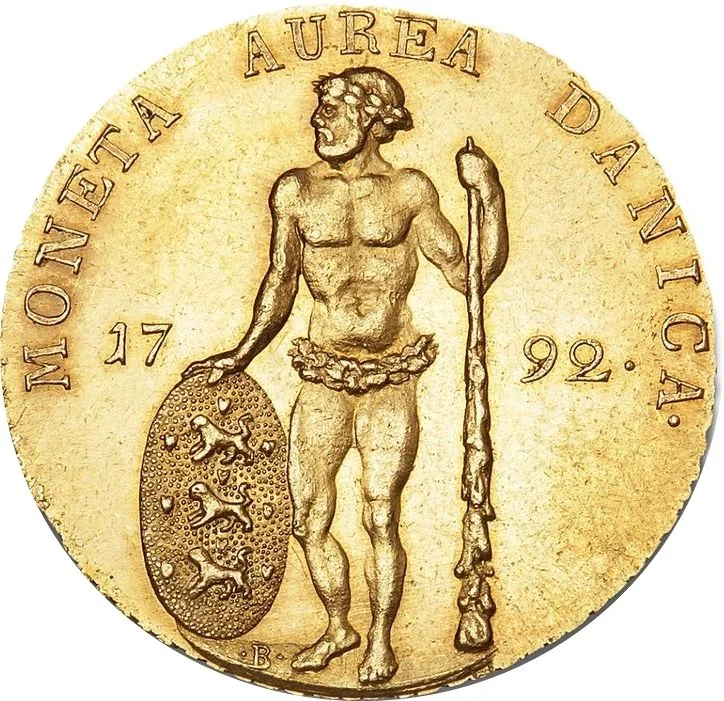
Wildman with club and Danish shield divides date.
Inscription:
MONETA · AUREA · DANICA ·
17 | 92·
17 | 92·
Script: Latin
Reverse
Description:
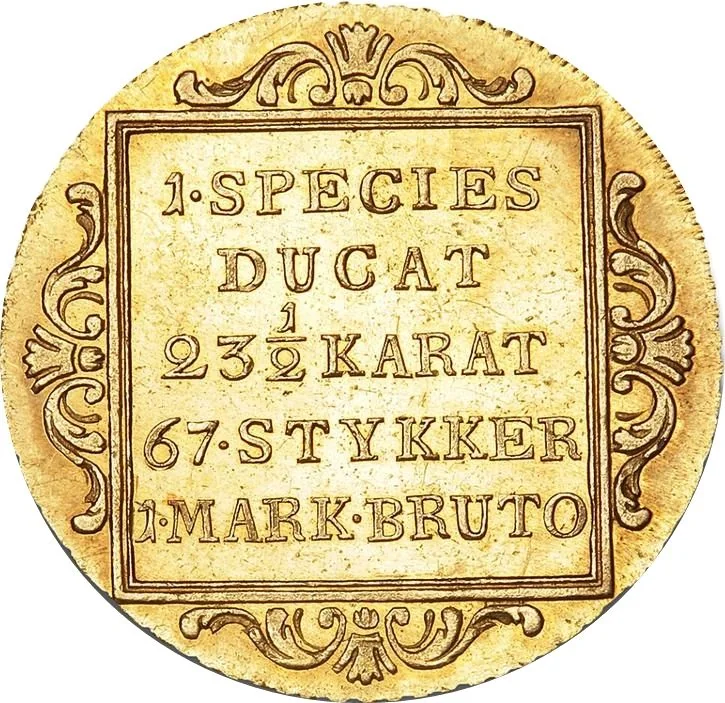
Ornate square frame with five lines detailing value and gold content.
Inscription:
1 · SPECIES
DUCAT
23 · ½ · KARAT
67 · STYKKER
1· MARK· BRUTO
DUCAT
23 · ½ · KARAT
67 · STYKKER
1· MARK· BRUTO
Script: Latin
Edge
Mints
| Name | Mark |
|---|---|
| Altona, Schleswig-Holstein | — |
Mintings
| Year | Mint Mark | Mintage | Quality | Collection |
|---|---|---|---|---|
| 1791 | — | — | ||
| 1792 | — | — | ||
| 1794 | — | — | ||
| 1802 | — | — |
Historical background
In 1791, Denmark operated under a complex and strained monetary system, a legacy of the previous century's economic policies. The state was officially on a silver standard, with the rigsdaler as the primary unit of account. However, decades of war financing and deficit spending had led to the proliferation of various forms of money, including overvalued "credit" coins made of less valuable metals and a substantial volume of inconvertible paper money issued by the state-run Kurantbanken. This created a dual system: the reliable specie rigsdaler (backed by silver) and the depreciated kurant rigsdaler (paper and credit coins), which traded at a significant discount against silver.
The situation was a source of economic friction and confusion. The fixed exchange rate between the silver and kurant rigsdaler was artificially maintained by royal decree, but market realities consistently undermined it, leading to a thriving black market for currency exchange. This disparity disrupted trade, as merchants and the public struggled with the real value of payments. Furthermore, the large amount of circulating paper money, without sufficient silver reserves to back it, created persistent inflationary pressures and undermined confidence in the state's finances.
This unstable environment placed Denmark within a broader European context of monetary experimentation and strain following the Seven Years' War. The government in Copenhagen, under the absolute monarchy, was acutely aware of the problems but faced the difficult task of reform without triggering a financial crisis or public unrest. The year 1791 thus represents a point of simmering tension within the Danish economy, setting the stage for more definitive—and ultimately disruptive—monetary reforms that would be attempted later in the decade.
The situation was a source of economic friction and confusion. The fixed exchange rate between the silver and kurant rigsdaler was artificially maintained by royal decree, but market realities consistently undermined it, leading to a thriving black market for currency exchange. This disparity disrupted trade, as merchants and the public struggled with the real value of payments. Furthermore, the large amount of circulating paper money, without sufficient silver reserves to back it, created persistent inflationary pressures and undermined confidence in the state's finances.
This unstable environment placed Denmark within a broader European context of monetary experimentation and strain following the Seven Years' War. The government in Copenhagen, under the absolute monarchy, was acutely aware of the problems but faced the difficult task of reform without triggering a financial crisis or public unrest. The year 1791 thus represents a point of simmering tension within the Danish economy, setting the stage for more definitive—and ultimately disruptive—monetary reforms that would be attempted later in the decade.
✨ Legendary