

1 Kurant Daler – Denmark
Denmark
Context

Material
References
KM: #Click to copy to clipboard645
Numista: #325285
Value
Bullion value: $58.69
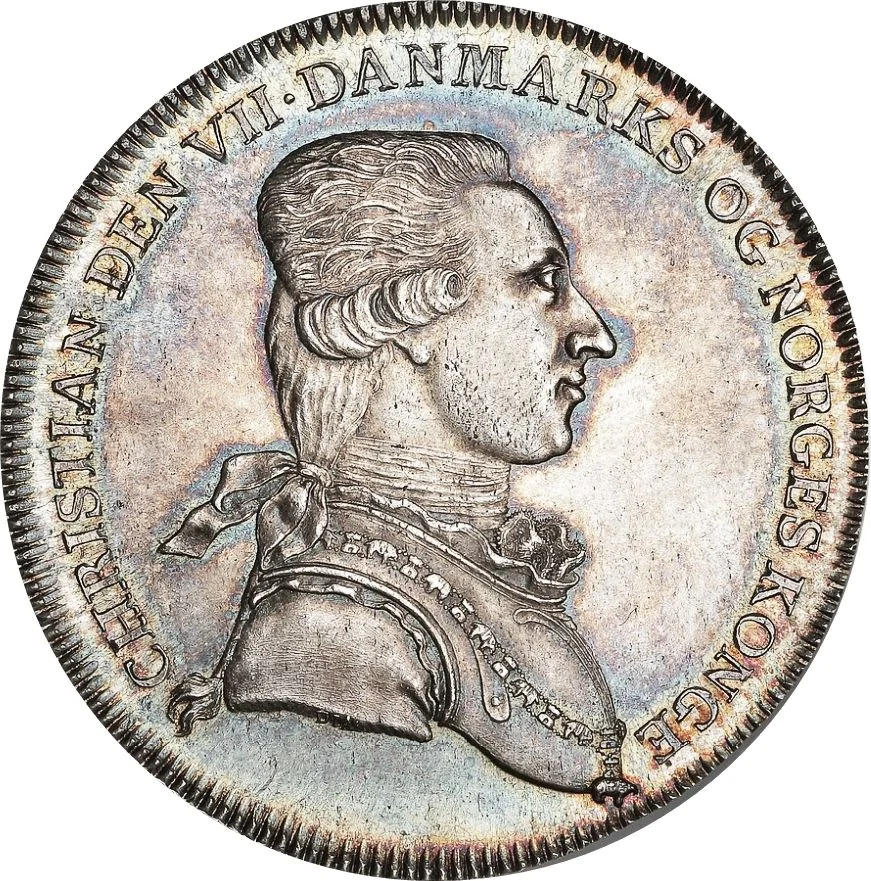
Obverse
Description:
Bust of King Christian VII in profile, wearing a high-collared coat and the Order of the Elephant necklace.
Inscription:
CHRISTIAN DEN VII · DANMARKS OG NORGES KONGE
Script: Latin
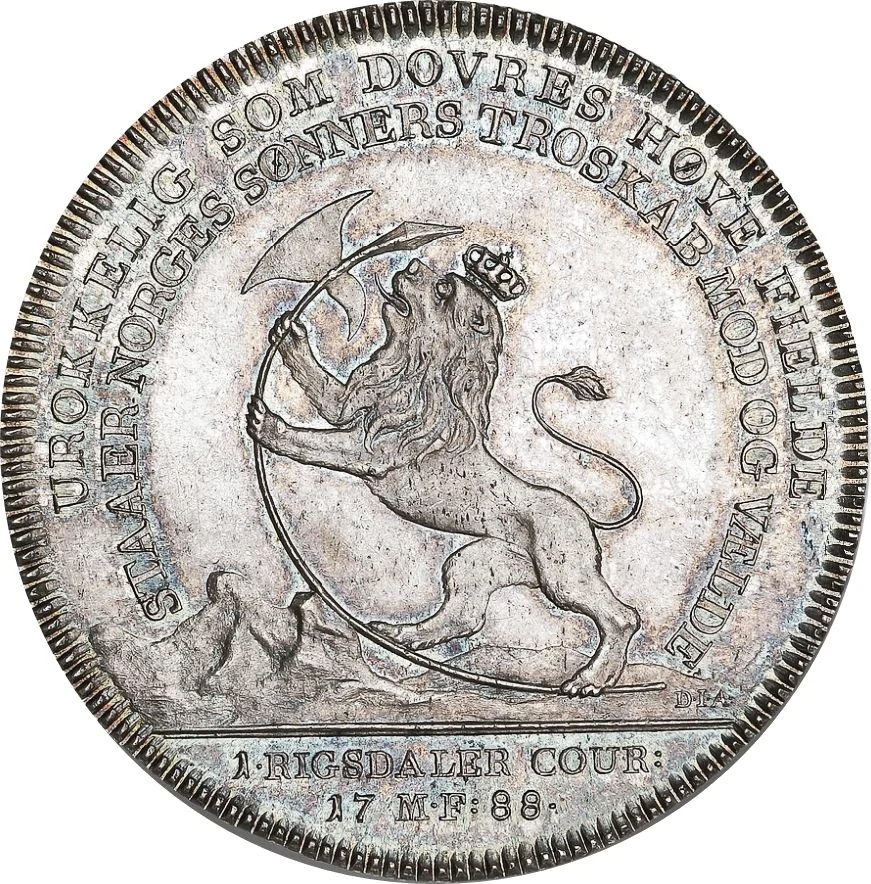
Reverse
Description:
Crowned lion facing left, holding a halberd, with a mountain behind. Inscription above along the rim; date and value below.
Inscription:
UROKKELIG SOM DOVRES HØYE FIELDE
STAAER NORGES SØNNERS TROSKAB MOD OG VÆLDE
D.I.A.
_____________________
1 · RIGSDALER COUR:
17 M·F: 88
STAAER NORGES SØNNERS TROSKAB MOD OG VÆLDE
D.I.A.
_____________________
1 · RIGSDALER COUR:
17 M·F: 88
Script: Latin
Edge
Mints
| Name | Mark |
|---|---|
| Altona, Schleswig-Holstein | — |
Mintings
| Year | Mint Mark | Mintage | Quality | Collection |
|---|---|---|---|---|
| 1788 | — | — |
Historical background
In 1788, Denmark operated under a silver-based monetary system, yet the reality was one of significant complexity and strain. The primary unit was the rigsdaler, subdivided into 96 skilling. However, the system was not uniform; a confusing array of older, debased coins and regional currencies, like the kurant rigsdaler used for domestic accounting, circulated alongside the theoretically pure species rigsdaler tied to silver. This duality created constant exchange challenges for merchants and the public, hindering efficient trade and economic calculation.
The period was marked by severe monetary instability, largely a legacy of the mid-century wars and economic policies. To finance conflicts like the Great Northern War and the state's involvement in the Atlantic slave trade, successive governments had heavily debased the coinage, reducing its silver content. This led to chronic inflation, a loss of public confidence in the currency, and a troubling outflow of full-weight silver coins (a phenomenon known as Gresham's Law, where "bad money drives out good"). By 1788, the state treasury was burdened with substantial debt, and the currency's value was volatile.
In response, the government of the reformist minister Count Ernst Schimmelmann was actively pursuing stabilization. Efforts were underway to restore confidence by standardizing the coinage and managing the national debt, often through negotiated settlements with creditors. These reforms were part of a broader "enlightened absolutist" agenda under King Christian VII (with power effectively held by the Crown Prince, later King Frederick VI) aimed at modernizing the Danish state and economy, though a full resolution of the monetary chaos would not be achieved until the major currency reform of 1813.
The period was marked by severe monetary instability, largely a legacy of the mid-century wars and economic policies. To finance conflicts like the Great Northern War and the state's involvement in the Atlantic slave trade, successive governments had heavily debased the coinage, reducing its silver content. This led to chronic inflation, a loss of public confidence in the currency, and a troubling outflow of full-weight silver coins (a phenomenon known as Gresham's Law, where "bad money drives out good"). By 1788, the state treasury was burdened with substantial debt, and the currency's value was volatile.
In response, the government of the reformist minister Count Ernst Schimmelmann was actively pursuing stabilization. Efforts were underway to restore confidence by standardizing the coinage and managing the national debt, often through negotiated settlements with creditors. These reforms were part of a broader "enlightened absolutist" agenda under King Christian VII (with power effectively held by the Crown Prince, later King Frederick VI) aimed at modernizing the Danish state and economy, though a full resolution of the monetary chaos would not be achieved until the major currency reform of 1813.
✨ Legendary