

6 Skilling – Denmark
Denmark
Context

Material
References
KM: #Click to copy to clipboard109
Numista: #82871
Value
Bullion value: $4.01
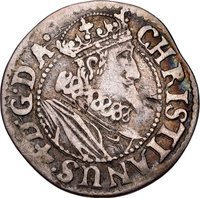
Obverse
Description:
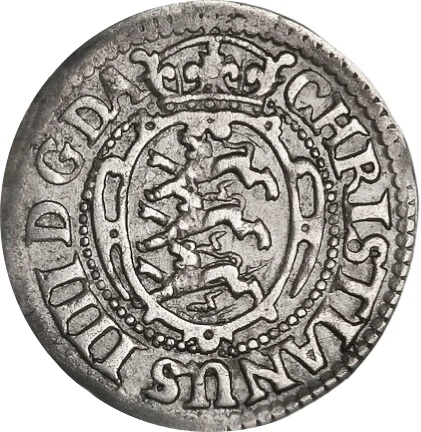
Crowned oval Danish arms in beaded circle, legend around.
Inscription:
CHRISTIANUS · IIII · D · G · D ·
Script: Latin
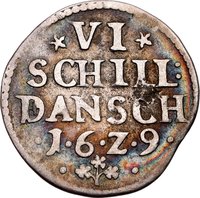
Reverse
Description:
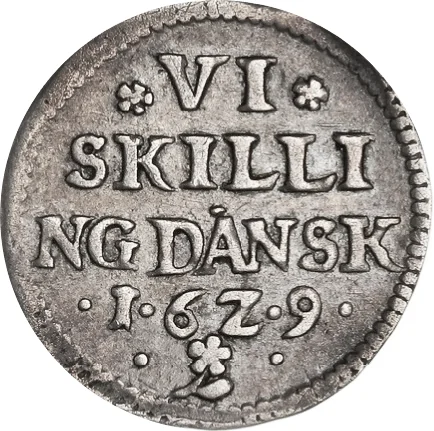
Value and date on four lines.
Mintmark placement varies.
Mintmark placement varies.
Inscription:
* VI *
SKILLI
NG DANSK
·1·6·2·9·
SKILLI
NG DANSK
·1·6·2·9·
Script: Latin
Edge
Mints
| Name | Mark |
|---|---|
| Copenhagen | ☘ |
Historical background
In 1627, Denmark found itself in a precarious monetary situation, deeply entangled in the economic turmoil of the Thirty Years' War. King Christian IV's costly military interventions in the conflict, particularly the defeat at the Battle of Lutter in 1626, had drained the royal treasury. To finance the ongoing war, the state resorted to the widespread debasement of the currency, notably the skilling. By reducing the silver content in coins while maintaining their face value, the crown could mint more coins from the same amount of silver, creating short-term revenue but triggering severe inflation and a loss of public trust.
This practice led to a classic "bad money drives out good" scenario, as described by Gresham's Law. Older, higher-silver coins were hoarded by the populace or melted down for their bullion value, leaving only the debased currency in common circulation. This eroded both domestic and international confidence in Danish money, disrupting trade and causing prices for essential goods to rise sharply. The situation was exacerbated by the need to pay foreign mercenaries, who often demanded payment in stable, full-valued currency, further straining the kingdom's precious metal reserves.
Ultimately, the currency crisis of 1627 was a symptom of the severe fiscal overextension of the Danish state. It reflected the immense pressure of financing a modern war with pre-modern fiscal structures. The monetary instability weakened the domestic economy at a critical time, contributing to the broader military and political setbacks that would culminate in Denmark's devastating defeat and the punitive Peace of Lübeck in 1629, which formally ended its involvement in the war.
This practice led to a classic "bad money drives out good" scenario, as described by Gresham's Law. Older, higher-silver coins were hoarded by the populace or melted down for their bullion value, leaving only the debased currency in common circulation. This eroded both domestic and international confidence in Danish money, disrupting trade and causing prices for essential goods to rise sharply. The situation was exacerbated by the need to pay foreign mercenaries, who often demanded payment in stable, full-valued currency, further straining the kingdom's precious metal reserves.
Ultimately, the currency crisis of 1627 was a symptom of the severe fiscal overextension of the Danish state. It reflected the immense pressure of financing a modern war with pre-modern fiscal structures. The monetary instability weakened the domestic economy at a critical time, contributing to the broader military and political setbacks that would culminate in Denmark's devastating defeat and the punitive Peace of Lübeck in 1629, which formally ended its involvement in the war.
💎 Extremely Rare