

1 guilder – Denmark
Add to wishlist
Denmark
Context
Years: 1625–1632
Issuer: Denmark
Ruler: Christian IV
Currency:
(1625—1813)
Demonetized: Yes
Total mintage: 42,428
Material
References
KM: #
Numista: #131961
Value
Bullion value: $384.59
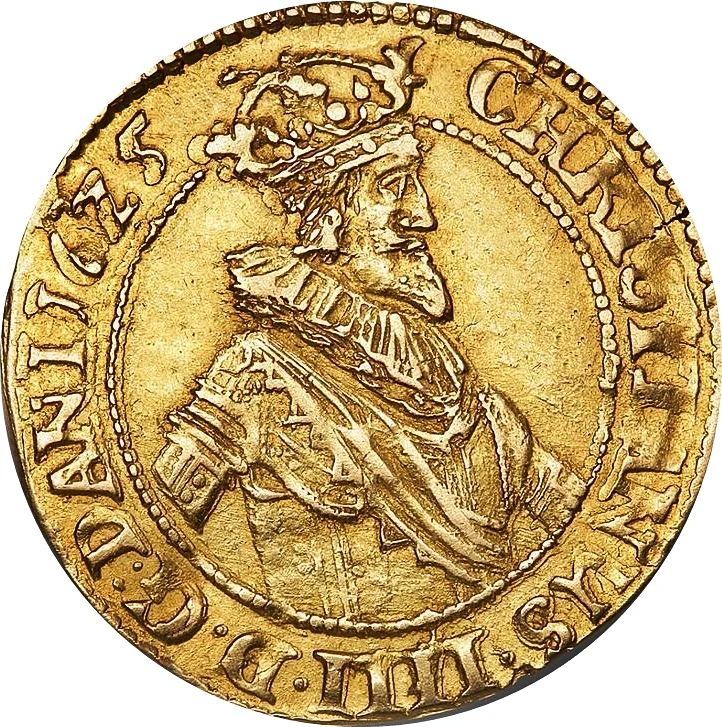
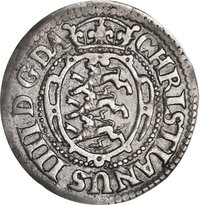
Obverse
Description:
King Christian IV in armor, facing right with a ruff and sash.
Inscription:
CHRISTIANUS · IIII · D : G · DANI 16Z5
Script: Latin
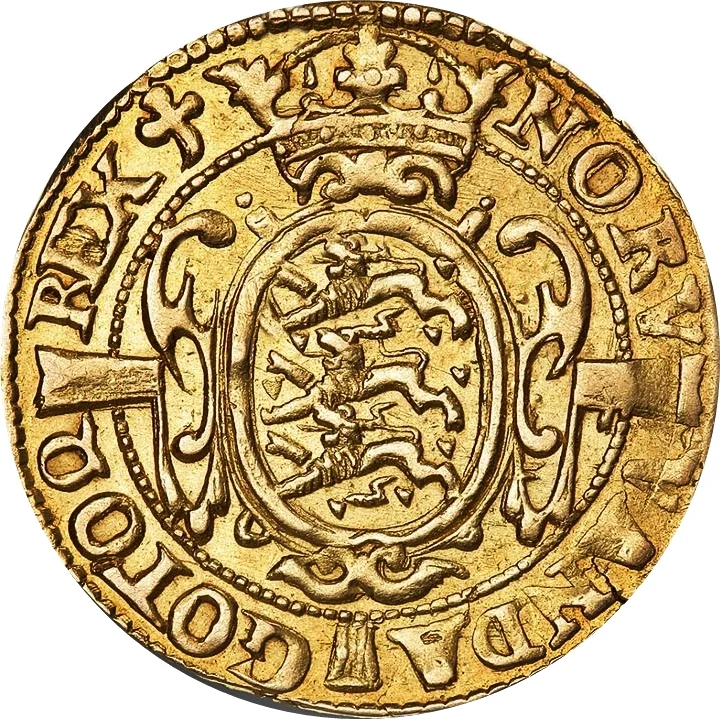
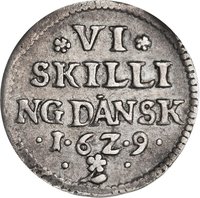
Reverse
Description:
Danish coat of arms on an oval shield with scrolls, a long cross behind.
Inscription:
NORV VANDA GOTOQ REX ☘
Script: Latin
Edge
Categories
| Person> Monarch |
| Symbols> Coat of Arms |
Mints
| Name | Mark |
|---|---|
| Copenhagen | ☘ |
Historical background
In 1625, Denmark was a significant European power under King Christian IV, but its currency system was strained and complex. The primary unit was the rigsdaler, a large silver coin, but the everyday economy relied on a confusing array of subsidiary coins, including marks, skilling, and hvid. These smaller coins were often minted from debased silver or base metals, leading to frequent fluctuations in their value relative to the rigsdaler. This created a dual system where "current money" (the debased circulating coins) traded at a discount against "species money" (full-value silver coins like the rigsdaler), causing uncertainty for both merchants and the peasantry.
The situation was exacerbated by the costs of Denmark’s involvement in the Thirty Years' War, which began with Christian IV's intervention as a Protestant leader in 1625. War expenditures drained the royal treasury, increasing the temptation for the crown to engage in inflationary practices. This often took the form of klippemønt ("clipped coin") – emergency coins struck from cut-up older coins or with reduced silver content – to pay soldiers and suppliers. While a short-term fiscal fix, this further degraded the currency's integrity and public trust.
Consequently, the monetary landscape was one of fragmentation and instability. Different regions and cities sometimes set their own exchange rates, and the constant influx of debased coinage from neighboring German states muddled the system further. This period thus represents a prelude to more formalized reforms, as the state struggled to balance the fiscal demands of warfare with the need for a stable medium of exchange in a kingdom whose economic foundations were still largely agricultural and reliant on sound currency for both taxation and trade.
The situation was exacerbated by the costs of Denmark’s involvement in the Thirty Years' War, which began with Christian IV's intervention as a Protestant leader in 1625. War expenditures drained the royal treasury, increasing the temptation for the crown to engage in inflationary practices. This often took the form of klippemønt ("clipped coin") – emergency coins struck from cut-up older coins or with reduced silver content – to pay soldiers and suppliers. While a short-term fiscal fix, this further degraded the currency's integrity and public trust.
Consequently, the monetary landscape was one of fragmentation and instability. Different regions and cities sometimes set their own exchange rates, and the constant influx of debased coinage from neighboring German states muddled the system further. This period thus represents a prelude to more formalized reforms, as the state struggled to balance the fiscal demands of warfare with the need for a stable medium of exchange in a kingdom whose economic foundations were still largely agricultural and reliant on sound currency for both taxation and trade.
✨ Legendary