

12 Mark – Denmark
Denmark
Context

Material
Diameter: 20.75 mm
Weight: 3.12 g
Gold weight: 2.73 g
Shape: Round
Composition: 87.5% Gold
Standard: Gold tenth ounce
Magnetic: No
References
KM: #Click to copy to clipboard585
Numista: #82700
Value
Bullion value: $454.88
Obverse
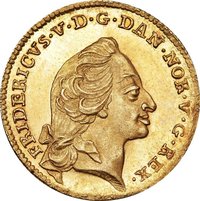
Description:
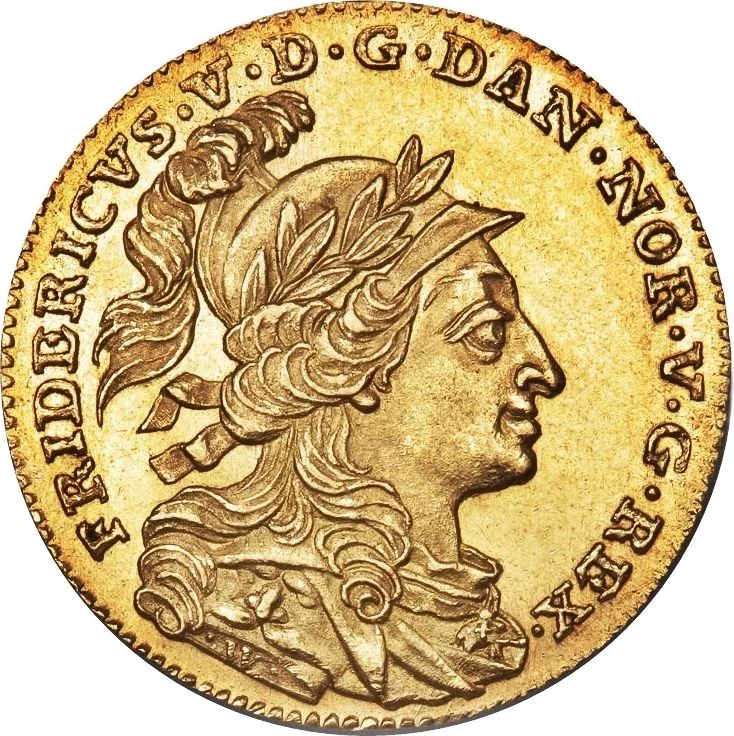
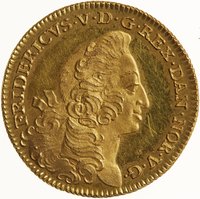
Armored bust of Frederik V in profile, wearing the Order of the Elephant and a plumed laurel helmet.
Inscription:
FRIDERICVS • V • D • G • DAN • NOR • V • G • REX •
.W.
.W.
Script: Latin
Reverse
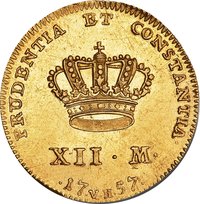
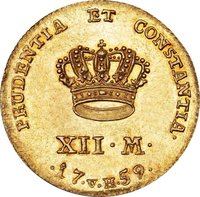
Description:
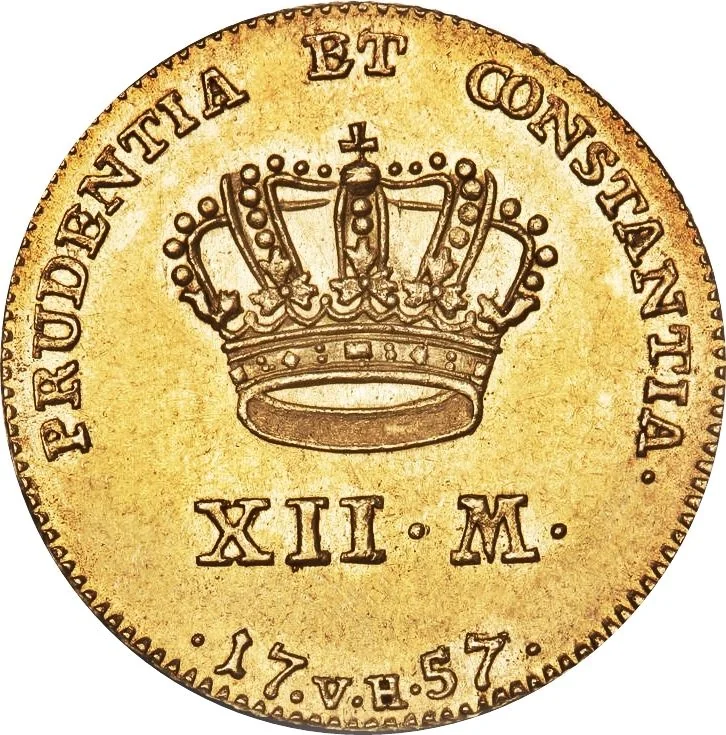
Crown above Roman numeral value. King's motto above. Date below, flanking mintmaster initials.
Inscription:
PRUDENTIA ET CONSTANTIA •
XII • M •
• 1758 •
V.H.
XII • M •
• 1758 •
V.H.
Script: Latin
Edge
Mints
| Name | Mark |
|---|---|
| Royal Danish Mint | — |
Mintings
| Year | Mint Mark | Mintage | Quality | Collection |
|---|---|---|---|---|
| 1757 | — | — | ||
| 1758 | — | — |
Historical background
In 1757, Denmark-Norway operated under a silver standard, with the primary currency being the rigsdaler specie, a large silver coin. However, the monetary system was complex and strained. The state frequently issued lower-quality subsidiary coins (like the rigsdaler courant, used for daily transactions) and credit paper ("credit sedler") to finance its expenditures, notably its involvement in the ongoing Seven Years' War (1756-1763). While Denmark remained neutral, it maintained a large, costly mobilized army to protect this neutrality, placing significant pressure on royal finances.
This period saw a growing divergence between the face value of coins and their intrinsic metal content, leading to a classic problem of bad money driving out good. Full-value silver rigsdaler specie were often hoarded or exported, while the less valuable courant coins flooded domestic circulation. This created a two-tier system with fluctuating exchange rates between the different forms of money, causing confusion and inefficiency in commerce. The public's trust in the value of the circulating medium was eroding.
Consequently, 1757 falls within a longer era of monetary experimentation and difficulty that would eventually lead to major reforms. The challenges of war finance, currency debasement, and the management of multiple parallel currencies highlighted the system's fragility. These persistent issues would culminate, just a few years later in the 1760s, in the establishment of the Danish Kurantbank and a more structured, though still problematic, paper currency system, setting the stage for a century of monetary evolution.
This period saw a growing divergence between the face value of coins and their intrinsic metal content, leading to a classic problem of bad money driving out good. Full-value silver rigsdaler specie were often hoarded or exported, while the less valuable courant coins flooded domestic circulation. This created a two-tier system with fluctuating exchange rates between the different forms of money, causing confusion and inefficiency in commerce. The public's trust in the value of the circulating medium was eroding.
Consequently, 1757 falls within a longer era of monetary experimentation and difficulty that would eventually lead to major reforms. The challenges of war finance, currency debasement, and the management of multiple parallel currencies highlighted the system's fragility. These persistent issues would culminate, just a few years later in the 1760s, in the establishment of the Danish Kurantbank and a more structured, though still problematic, paper currency system, setting the stage for a century of monetary evolution.
💎 Extremely Rare