

8 skilling – Denmark
Add to wishlist
Denmark
Context
Material
Diameter: 22 mm
Weight: 3.06 g
Silver Weight:: 1.72 g
Shape: Round
Composition: 56.2% Silver
Standard: Gold tenth ounce
Magnetic: No
References
KM: #
Numista: #82695
Value
Bullion value: $4.31
Obverse
Description:
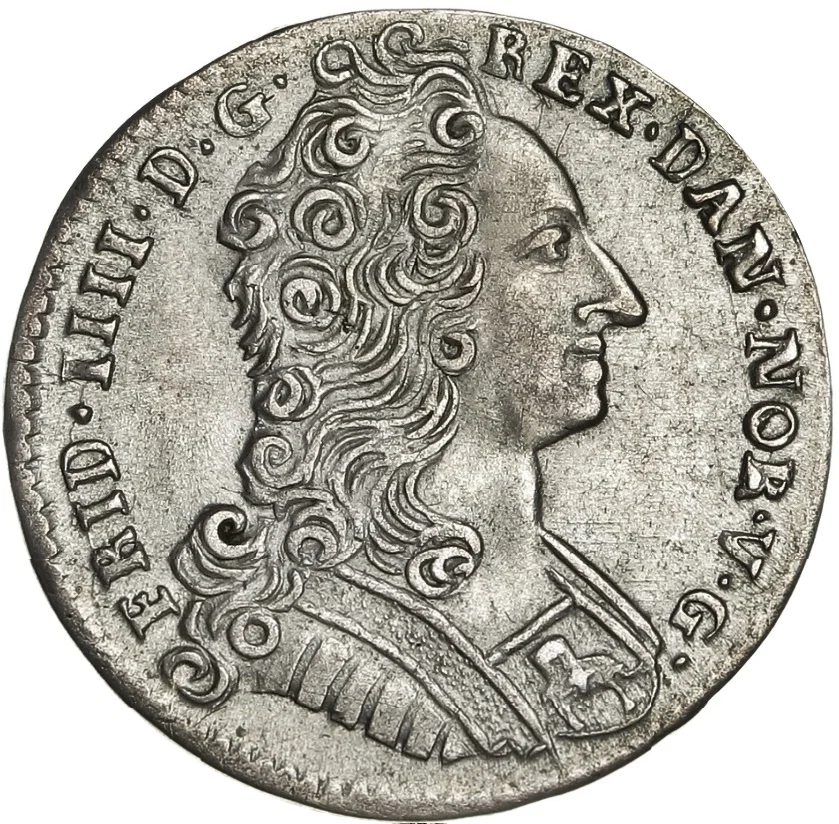
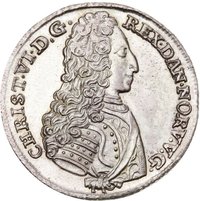
Bust of Frederik IV facing right, legend encircled by curly hair.
Inscription:
FRID.IIII.D.G.REX DAN.NOR.V.G
Script: Latin
Reverse
Description:
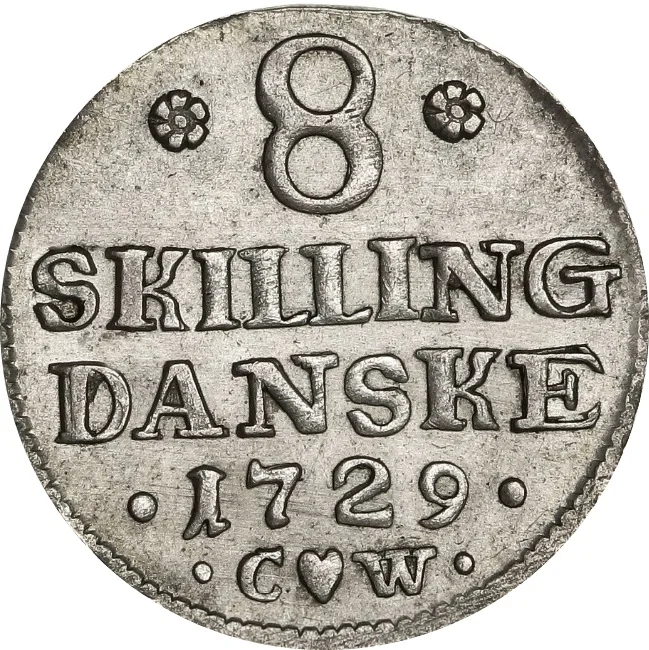
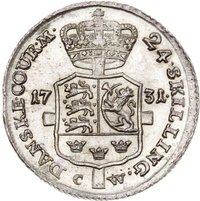
Value, date, mintmark.
Four lines, heart center.
Four lines, heart center.
Inscription:
* 8 *
SKILLING
DANSKE
• 1729 •
C ♥ W
SKILLING
DANSKE
• 1729 •
C ♥ W
Script: Latin
Edge
Mintings
| Year | Mint Mark | Mintage | Quality | Collection |
|---|---|---|---|---|
| 1729 | CW | — | ||
| 1730 | CW | — |
Historical background
In 1729, Denmark was navigating a complex and strained currency situation, largely a legacy of the Great Northern War (1700-1721). The prolonged conflict had drained the state's finances, leading to severe debasement of the coinage. The government, under King Frederick IV, had repeatedly reduced the silver content of coins to fund the war effort, creating a system where older, high-value coins were hoarded or melted down, while newer, inferior coins flooded the market. This resulted in a classic "bad money drives out good" scenario (Gresham's Law), rampant inflation, and a profound loss of public trust in the monetary system.
The immediate response was the Currency Regulation of 1728, which took effect in the early months of 1729. This decree aimed to stabilize the situation by introducing a new fixed exchange rate between the various circulating coins, including the krone, mark, and skilling. Crucially, it sought to establish a firm silver standard by defining the riksdaler specie as the primary unit of account, theoretically containing a specific weight of fine silver. However, the regulation was essentially a forced revaluation, effectively devaluing the already-circulating debased coins overnight, which caused significant hardship and confusion among merchants and the general populace.
Therefore, the currency situation in 1729 was one of fragile and contested stabilization. While the authorities had taken decisive action to halt the downward spiral and re-anchor the currency to silver, the practical outcome was economic disruption and social discontent. The reform did not immediately resolve the underlying scarcity of sound money, and Denmark would continue to grapple with monetary instability for years, setting the stage for further reforms later in the 18th century. The year represents a pivotal, if painful, transition from wartime fiscal emergency to a more ordered, though not yet fully trusted, monetary regime.
The immediate response was the Currency Regulation of 1728, which took effect in the early months of 1729. This decree aimed to stabilize the situation by introducing a new fixed exchange rate between the various circulating coins, including the krone, mark, and skilling. Crucially, it sought to establish a firm silver standard by defining the riksdaler specie as the primary unit of account, theoretically containing a specific weight of fine silver. However, the regulation was essentially a forced revaluation, effectively devaluing the already-circulating debased coins overnight, which caused significant hardship and confusion among merchants and the general populace.
Therefore, the currency situation in 1729 was one of fragile and contested stabilization. While the authorities had taken decisive action to halt the downward spiral and re-anchor the currency to silver, the practical outcome was economic disruption and social discontent. The reform did not immediately resolve the underlying scarcity of sound money, and Denmark would continue to grapple with monetary instability for years, setting the stage for further reforms later in the 18th century. The year represents a pivotal, if painful, transition from wartime fiscal emergency to a more ordered, though not yet fully trusted, monetary regime.
💎 Extremely Rare