

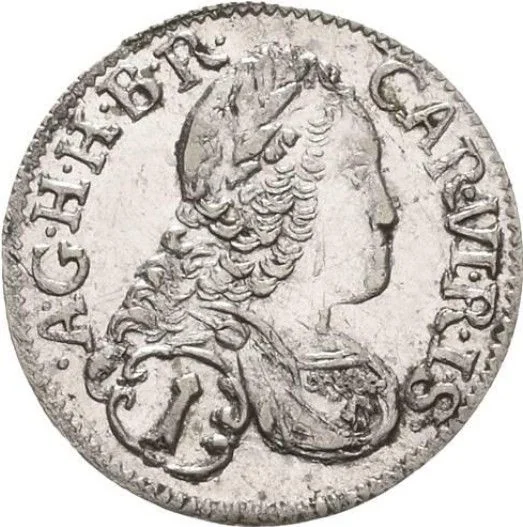
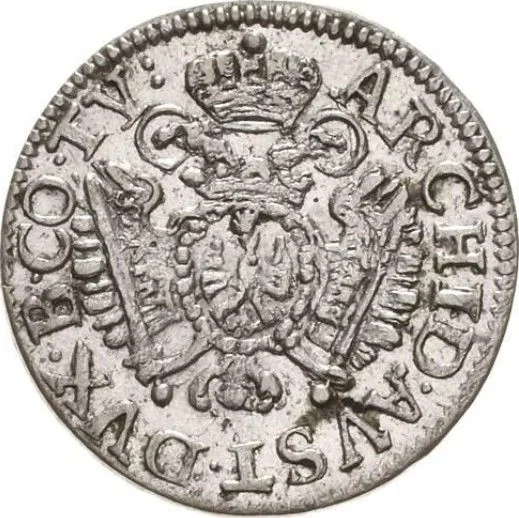
1 Kreuzer – County of Tyrol
Austria

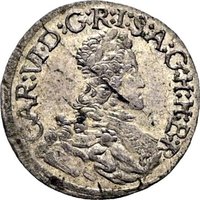
Obverse
Description:
Right-facing bust. Value in cartouche divides legend. Circular legend begins at 1 o'clock.
Inscription:
CAR VI R I S A G H H B R
(1)
(1)
Script: Latin
Engraver: Josef Christof König
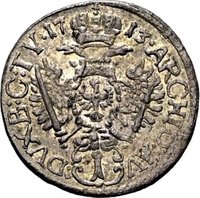
Reverse
Description:
Imperial double-headed eagle with Tyrol shield.
Inscription:
ARCHID AVST DVX B CO TYR
Script: Latin
Engraver: Josef Christof König
Edge
Plain
Mints
| Name | Mark |
|---|---|
| Hall | — |
Mintings
| Year | Mint Mark | Mintage | Quality | Collection |
|---|---|---|---|---|
| — | — | — |
Historical background
In 1712, the County of Tyrol, a strategic alpine territory within the Habsburg Empire, operated under a complex and strained monetary system. The primary currency was the Tyrolean Kreuzer, with 60 Kreuzer equaling 1 Gulden (or Florin). However, the region's economy was not isolated; it was heavily influenced by the monetary policies of the wider Habsburg lands and the influx of foreign coinage from trade across the Brenner Pass. This circulation created a chaotic environment where coins of varying intrinsic silver content—from local issues to Bavarian, Venetian, and Swiss coins—competed, leading to frequent disputes over exchange rates and valuation.
The root of the monetary instability lay in the Great Turkish War (1683-1699) and the War of the Spanish Succession (1701-1714), which had drained Habsburg coffers. To finance these conflicts, the central government in Vienna repeatedly debased the coinage, reducing the silver content in coins like the Kreuzer to generate seigniorage profit. This practice, conducted at the mint in Hall, near Innsbruck, led to a severe loss of public confidence. "Good," older coins with higher silver content were hoarded, while the new, "bad" debased coins flooded the market, causing inflation and harming local trade and wage earners.
Consequently, the Estates of Tyrol and the local authorities faced significant pressure to stabilize the currency. Their efforts were largely reactive, involving periodic re-coinages and attempts to regulate the acceptance of foreign money. However, these measures were temporary fixes against the overwhelming fiscal demands of the imperial war machine. The situation in 1712 was thus one of entrenched instability, characterized by a widening gap between the official face value of coins and their actual metal worth, sowing economic uncertainty and discontent among Tyrol's population and merchants.
The root of the monetary instability lay in the Great Turkish War (1683-1699) and the War of the Spanish Succession (1701-1714), which had drained Habsburg coffers. To finance these conflicts, the central government in Vienna repeatedly debased the coinage, reducing the silver content in coins like the Kreuzer to generate seigniorage profit. This practice, conducted at the mint in Hall, near Innsbruck, led to a severe loss of public confidence. "Good," older coins with higher silver content were hoarded, while the new, "bad" debased coins flooded the market, causing inflation and harming local trade and wage earners.
Consequently, the Estates of Tyrol and the local authorities faced significant pressure to stabilize the currency. Their efforts were largely reactive, involving periodic re-coinages and attempts to regulate the acceptance of foreign money. However, these measures were temporary fixes against the overwhelming fiscal demands of the imperial war machine. The situation in 1712 was thus one of entrenched instability, characterized by a widening gap between the official face value of coins and their actual metal worth, sowing economic uncertainty and discontent among Tyrol's population and merchants.
💎 Extremely Rare