

24 skilling – Norway
Add to wishlist
Norway
Context
Years: 1763–1765
Issuer: Norway
Ruler: Frederick V
Currency:
(1746—1814)
Demonetized: Yes
Total mintage: 1,966,000
Material
References
KM: #
Numista: #82388
Value
Bullion value: $12.94
Obverse
Description:
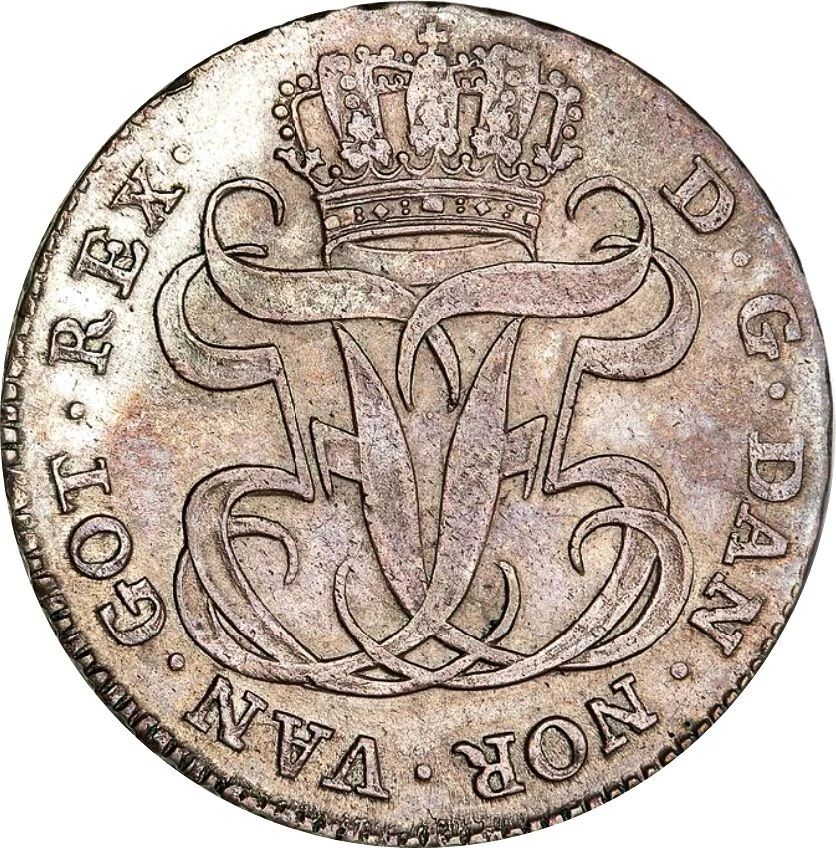
Crowned mirrored monogram of Frederik V. Inscription surrounds. Beaded edge.
Inscription:
· D · G · DAN · NOR · VAN · GOT · REX ·
Script: Latin
Reverse
Description:
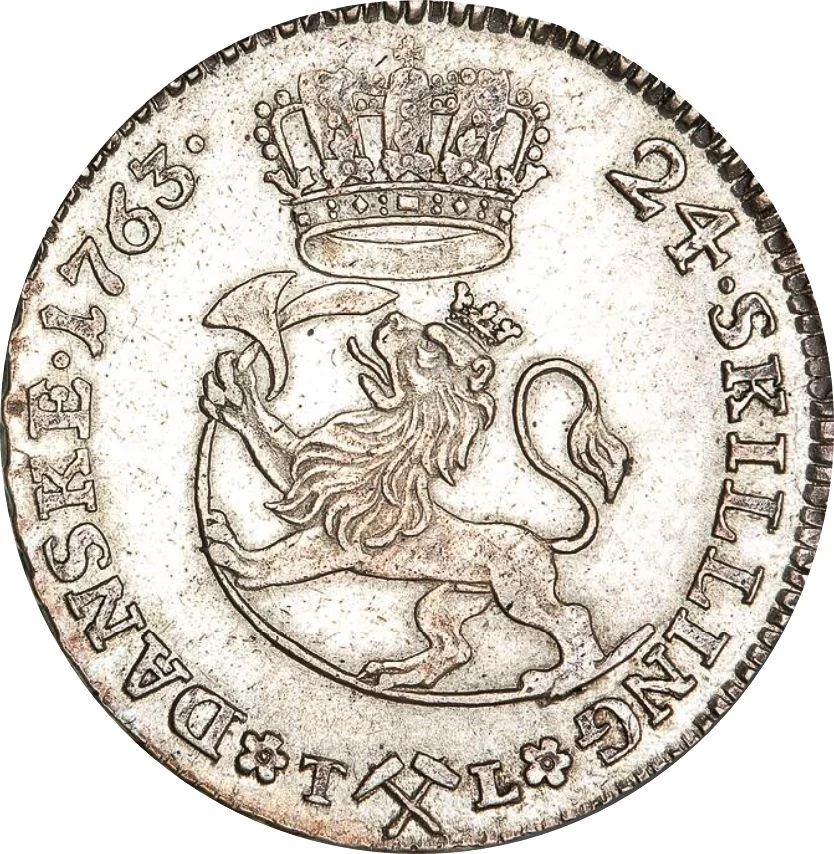
Norwegian lion with axe facing left, crowned twice. Inscription surrounds, mintmark and initials below. Beaded edge.
Inscription:
·24·SKILLING | DANSKE·1763·
✿ T ⚒ L ✿
✿ T ⚒ L ✿
Script: Latin
Edge
Mints
| Name | Mark |
|---|---|
| Norwegian Mint | — |
Mintings
| Year | Mint Mark | Mintage | Quality | Collection |
|---|---|---|---|---|
| 1763 | — | 1,085,000 | ||
| 1764 | — | 622,000 | ||
| 1765 | — | 259,000 |
Historical background
In 1763, Norway found itself in a severe monetary crisis, a direct consequence of its economic union with Denmark under the Danish-Norwegian state. The primary issue was a catastrophic shortage of specie (coinage), particularly silver, which crippled everyday commerce. This scarcity was exacerbated by the global outflow of silver from Europe to Asia and by Denmark-Norway's own negative trade balance, which drained coinage abroad. To function, local economies increasingly relied on a chaotic system of credit notes, promissory IOUs, and barter, creating uncertainty and hindering trade.
The situation was fundamentally linked to the policies of the Danish crown, which controlled monetary policy from Copenhagen. A significant contributing factor was the existence of the Norges Bank, a private note-issuing bank established in 1763 in Trondheim—the same year as the crisis peaked. While intended to provide stability, its banknotes faced deep public distrust and were not accepted as legal tender for tax payments to the state. This lack of sovereign backing severely limited their usefulness and acceptance, failing to alleviate the coin shortage.
Ultimately, the crisis of 1763 highlighted Norway's vulnerable position within the union and its lack of control over its own financial destiny. The desperate shortage of reliable currency stifled economic activity and revealed the inadequacy of the existing financial structures. This period of monetary distress underscored the need for a stable and trusted currency system, a problem that would persist for decades until the establishment of a modern, state-backed central bank much later in Norwegian history.
The situation was fundamentally linked to the policies of the Danish crown, which controlled monetary policy from Copenhagen. A significant contributing factor was the existence of the Norges Bank, a private note-issuing bank established in 1763 in Trondheim—the same year as the crisis peaked. While intended to provide stability, its banknotes faced deep public distrust and were not accepted as legal tender for tax payments to the state. This lack of sovereign backing severely limited their usefulness and acceptance, failing to alleviate the coin shortage.
Ultimately, the crisis of 1763 highlighted Norway's vulnerable position within the union and its lack of control over its own financial destiny. The desperate shortage of reliable currency stifled economic activity and revealed the inadequacy of the existing financial structures. This period of monetary distress underscored the need for a stable and trusted currency system, a problem that would persist for decades until the establishment of a modern, state-backed central bank much later in Norwegian history.
💎 Extremely Rare