

1 Skilling – Norway
Norway
Context
Years: 1761–1765
Issuer: Norway 
Ruler: Frederick V
Currency:
(1746—1814)
Demonetized: Yes
Total mintage: 2,846,814
Material
References
KM: #Click to copy to clipboard240
Numista: #85512
Obverse
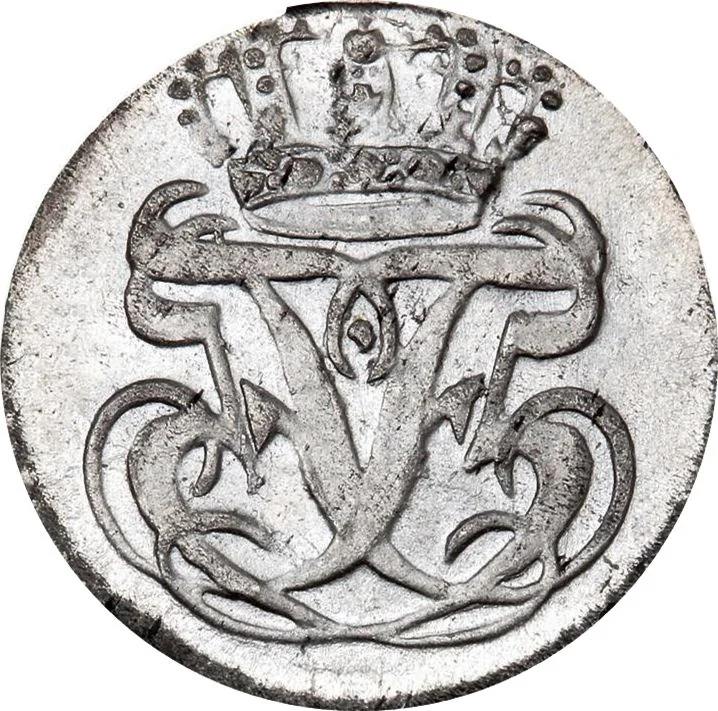
Description:
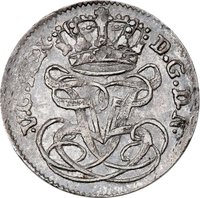
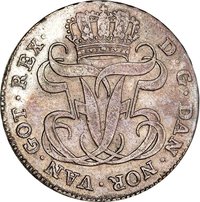
Crowned mirrored "F5" monogram. Beaded edge.
Script: Latin
Reverse
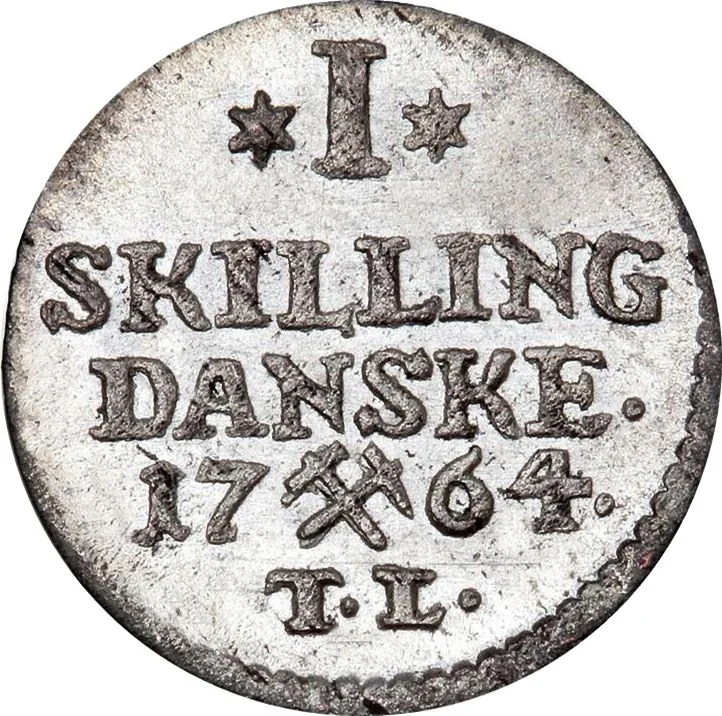
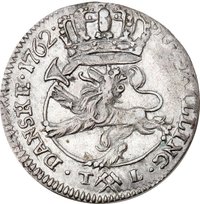
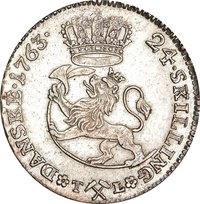
Description:
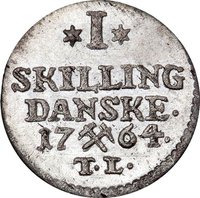
Value and date on four lines.
Date divided by mintmark.
Mintmaster's initials below.
Beaded edge.
Date divided by mintmark.
Mintmaster's initials below.
Beaded edge.
Inscription:
✶I✶
SKILLING
DANSKE·
17 ⚒ 64·
T· L·
SKILLING
DANSKE·
17 ⚒ 64·
T· L·
Script: Latin
Edge
Plain
Mints
| Name | Mark |
|---|---|
| Norwegian Mint | — |
Mintings
| Year | Mint Mark | Mintage | Quality | Collection |
|---|---|---|---|---|
| 1761 | — | — | ||
| 1762 | — | 29,014 | ||
| 1763 | — | 931,100 | ||
| 1764 | — | — | ||
| 1765 | — | 1,886,700 |
Historical background
In 1761, Norway was part of the Danish-Norwegian dual monarchy, and its currency system was complex and strained. The primary currency was the Danish rigsdaler, divided into 96 skilling. However, the system was not uniform; a multitude of older, often debased coins from various periods remained in circulation alongside the newer issues. Furthermore, the state frequently faced shortages of small change, leading to significant inconvenience in everyday trade and prompting the use of makeshift solutions like private token coins and promissory notes in local commerce.
The period was marked by ongoing monetary instability. Decades of war, particularly the Great Northern War (1700-1721), had drained state finances, leading to repeated devaluations and manipulations of the coinage. While the mid-18th century saw some attempts at reform, the money supply remained unreliable. A critical issue was the disparity between the face value of coins and their intrinsic metal content, which encouraged the export and melting down of full-valued coins, leaving poorer quality money in domestic circulation. This Gresham's Law dynamic ("bad money drives out good") perpetuated economic inefficiency.
Economically, Norway's situation was also shaped by its dependence on Copenhagen. All monetary policy was dictated by the central authorities in Denmark, with Norway having no independent mint; coins were struck in Copenhagen and Altona. The year 1761 falls within a broader era of mercantilist policy, where the currency was managed to serve the state's fiscal needs and control the wider economy of the united kingdoms. This centralized control, combined with the physical scarcity of sound coin, created a monetary environment that was a persistent challenge for Norwegian merchants, farmers, and the growing bureaucratic class.
The period was marked by ongoing monetary instability. Decades of war, particularly the Great Northern War (1700-1721), had drained state finances, leading to repeated devaluations and manipulations of the coinage. While the mid-18th century saw some attempts at reform, the money supply remained unreliable. A critical issue was the disparity between the face value of coins and their intrinsic metal content, which encouraged the export and melting down of full-valued coins, leaving poorer quality money in domestic circulation. This Gresham's Law dynamic ("bad money drives out good") perpetuated economic inefficiency.
Economically, Norway's situation was also shaped by its dependence on Copenhagen. All monetary policy was dictated by the central authorities in Denmark, with Norway having no independent mint; coins were struck in Copenhagen and Altona. The year 1761 falls within a broader era of mercantilist policy, where the currency was managed to serve the state's fiscal needs and control the wider economy of the united kingdoms. This centralized control, combined with the physical scarcity of sound coin, created a monetary environment that was a persistent challenge for Norwegian merchants, farmers, and the growing bureaucratic class.
💎 Very Rare