

5 Guineas – United Kingdom
United Kingdom
Context

Material
References
KM: #Click to copy to clipboard535
Numista: #80825
Value
Bullion value: $6394.44
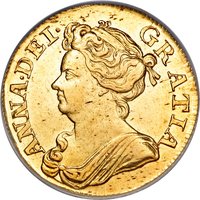
Obverse
Description:
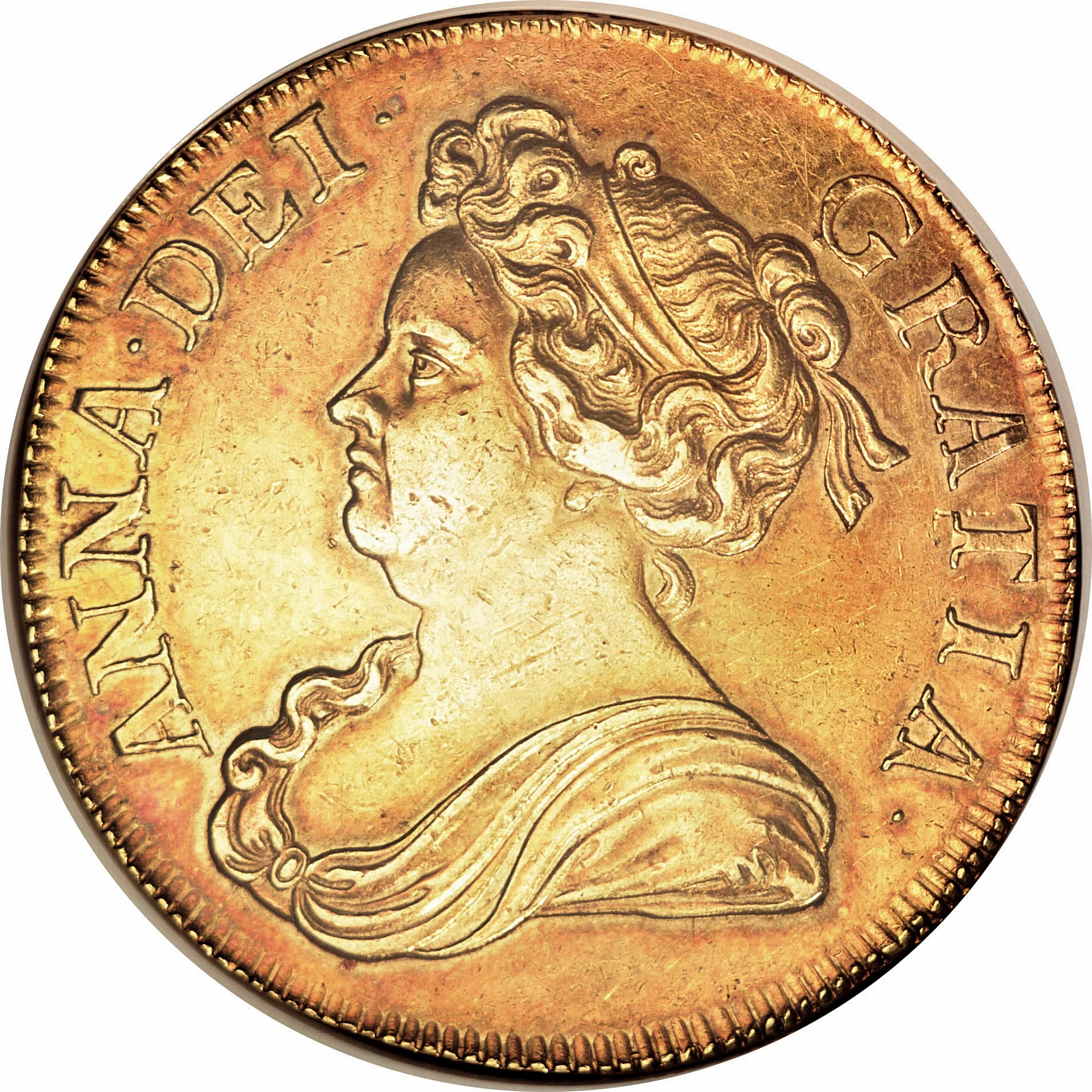
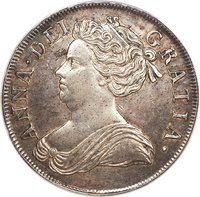
Queen Anne left-facing bust, legend surrounding.
Inscription:
ANNA • DEI • GRATIA
Script: Latin
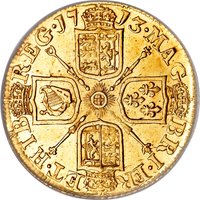
Reverse
Description:
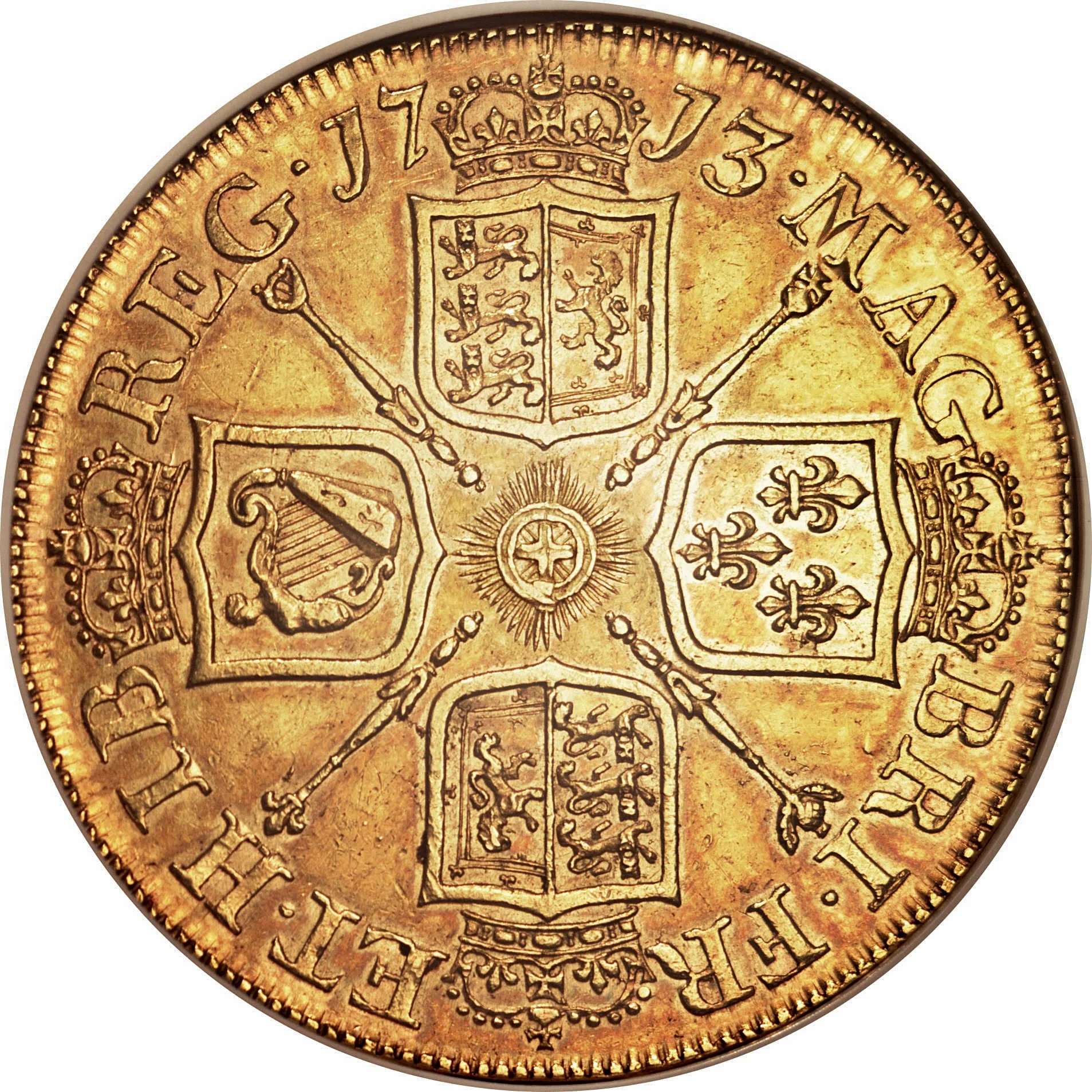
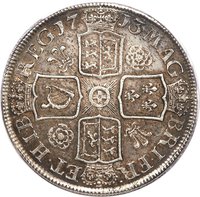
Crowned shields flank a central Garter star; sceptres in angles, date above, legend around.
Inscription:
MAG - BRI • FR ET • HIB - REG • 1713
Script: Latin
Edge
Inscribed with regnal year in words
Legend:
DVODECIMO
Mintings
| Year | Mint Mark | Mintage | Quality | Collection |
|---|---|---|---|---|
| 1711 | — | — | ||
| 1713 | — | — | ||
| 1714 | — | — |
Historical background
In 1711, the currency situation in the United Kingdom was one of profound crisis and transition, rooted in the financial strains of prolonged continental war. The War of the Spanish Succession (1701-1714) had placed immense pressure on the Treasury, leading to a severe shortage of silver coinage. The intrinsic value of the silver in coins like the shilling had become higher than their face value, causing them to be melted down or hoarded. Consequently, the circulating currency was a degraded mix of underweight, clipped, and counterfeit coins, making everyday commerce difficult and undermining public confidence in the monetary system.
This crisis prompted the government of Queen Anne, advised by Lord Treasurer Robert Harley, to seek a radical solution. In 1711, a key development was the incorporation of the South Sea Company, which was granted a monopoly on trade with Spanish South America in exchange for assuming approximately £9 million of the government's war debt. This financial engineering, while not directly minting new coin, was a landmark attempt to manage the national debt and stabilize public credit through private enterprise. It represented a shift from pure specie (coin) to paper instruments and debt equity, setting the stage for future financial innovations.
However, the immediate currency problem required a more direct remedy, which would arrive shortly after. The Great Recoinage of 1696, under William III, had attempted to solve the same issue but its effects had worn off. The situation demanded a more robust and standardized coinage, a task that would be decisively addressed with the hiring of Sir Isaac Newton as Warden (and later Master) of the Royal Mint in 1696, whose reforms were still shaping production. By 1711, the groundwork was being laid for the eventual restoration of a reliable silver coinage, but the year itself stands as a point of acute distress, where the weaknesses of physical currency starkly contrasted with the burgeoning power of financial credit and state debt management.
This crisis prompted the government of Queen Anne, advised by Lord Treasurer Robert Harley, to seek a radical solution. In 1711, a key development was the incorporation of the South Sea Company, which was granted a monopoly on trade with Spanish South America in exchange for assuming approximately £9 million of the government's war debt. This financial engineering, while not directly minting new coin, was a landmark attempt to manage the national debt and stabilize public credit through private enterprise. It represented a shift from pure specie (coin) to paper instruments and debt equity, setting the stage for future financial innovations.
However, the immediate currency problem required a more direct remedy, which would arrive shortly after. The Great Recoinage of 1696, under William III, had attempted to solve the same issue but its effects had worn off. The situation demanded a more robust and standardized coinage, a task that would be decisively addressed with the hiring of Sir Isaac Newton as Warden (and later Master) of the Royal Mint in 1696, whose reforms were still shaping production. By 1711, the groundwork was being laid for the eventual restoration of a reliable silver coinage, but the year itself stands as a point of acute distress, where the weaknesses of physical currency starkly contrasted with the burgeoning power of financial credit and state debt management.
✨ Legendary