

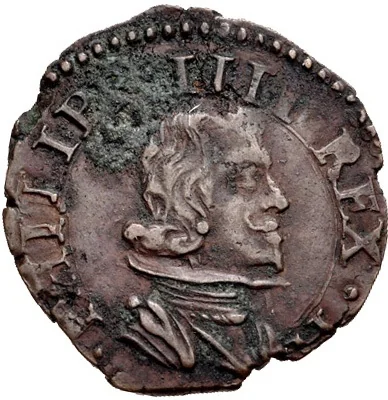
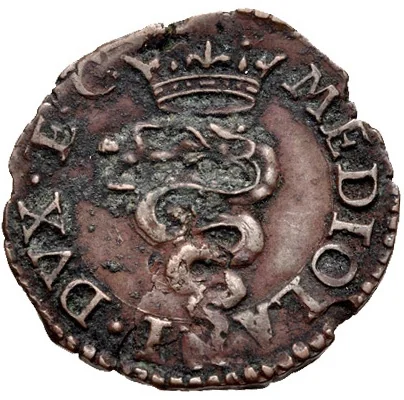
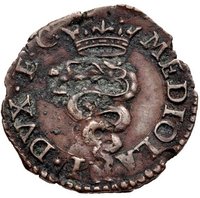
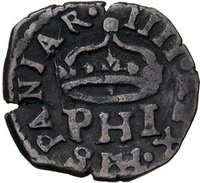
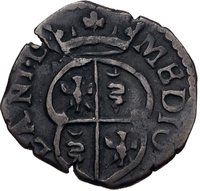
1 Quattrino – Milan
Italy
Context
Years: 1621–1665
Country: Italy 
Issuer: Milan
Ruler: Philip III
Currency:
(1515—1796)
Demonetized: Yes
Material
References
KM: #Click to copy to clipboard32
Numista: #80497
Obverse
Reverse
Edge
Plain
Mints
| Name | Mark |
|---|---|
| Milan | — |
Mintings
| Year | Mint Mark | Mintage | Quality | Collection |
|---|---|---|---|---|
| — | — | — |
Historical background
In 1621, Milan found itself at a critical juncture within the complex monetary landscape of the Spanish Habsburg Empire. As the Duchy of Milan was a vital strategic and financial hub for Spain’s European ambitions, its currency was directly impacted by imperial fiscal policy. The primary circulating coins were the silver scudo and the gold doppia, but the system was plagued by a proliferation of debased foreign coins and clipped or counterfeit domestic ones, leading to widespread confusion and loss of confidence in everyday transactions. This instability was exacerbated by the Thirty Years' War (1618-1648), which placed enormous strain on the Spanish treasury and prompted the Crown to often manipulate coinage values to fund its military campaigns.
The situation reached a crisis point with the accession of King Philip IV and his minister, the Count-Duke of Olivares, who inherited severe financial exhaustion. In response, the Spanish Crown issued a series of drastic monetary decrees in 1621 aimed at centralizing control and extracting revenue. These measures included calling in existing coins for re-minting at a lower intrinsic value—a form of seigniorage—and attempting to impose fixed exchange rates between different denominations. For Milan, this meant an abrupt devaluation of its circulating currency, effectively a forced loan from the public to the state, which disrupted commerce and sparked immediate economic distress.
Consequently, the monetary reforms of 1621 failed to achieve stability and instead intensified the Duchy's economic woes. Prices became volatile, creditors suffered losses, and mercantile activity in this wealthy commercial capital was severely hampered. The decrees highlighted the fundamental tension between Milan’s robust local economy and the extractive demands of its imperial ruler. This period marked the beginning of a prolonged era of monetary turbulence for Milan, contributing to a gradual decline in its economic prominence within Italy as the century progressed, as trust in the currency eroded alongside faith in Habsburg fiscal management.
The situation reached a crisis point with the accession of King Philip IV and his minister, the Count-Duke of Olivares, who inherited severe financial exhaustion. In response, the Spanish Crown issued a series of drastic monetary decrees in 1621 aimed at centralizing control and extracting revenue. These measures included calling in existing coins for re-minting at a lower intrinsic value—a form of seigniorage—and attempting to impose fixed exchange rates between different denominations. For Milan, this meant an abrupt devaluation of its circulating currency, effectively a forced loan from the public to the state, which disrupted commerce and sparked immediate economic distress.
Consequently, the monetary reforms of 1621 failed to achieve stability and instead intensified the Duchy's economic woes. Prices became volatile, creditors suffered losses, and mercantile activity in this wealthy commercial capital was severely hampered. The decrees highlighted the fundamental tension between Milan’s robust local economy and the extractive demands of its imperial ruler. This period marked the beginning of a prolonged era of monetary turbulence for Milan, contributing to a gradual decline in its economic prominence within Italy as the century progressed, as trust in the currency eroded alongside faith in Habsburg fiscal management.
💎 Very Rare