

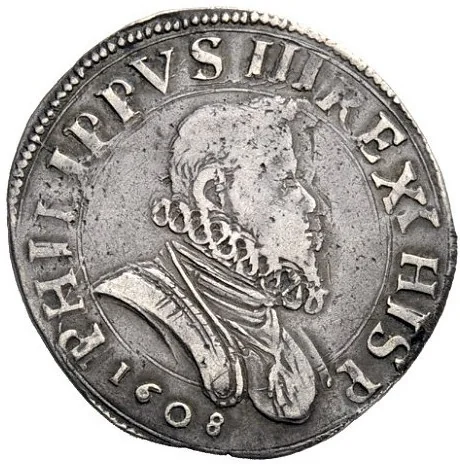
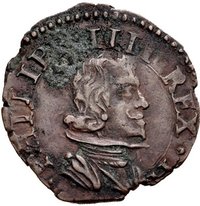
Obverse
Description:
Bust right, high collar, date below.
Inscription:
PHILIPPVS III REX. HISP
1608
1608
Script: Latin
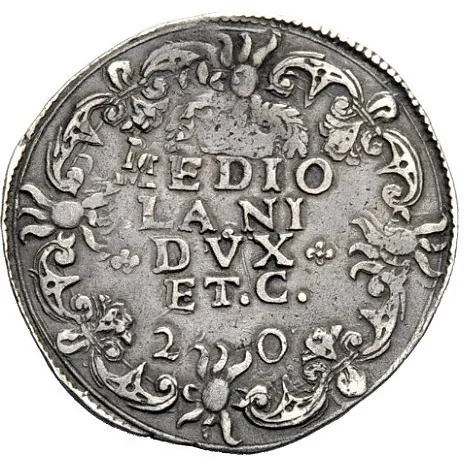
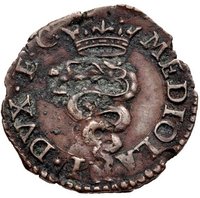
Reverse
Description:
Crowned two-branch motif above inscribed text, all within an ornate frame.
Inscription:
MEDIO
LA NI
DVX
ET.C.
2 0
LA NI
DVX
ET.C.
2 0
Script: Latin
Edge
Mints
| Name | Mark |
|---|---|
| Milan | — |
Mintings
| Year | Mint Mark | Mintage | Quality | Collection |
|---|---|---|---|---|
| 1608 | — | — |
Historical background
In 1608, Milan was a major financial hub within the Spanish Empire, but its currency system was a complex and troubled mosaic. The primary unit was the lira imperiale, a money of account, but the physical circulation was dominated by a bewildering array of real coins: Spanish silver reales, gold scudi from various Italian states, and a plethora of debased local sesini and soldi. The critical problem was the severe shortage of high-quality, full-weight coinage. Good silver and gold coins were hoarded or exported for international trade, leaving the local economy choked with underweight, worn, and clipped coins, leading to price inflation and daily transactional friction.
This "bad money driving out good" situation was exacerbated by the policies of the ruling Spanish authorities. The Milanese mint, under the governorship of the Count of Fuentes, had engaged in aggressive debasement of the low-denomination coinage to profit the state treasury, a short-term fiscal fix that eroded public trust. Furthermore, Spain's endless military campaigns across Europe drained vast quantities of bullion from Milan to pay troops, creating a persistent drain on the city's monetary stock. The exchange rates between the myriad coins fluctuated constantly, causing confusion in markets and harming both merchants and wage earners.
Consequently, 1608 fell within a period of intense monetary crisis and experimentation. Authorities responded with repeated but largely ineffective tariffs—official decrees that attempted to fix the value of various coins in relation to the lira. These edicts were frequently ignored in practice, as market forces dictated higher premiums for full-weight coins. The situation created a pressing need for reform, which would eventually lead to significant proposals and changes in the following years, including discussions about establishing a public bank to stabilize credit and transactions, foreshadowing the future Banco di Sant'Ambrogio.
This "bad money driving out good" situation was exacerbated by the policies of the ruling Spanish authorities. The Milanese mint, under the governorship of the Count of Fuentes, had engaged in aggressive debasement of the low-denomination coinage to profit the state treasury, a short-term fiscal fix that eroded public trust. Furthermore, Spain's endless military campaigns across Europe drained vast quantities of bullion from Milan to pay troops, creating a persistent drain on the city's monetary stock. The exchange rates between the myriad coins fluctuated constantly, causing confusion in markets and harming both merchants and wage earners.
Consequently, 1608 fell within a period of intense monetary crisis and experimentation. Authorities responded with repeated but largely ineffective tariffs—official decrees that attempted to fix the value of various coins in relation to the lira. These edicts were frequently ignored in practice, as market forces dictated higher premiums for full-weight coins. The situation created a pressing need for reform, which would eventually lead to significant proposals and changes in the following years, including discussions about establishing a public bank to stabilize credit and transactions, foreshadowing the future Banco di Sant'Ambrogio.
✨ Legendary