

2 shillings – Uganda
Add to wishlist
Uganda
Context
Year: 1966
Issuer: Uganda
Issuing organization: Bank of Uganda
Period:
(since 1962)
Currency:
(1966—1987)
Demonetized: Yes
Total mintage: 4,008,250
Material
Diameter: 30.1 mm
Weight: 11.66 g
Thickness: 2.31 mm
Shape: Round
Composition: Copper-nickel
Technique: Milled
Alignment: Medal alignment
flip
References
KM: #
Numista: #12003
Value
Exchange value: 2 UGS
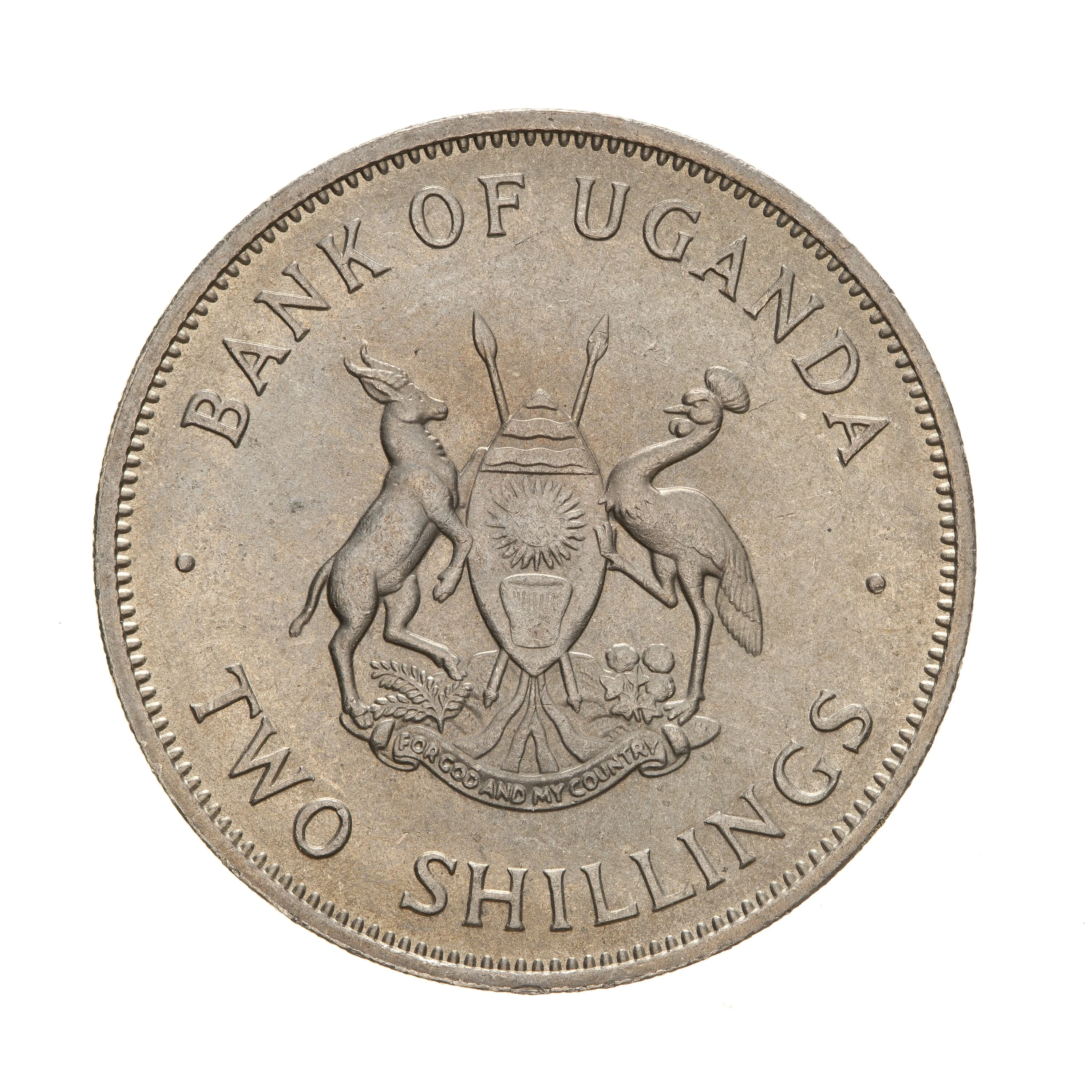
Obverse
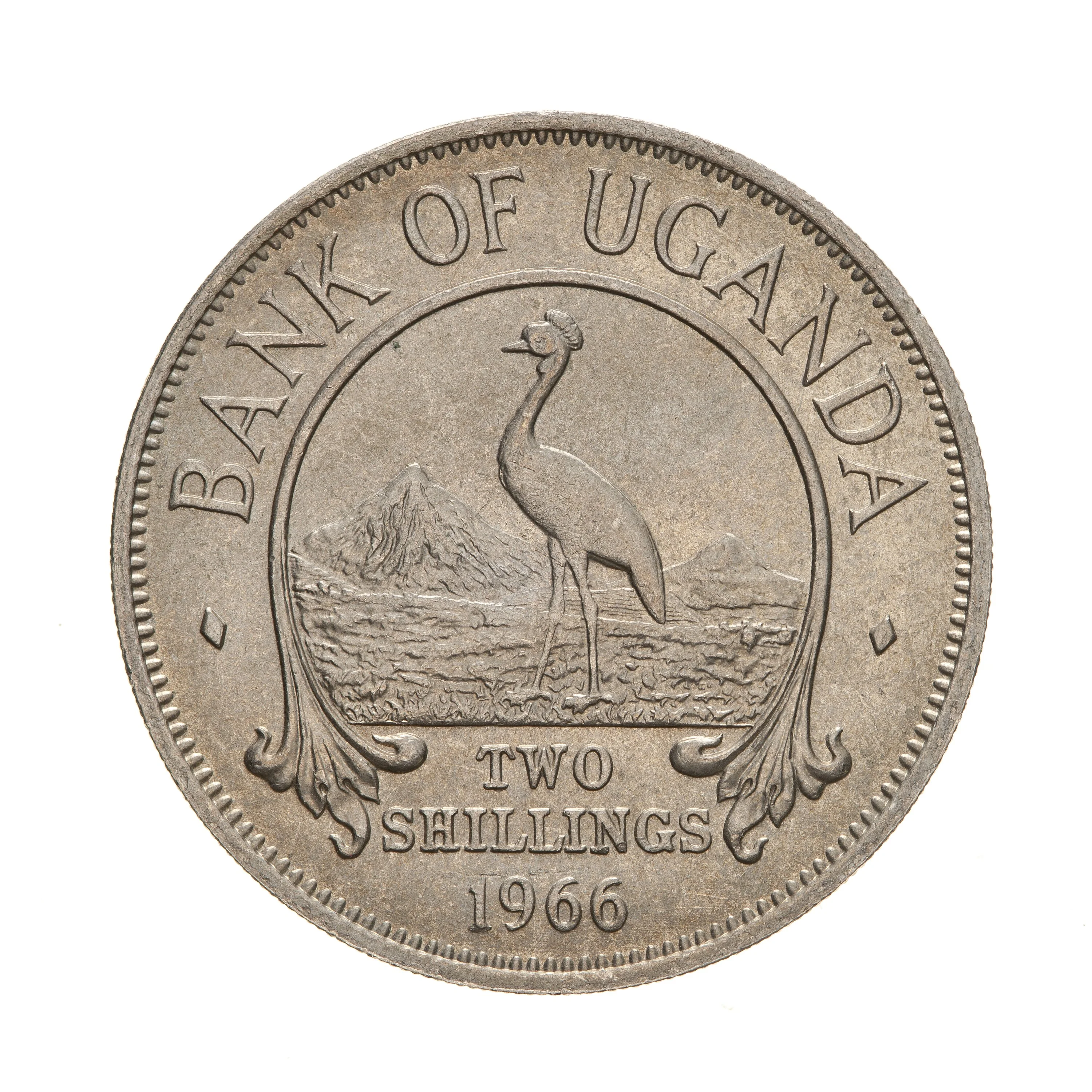
Reverse
Description:
Grey crowned crane facing left, floral ornament, mountains behind.
Inscription:
· BANK OF UGANDA ·
TWO SHILLINGS
1966
TWO SHILLINGS
1966
Script: Latin
Edge
Reeded
Categories
| Animal> Bird |
| Symbols> Coat of Arms |
Mints
| Name | Mark |
|---|---|
| Royal Mint (Tower Hill) | — |
Mintings
| Year | Mint Mark | Mintage | Quality | Collection |
|---|---|---|---|---|
| 1966 | — | 4,000,000 | ||
| 1966 | — | 8,250 | Proof |
Historical background
In 1966, Uganda's currency situation was fundamentally shaped by political upheaval and the assertion of central bank authority. The nation was using the East African shilling, a common currency issued by the East African Currency Board (EACB) and shared with Kenya and Tanzania. However, following the political crisis of 1966, which saw Prime Minister Milton Obote suspend the constitution and declare himself executive president, the government sought greater monetary independence and control over its economy. This political consolidation created an urgent impetus to establish a national currency as a symbol of sovereignty.
Consequently, on August 15, 1966, the Bank of Uganda was formally opened and immediately issued the first Ugandan shilling (UGX) to replace the East African shilling at par (1:1). This move was both practical and symbolic, allowing the new Obote government to direct monetary policy specifically for Uganda's needs and to sever a tangible link to the colonial-era currency union. The initial notes famously featured an image of the historic "Ivory Tower" at Makerere University.
The transition was executed smoothly from a technical standpoint, but it occurred against a backdrop of significant political tension and economic uncertainty. The currency change was part of a broader centralization of power, and the new banknotes entered circulation in an economy still largely dependent on agricultural exports like coffee and cotton. Thus, the 1966 currency reform marked Uganda's decisive step toward monetary self-determination, albeit within a political environment that would become increasingly unstable in the years to follow.
Consequently, on August 15, 1966, the Bank of Uganda was formally opened and immediately issued the first Ugandan shilling (UGX) to replace the East African shilling at par (1:1). This move was both practical and symbolic, allowing the new Obote government to direct monetary policy specifically for Uganda's needs and to sever a tangible link to the colonial-era currency union. The initial notes famously featured an image of the historic "Ivory Tower" at Makerere University.
The transition was executed smoothly from a technical standpoint, but it occurred against a backdrop of significant political tension and economic uncertainty. The currency change was part of a broader centralization of power, and the new banknotes entered circulation in an economy still largely dependent on agricultural exports like coffee and cotton. Thus, the 1966 currency reform marked Uganda's decisive step toward monetary self-determination, albeit within a political environment that would become increasingly unstable in the years to follow.
Series: 1966 Series
🌱 Fairly Common