

3 Grossus – Duchy of Livonia
Context
Year: 1619
Country: Livonia
Issuer: Duchy of Livonia
Ruler: Sigismund III Vasa
Currency:
(1581—1629)
Subdivision: 3 Grossus = 1⁄12 Thaler
Demonetized: Yes
Material
References
KM: #Click to copy to clipboardA6
Numista: #78801
Value
Bullion value: $5.58
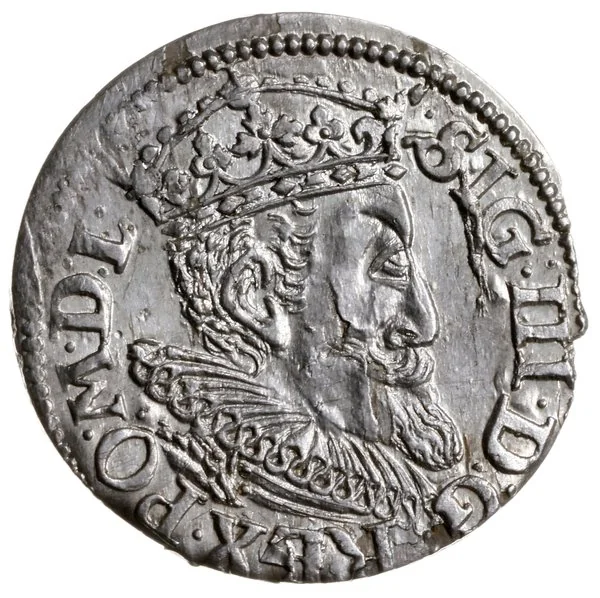
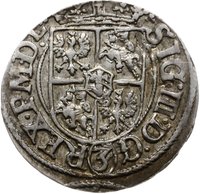
Obverse
Description:
Right-facing crowned bust with long, rounded beard, encircled by legend.
Inscription:
SIG : III : D : G : REX : PO : M : D : L ·
Script: Latin
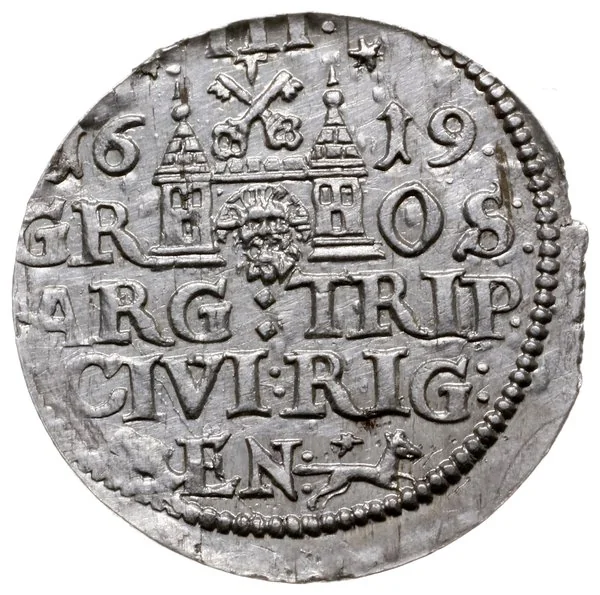
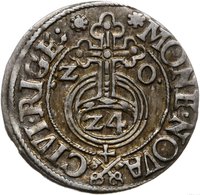
Reverse
Description:
Castle beneath crossed keys, encircled by stacked text.
Inscription:
III
16 - 19
GR - OS
ARG : TRIP
CIVI : RIG
EN
16 - 19
GR - OS
ARG : TRIP
CIVI : RIG
EN
Script: Latin
Edge
Plain
Categories
| Building> Castle or fortification |
Mints
| Name | Mark |
|---|---|
| Riga | — |
Mintings
| Year | Mint Mark | Mintage | Quality | Collection |
|---|---|---|---|---|
| 1619 | — | — |
Historical background
In 1619, the Duchy of Livonia, a territory contested between Sweden and the Polish-Lithish Commonwealth, existed in a state of monetary chaos and transition. Officially under Polish suzerainty since the 1561 Treaty of Vilnius, the duchy was a battleground in the ongoing Polish-Swedish wars, with Sweden controlling key areas like Riga. This political fragmentation directly caused a complex and unstable currency situation, where multiple coinages circulated simultaneously without a unified standard. The Polish king's official mint in Riga (operating intermittently due to war) produced Polish-Lithuanian coins like grosze and talars, while Swedish occupation zones saw the influx of Swedish öre and dalers. Furthermore, a vast amount of older, often debased, regional coinage and foreign currencies from trade, particularly German Reichstalers and Dutch leeuwendaalders, remained in daily use, creating a bewildering marketplace for merchants and peasants alike.
The core of the problem was severe currency debasement. To finance the constant warfare, both Polish and Swedish authorities, as well as previous local rulers, had frequently reduced the silver content in their minted coins. This practice led to rampant inflation, a loss of public trust in coinage, and the phenomenon of "good" full-weight coins being hoarded or exported while "bad" debased coins flooded local transactions. The value of a coin was often determined by its weight and actual metal content rather than its face value, requiring money-changers and merchants to assess each piece individually, stifling commerce and creating widespread economic uncertainty.
Consequently, the year 1619 fell within a period where the Duchy of Livonia lacked a sovereign, stable monetary system. It was a fractured economic zone characterized by competing currencies, inflationary pressure from war finance, and the practical use of a hybrid of old and new, foreign and domestic, sound and debased metal. This instability would only begin to resolve later in the century when Swedish hegemony was solidified, allowing for the imposition of a more uniform monetary standard across the entire Baltic region.
The core of the problem was severe currency debasement. To finance the constant warfare, both Polish and Swedish authorities, as well as previous local rulers, had frequently reduced the silver content in their minted coins. This practice led to rampant inflation, a loss of public trust in coinage, and the phenomenon of "good" full-weight coins being hoarded or exported while "bad" debased coins flooded local transactions. The value of a coin was often determined by its weight and actual metal content rather than its face value, requiring money-changers and merchants to assess each piece individually, stifling commerce and creating widespread economic uncertainty.
Consequently, the year 1619 fell within a period where the Duchy of Livonia lacked a sovereign, stable monetary system. It was a fractured economic zone characterized by competing currencies, inflationary pressure from war finance, and the practical use of a hybrid of old and new, foreign and domestic, sound and debased metal. This instability would only begin to resolve later in the century when Swedish hegemony was solidified, allowing for the imposition of a more uniform monetary standard across the entire Baltic region.
✨ Legendary