

1.5 Grossus – Duchy of Livonia
Context
Years: 1616–1617
Country: Livonia
Issuer: Duchy of Livonia
Ruler: Sigismund III Vasa
Currency:
(1581—1629)
Subdivision: 1.5 Grossus = 1⁄24 Thaler
Demonetized: Yes
References
KM: #Click to copy to clipboard7
Numista: #78800
Obverse
Description:
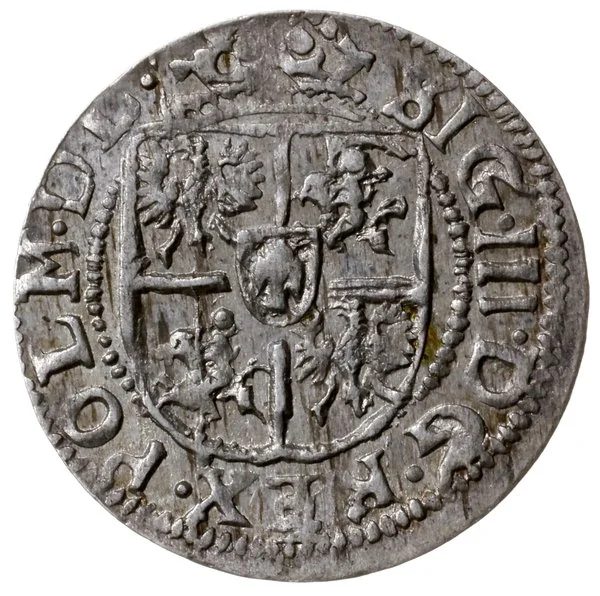
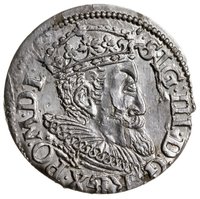
Quartered shield with crown, encircled by inscription.
Inscription:
SIG · III · DG · REX · POL · M · D · L ·
Script: Latin
Reverse
Description:
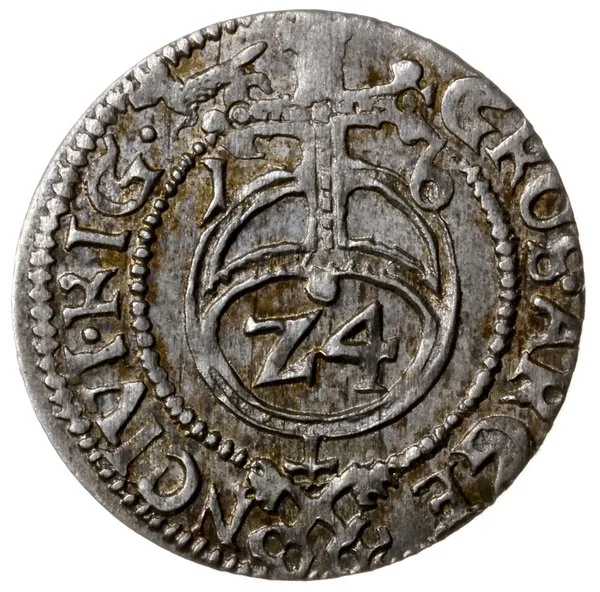
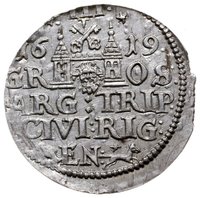
Crossed keys and date flank a crossed orb, encircled by a legend.
Inscription:
GROS · ARGE - N · CIVI · RIG ·
1 - 6
Z4
1 - 6
Z4
Script: Latin
Edge
Plain
Mints
| Name | Mark |
|---|---|
| Riga | — |
Mintings
| Year | Mint Mark | Mintage | Quality | Collection |
|---|---|---|---|---|
| 1616 | — | — | ||
| 1617 | — | — |
Historical background
In 1616, the Duchy of Livonia, a territory contested between Sweden and the Polish-Lithish Commonwealth, existed in a state of monetary chaos and transition. Officially under Polish suzerainty since the 1561 Treaty of Vilnius, the Duchy’s economy was strained by the ongoing Polish-Swedish wars, which frequently swept across its lands. The circulating currency was a complex and debased mixture, primarily consisting of low-quality Polish szelągs (shillings) and trojak (three-groschen) coins, alongside older issues from the Livonian Order period and a flood of inferior Swedish coinage from occupied areas. This created a climate of uncertainty where the intrinsic metal value of coins was often higher than their nominal worth, leading to hoarding and rampant inflation.
The monetary situation was further destabilized by the autonomous minting rights granted to the Duchy. The mint in Riga, the region's economic hub, periodically struck its own coins, but these issues were often sporadic and insufficient to establish a stable standard. More damagingly, various provincial mints and even private individuals engaged in the widespread production of counterfeit and clipped coins, exacerbating the debasement. This "bad money" increasingly drove out the remaining "good money," crippling legitimate trade and tax collection, as both merchants and the ducal administration struggled to assign reliable value to payments.
Consequently, by 1616, the Duchy of Livonia lacked a unified, trusted currency. Economic life relied on a cumbersome system of weighing coins and constant negotiation over exchange rates, severely hindering commerce. The situation reflected the broader political fragility of the Duchy, caught between two warring powers, with neither able to impose lasting monetary order. This instability would only begin to resolve later in the century when Swedish conquest solidified control and implemented their own monetary system across the Baltic provinces.
The monetary situation was further destabilized by the autonomous minting rights granted to the Duchy. The mint in Riga, the region's economic hub, periodically struck its own coins, but these issues were often sporadic and insufficient to establish a stable standard. More damagingly, various provincial mints and even private individuals engaged in the widespread production of counterfeit and clipped coins, exacerbating the debasement. This "bad money" increasingly drove out the remaining "good money," crippling legitimate trade and tax collection, as both merchants and the ducal administration struggled to assign reliable value to payments.
Consequently, by 1616, the Duchy of Livonia lacked a unified, trusted currency. Economic life relied on a cumbersome system of weighing coins and constant negotiation over exchange rates, severely hindering commerce. The situation reflected the broader political fragility of the Duchy, caught between two warring powers, with neither able to impose lasting monetary order. This instability would only begin to resolve later in the century when Swedish conquest solidified control and implemented their own monetary system across the Baltic provinces.
✨ Legendary