

3 Polker – Duchy of Livonia
Context
Years: 1620–1624
Country: Livonia
Issuer: Duchy of Livonia
Ruler: Sigismund III Vasa
Currency:
(1581—1629)
Subdivision: 3 Polker = 1⁄24 Thaler
Demonetized: Yes
References
KM: #Click to copy to clipboard8
Numista: #86400
Obverse
Description:
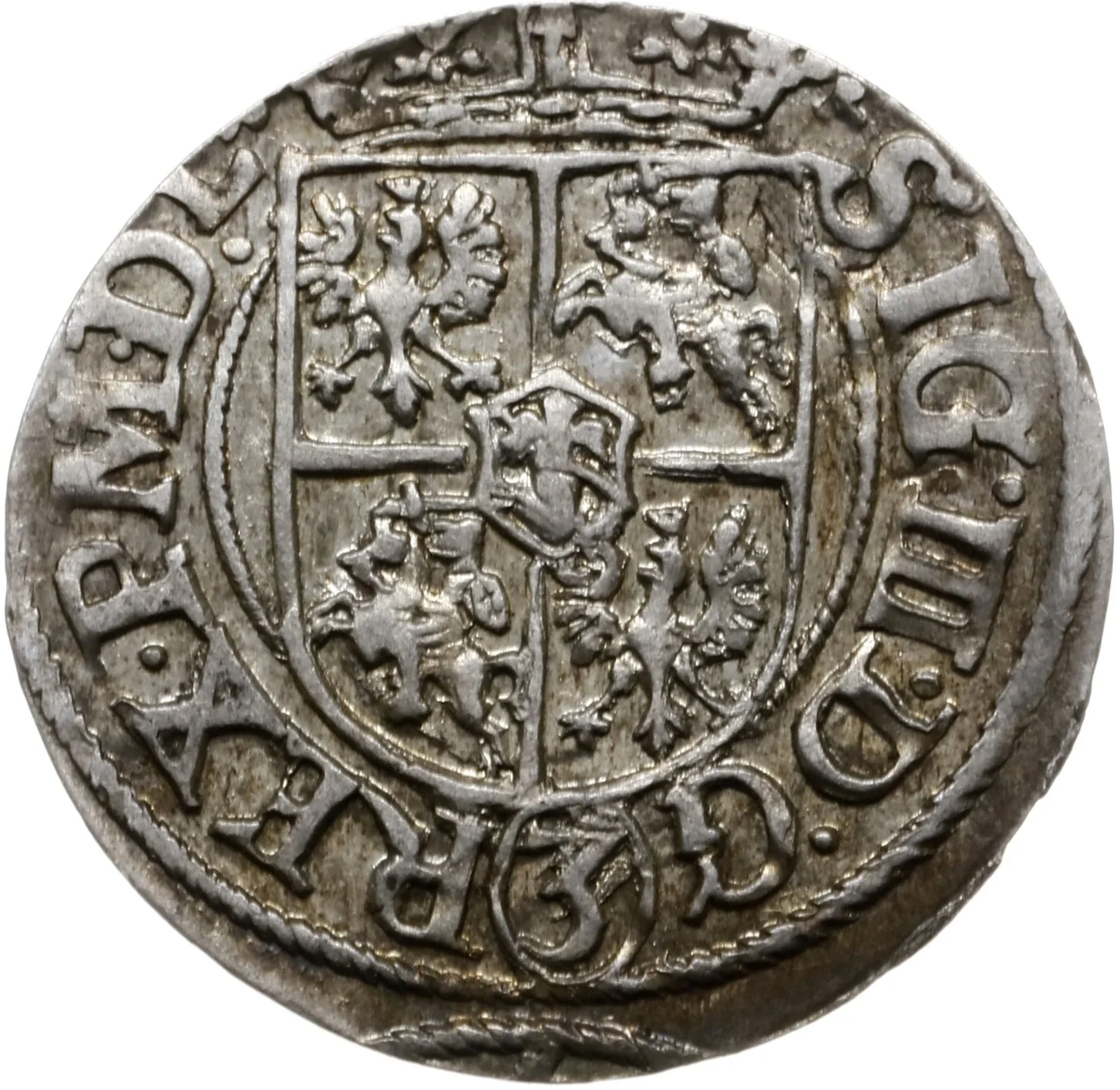
Quartered shield with crown, encircled by inscription.
Inscription:
SIG : III · D : G · REX · P · M · D · L ·
3
3
Script: Latin
Reverse
Description:
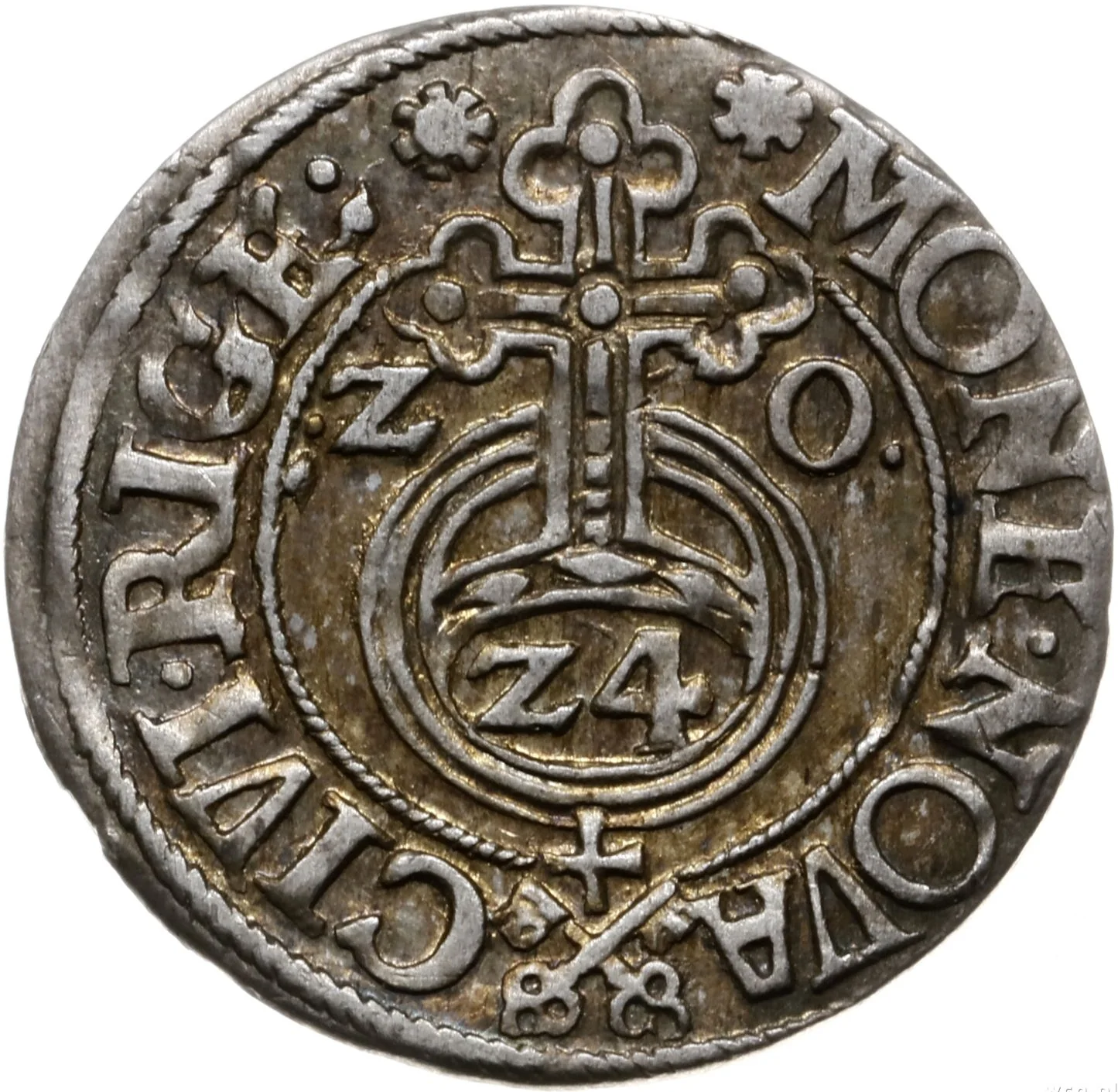
Cross on orb with value, symbol, and date, encircled by legend.
Inscription:
MONE · NOVA · CIVI · RIGE :
Z - 0
Z4
Z - 0
Z4
Script: Latin
Edge
Plain
Mints
| Name | Mark |
|---|---|
| Riga | — |
Mintings
| Year | Mint Mark | Mintage | Quality | Collection |
|---|---|---|---|---|
| 1620 | — | — | ||
| 1624 | — | — | BU |
Historical background
In 1620, the Duchy of Livonia, a territory contested between Sweden and the Polish-Lithuanian Commonwealth, existed in a state of monetary chaos and transition. Officially under Polish suzerainty since the 1561 Treaty of Vilnius, the region was a battleground in the ongoing Polish-Swedish War (1600–1629). By 1620, Swedish forces under King Gustavus Adolphus had captured Riga and were consolidating control over much of the duchy, though Polish claims and influence remained. This political duality created a complex monetary landscape where multiple currencies circulated without a unified standard.
The circulating medium was a confusing mixture of physical coinage and accounting units. In practice, the most important currency was the Polish-Lithuanian Commonwealth's monetary system, centered on the złoty (gulden) and the grosz. However, a vast array of foreign coins also circulated freely, including Swedish riksdalers, German thalers, Dutch ducats, and Russian kopecks, all valued by their precious metal content rather than a central authority. Furthermore, the "Riga Mark" persisted as a key accounting unit for large transactions and trade, a legacy of the region's Hanseatic past, though it was no longer minted as a physical coin.
This situation led to significant economic difficulties. Chronic currency shortages were exacerbated by the hoarding of full-weight silver coins, while debased and clipped coins flooded the market. Merchants and authorities faced constant challenges with exchange rates and valuations, hindering trade and tax collection. The Swedish occupation from 1621 onward would soon attempt to impose order by introducing a new monetary system based on the Swedish riksdaler, but in 1620, the Duchy of Livonia remained a zone of monetary fragmentation, reflecting its precarious and contested political status.
The circulating medium was a confusing mixture of physical coinage and accounting units. In practice, the most important currency was the Polish-Lithuanian Commonwealth's monetary system, centered on the złoty (gulden) and the grosz. However, a vast array of foreign coins also circulated freely, including Swedish riksdalers, German thalers, Dutch ducats, and Russian kopecks, all valued by their precious metal content rather than a central authority. Furthermore, the "Riga Mark" persisted as a key accounting unit for large transactions and trade, a legacy of the region's Hanseatic past, though it was no longer minted as a physical coin.
This situation led to significant economic difficulties. Chronic currency shortages were exacerbated by the hoarding of full-weight silver coins, while debased and clipped coins flooded the market. Merchants and authorities faced constant challenges with exchange rates and valuations, hindering trade and tax collection. The Swedish occupation from 1621 onward would soon attempt to impose order by introducing a new monetary system based on the Swedish riksdaler, but in 1620, the Duchy of Livonia remained a zone of monetary fragmentation, reflecting its precarious and contested political status.
⭐ Rare