


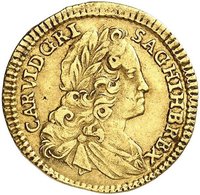
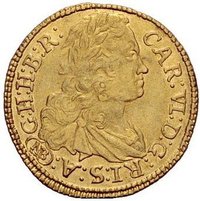
Obverse
Description:
Laureate bust right, inscription above starting at top. Reverse with mintmark, no pearl circle.
Inscription:
CAR : VI : D : G : R : I : S : A : GE : HI : HV : B : REX :
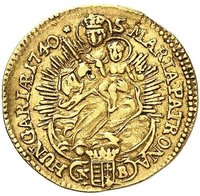
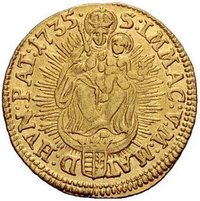
Reverse
Description:
Radiant crowned Madonna holding scepter and seated child on a crescent above a crowned Hungarian shield. Mintmark N B. Date within inscription.
Inscription:
S : IMMAC : VIRG : M : MAT : D : P : HU : 1736
Edge
Plain
Mints
| Name | Mark |
|---|---|
| Baia Mare | NB |
Mintings
| Year | Mint Mark | Mintage | Quality | Collection |
|---|---|---|---|---|
| 1736 | N-B | — |
Historical background
In 1736, the currency situation in the Kingdom of Hungary, then part of the Habsburg Monarchy, was characterized by a complex and unstable bimetallic system. The official currency was based on the silver guilder (or forint), but the economy also relied heavily on gold ducats for larger transactions. However, the monarchy was grappling with a chronic shortage of precious metals, leading to a proliferation of debased and counterfeit coins circulating alongside official mintings. This created significant confusion in trade, as the value of coins was often determined by their actual metal content rather than their face value.
The root of the instability lay in the state's fiscal policies, particularly the costs of ongoing wars and the lavish court in Vienna. To finance these expenditures, the Habsburg authorities frequently reduced the silver content in minted coins, a practice known as debasement. This led to the phenomenon of "good money" (older, purer coins) being hoarded or melted down, while "bad money" (newer, debased coins) flooded the market, in accordance with Gresham's Law. The situation was exacerbated by the influx of lower-quality coins from neighboring regions and the Ottoman Empire, further undermining trust in the currency.
Consequently, prices and exchange rates were highly volatile, hindering commerce and creating economic uncertainty. While attempts at monetary reform were discussed, substantive change would not come until the reign of Maria Theresa, with the standardized Conventionsthaler system introduced in the 1750s. Therefore, in 1736, Hungary's currency landscape was one of transition and disorder, reflecting the broader fiscal strains of the Habsburg state before the era of more centralized monetary control.
The root of the instability lay in the state's fiscal policies, particularly the costs of ongoing wars and the lavish court in Vienna. To finance these expenditures, the Habsburg authorities frequently reduced the silver content in minted coins, a practice known as debasement. This led to the phenomenon of "good money" (older, purer coins) being hoarded or melted down, while "bad money" (newer, debased coins) flooded the market, in accordance with Gresham's Law. The situation was exacerbated by the influx of lower-quality coins from neighboring regions and the Ottoman Empire, further undermining trust in the currency.
Consequently, prices and exchange rates were highly volatile, hindering commerce and creating economic uncertainty. While attempts at monetary reform were discussed, substantive change would not come until the reign of Maria Theresa, with the standardized Conventionsthaler system introduced in the 1750s. Therefore, in 1736, Hungary's currency landscape was one of transition and disorder, reflecting the broader fiscal strains of the Habsburg state before the era of more centralized monetary control.

✨ Legendary