

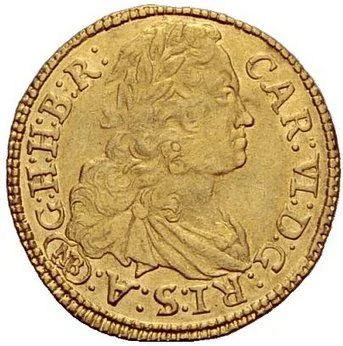

Obverse
Description:
Laureate bust right, breaking top inscription. Mintmark in framed shoulder. No pearl circle.
Inscription:
CAR : VI : D : G : R : I : S : A : (NB) G : H : H : B : R :
Script: Latin
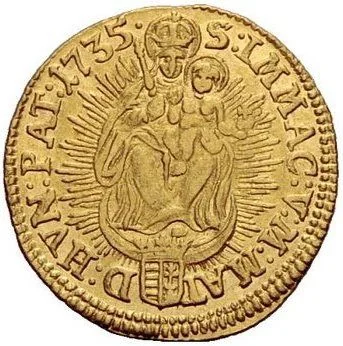
Reverse
Description:
Radiant crowned Madonna, holding a scepter and seated on a crescent moon with the Child on her left arm. A double-crowned Hungarian shield is below, with the date in the inscription.
Inscription:
S · IMMAC · V · MAR · MAT · D· P · H · 17 35 ·
Script: Latin
Edge
Plain
Mints
| Name | Mark |
|---|---|
| Baia Mare | NB |
Mintings
| Year | Mint Mark | Mintage | Quality | Collection |
|---|---|---|---|---|
| 1735 | N-B | — |
Historical background
In 1735, the currency situation in the Kingdom of Hungary, then part of the Habsburg Monarchy, was characterized by instability and a complex, multi-layered monetary system. The primary unit was the silver forint (florin), but the everyday economy relied heavily on copper and silver krajcár (kreuzer), with 60 krajcár to one forint. However, the value and metal content of these coins were not stable. The monarchy frequently debased the coinage—reducing the precious metal content—to finance its ongoing military campaigns, particularly against the Ottoman Empire. This practice, alongside a chronic shortage of small change, created significant confusion and hindered trade.
The monetary landscape was further complicated by the circulation of older, higher-value "good money" alongside newer, debased coinage, leading to Gresham's Law in action where "bad money drives out good." People hoarded older, full-weight silver coins, removing them from circulation and worsening the scarcity of reliable currency. Additionally, various regional and foreign coins, including Turkish akçe and thalers from German states, circulated at fluctuating exchange rates, making transactions a daily exercise in calculation and trust.
This chaotic environment placed a heavy burden on the peasantry and smaller merchants, who bore the brunt of the inflation and uncertainty. While the Habsburg authorities in Vienna issued decrees to regulate exchange rates, their effectiveness was limited on the ground. The situation reflected Hungary's integrated yet subordinate position within the Habsburg fiscal-military state, where monetary policy was dictated by the crown's central needs, often at the expense of local economic stability, a tension that would persist for decades.
The monetary landscape was further complicated by the circulation of older, higher-value "good money" alongside newer, debased coinage, leading to Gresham's Law in action where "bad money drives out good." People hoarded older, full-weight silver coins, removing them from circulation and worsening the scarcity of reliable currency. Additionally, various regional and foreign coins, including Turkish akçe and thalers from German states, circulated at fluctuating exchange rates, making transactions a daily exercise in calculation and trust.
This chaotic environment placed a heavy burden on the peasantry and smaller merchants, who bore the brunt of the inflation and uncertainty. While the Habsburg authorities in Vienna issued decrees to regulate exchange rates, their effectiveness was limited on the ground. The situation reflected Hungary's integrated yet subordinate position within the Habsburg fiscal-military state, where monetary policy was dictated by the crown's central needs, often at the expense of local economic stability, a tension that would persist for decades.

✨ Legendary