

1 rupee – Mughal Empire
Add to wishlist
India
Context
Years: 1761–1765
Country: India
Issuer: Mughal Empire
Ruler: Shah Alam II
Currency:
(1540—1842)
Demonetized: Yes
Material
References
KM: #
Numista: #77353
Value
Bullion value: $28.72
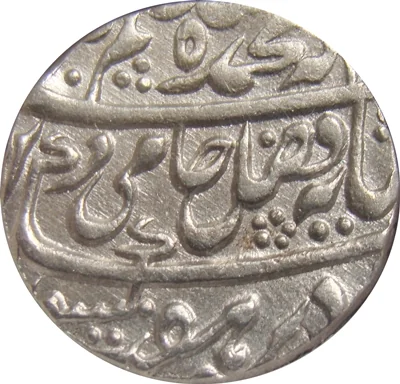
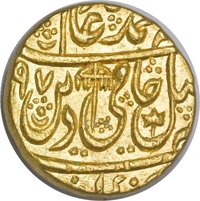
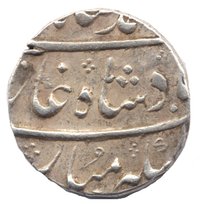
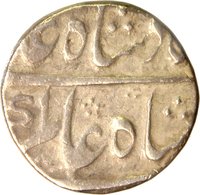
Obverse
Description:
Inscribed.
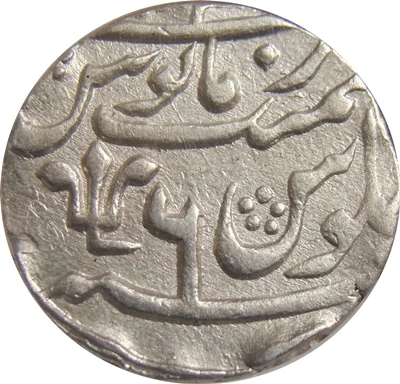
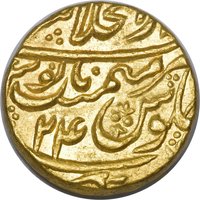
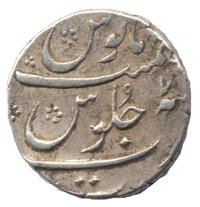
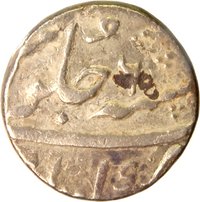
Reverse
Description:
Inscription. Trident mint.
Edge
Mints
| Name | Mark |
|---|---|
| Azimabad | — |
Mintings
| Year | Mint Mark | Mintage | Quality | Collection |
|---|---|---|---|---|
| 1761 | — | — | ||
| 1762 | — | — | ||
| 1763 | — | — | ||
| 1764 | — | — | ||
| 1765 | — | — |
Historical background
By 1761, the Mughal Empire's currency system, once a pillar of its administrative and economic strength, was in a state of severe strain and fragmentation. The imperial silver rupee, standardized under Akbar, remained the nominal standard, but its authority was rapidly eroding. Decades of political instability, palace coups, and foreign invasions (notably Nadir Shah's sack of Delhi in 1739) had drastically depleted the central treasury's reserves of precious metals. This scarcity of bullion at the core directly constrained the Mughal mints' ability to produce currency in sufficient volume and guaranteed purity, leading to a shortage of reliable coinage in the wider economy.
The vacuum of central monetary authority was being filled by regional powers. Key successor states like Bengal, Awadh, and Hyderabad, along with the rising Maratha Confederacy, increasingly struck their own rupees, often imitating Mughal designs but with local control over minting. Furthermore, European trading companies, particularly the English East India Company, were gaining significant economic influence. Their gold mohurs and silver rupees, minted at their own factories (like in Calcutta and Madras), circulated widely, creating parallel currency zones. This period thus saw a shift from a unified imperial currency to a competitive and fragmented monetary landscape where the prestige of a coin depended more on the credibility of its issuing authority than the fading name of the Mughal emperor.
The critical year of 1761 itself, marked by the Third Battle of Panipat, accelerated this financial decline. The catastrophic defeat of the Maratha army, a major regional power that still nominally acknowledged Mughal suzerainty, further destabilized North India. While the Mughal emperor Shah Alam II was left with even less real power, the battle did not immediately resolve the currency crisis. Instead, it deepened the political chaos, encouraging further localization of minting and trade. Consequently, the currency situation reflected the empire's political reality: the Mughal rupee remained a familiar unit of account, but its production and guarantee were no longer under imperial control, paving the way for the eventual monetary dominance of the East India Company in the decades to follow.
The vacuum of central monetary authority was being filled by regional powers. Key successor states like Bengal, Awadh, and Hyderabad, along with the rising Maratha Confederacy, increasingly struck their own rupees, often imitating Mughal designs but with local control over minting. Furthermore, European trading companies, particularly the English East India Company, were gaining significant economic influence. Their gold mohurs and silver rupees, minted at their own factories (like in Calcutta and Madras), circulated widely, creating parallel currency zones. This period thus saw a shift from a unified imperial currency to a competitive and fragmented monetary landscape where the prestige of a coin depended more on the credibility of its issuing authority than the fading name of the Mughal emperor.
The critical year of 1761 itself, marked by the Third Battle of Panipat, accelerated this financial decline. The catastrophic defeat of the Maratha army, a major regional power that still nominally acknowledged Mughal suzerainty, further destabilized North India. While the Mughal emperor Shah Alam II was left with even less real power, the battle did not immediately resolve the currency crisis. Instead, it deepened the political chaos, encouraging further localization of minting and trade. Consequently, the currency situation reflected the empire's political reality: the Mughal rupee remained a familiar unit of account, but its production and guarantee were no longer under imperial control, paving the way for the eventual monetary dominance of the East India Company in the decades to follow.
✨ Legendary