Logo Title
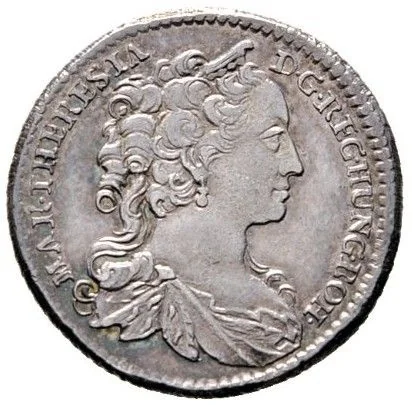
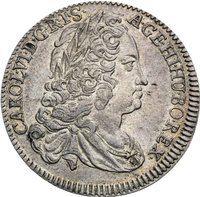
obverse
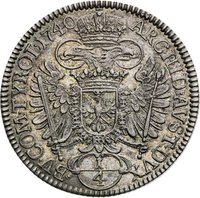
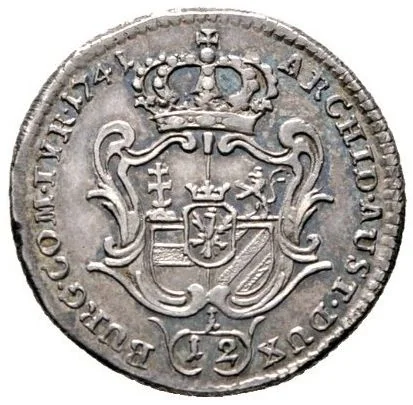
reverse
H. D. Rauch
Austria
Context
Year: 1741
Country: Austria Country flag
Currency:
Demonetized: Yes
Material
Weight: 2.4 g
Shape: Round
Composition: Billon (43.7% Silver)
References
KM: #Click to copy to clipboard1675
Numista: #77337

Obverse

Description:
Young Maria Theresia portrait, legend around (starts at 7 o'clock).
Inscription:
MAR THERESIA D G REG HUNG BOH
Script: Latin

Reverse

Description:
Four-fold shield with Hungarian, Bohemian, Austrian, and Burgundian arms, Tyrol at center. Value below, legend around.
Inscription:
ARCHID AUST DUX BURG COM TYR 1741
Script: Latin

Edge
Mints

NameMark
Hall

Mintings

YearMint MarkMintageQualityCollection
1741

Historical background

In 1741, the County of Tyrol, a crown land of the Habsburg Monarchy, operated within a complex and fragmented monetary landscape typical of the Holy Roman Empire. The region did not have a uniform, exclusive currency but instead circulated a multitude of coins from various issuing authorities. These included Habsburg Konventionsmünzen (convention coins) from Austria, silver Thalers from German states, and a persistent circulation of older, debased coins. This proliferation created constant challenges for trade, as the value of coins depended on their metal content, origin, and wear, requiring frequent official valuation lists (Münzpatente) to set exchange rates.

The monetary situation was further strained by the ongoing War of the Austrian Succession (1740-1748), which began the previous year. The war placed immense financial pressure on Vienna, leading to inflationary practices such as the reduction of silver content in coins to fund military campaigns. While the formal Conventionsfuß (monetary standard) of 20 Gulden from a Cologne mark of silver, established in the 1730s, provided a theoretical benchmark, wartime exigencies often undermined it. Tyrol, as a strategic Alpine territory, felt these economic pressures directly, with the risk of currency devaluation and an influx of even poorer-quality coins from neighboring conflict zones.

Locally, Tyrol's economy was underpinned by its silver mines, particularly at Schwaz, which historically gave the land significant monetary influence. However, by 1741, output had declined from its peak, reducing Tyrol's direct role as a major bullion supplier for the Habsburg minting apparatus. The county’s authorities thus grappled with balancing imperial fiscal demands with the need for reliable medium of exchange for local commerce and toll transactions across its crucial mountain passes. The monetary environment was one of uncertainty, characterized by the coexistence of official standards, wartime debasement, and a daily reality of heterogeneous coinage that complicated every transaction.
Legendary