

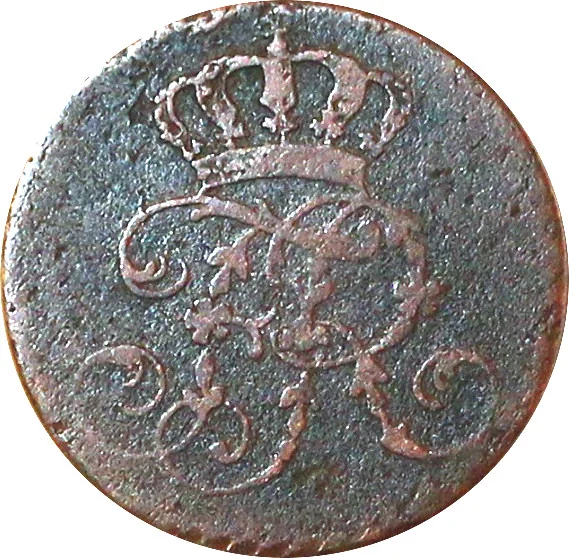
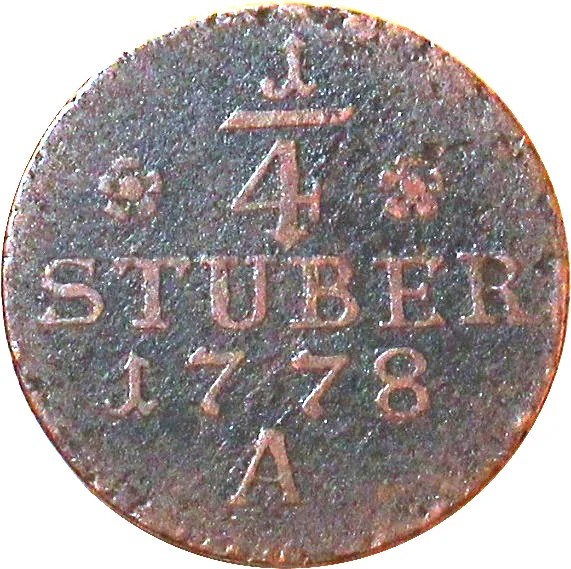
¼ stüber – East Frisia
Add to wishlist
Germany
Context
Years: 1777–1784
Country: Germany
Issuer: East Frisia
Ruler: Frederick II
Currency:
Demonetized: Yes
Total mintage: 670,000
Material
References
KM: #
Numista: #75301
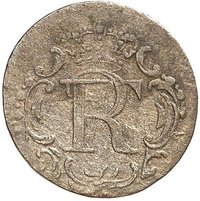
Obverse
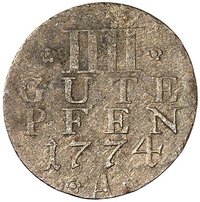
Reverse
Edge
Mints
| Name | Mark |
|---|---|
| Aurich | A |
Historical background
In 1777, East Frisia existed in a complex and fragmented monetary landscape, a direct consequence of its political status. The region was not an independent sovereign state but a Prussian province, having been annexed by Frederick the Great in 1744. However, the legal and monetary transition was incomplete. While Prussian authority was established, older monetary systems from the prior era—particularly those tied to the Holy Roman Empire and the neighboring Dutch Republic—remained deeply embedded in daily commerce and regional identity.
Consequently, multiple currencies circulated simultaneously, creating a practical challenge for trade and administration. The official Prussian Reichsthaler was mandated for state payments and larger transactions, yet the older Emder Courant thaler, pegged to the stable Dutch guilder, remained the preferred unit of account for much local business and banking. Alongside these, a plethora of smaller regional and foreign coins, including Dutch ducats and various German Groschen, facilitated everyday market exchanges. This multiplicity required constant calculation and exchange, often leading to confusion and arbitrage.
The situation was further complicated by East Frisia’s enduring economic ties to the Netherlands. The province’s trade, especially through the port of Emden, was heavily oriented westward, making the stable Dutch currency a natural benchmark. Thus, in 1777, East Frisians navigated a dual monetary reality: the top-down imposition of Prussian fiscal control symbolized by the Reichsthaler, and the bottom-up persistence of a North Sea trade currency, the Courant, which reflected the region's enduring commercial and cultural links beyond its new political borders.
Consequently, multiple currencies circulated simultaneously, creating a practical challenge for trade and administration. The official Prussian Reichsthaler was mandated for state payments and larger transactions, yet the older Emder Courant thaler, pegged to the stable Dutch guilder, remained the preferred unit of account for much local business and banking. Alongside these, a plethora of smaller regional and foreign coins, including Dutch ducats and various German Groschen, facilitated everyday market exchanges. This multiplicity required constant calculation and exchange, often leading to confusion and arbitrage.
The situation was further complicated by East Frisia’s enduring economic ties to the Netherlands. The province’s trade, especially through the port of Emden, was heavily oriented westward, making the stable Dutch currency a natural benchmark. Thus, in 1777, East Frisians navigated a dual monetary reality: the top-down imposition of Prussian fiscal control symbolized by the Reichsthaler, and the bottom-up persistence of a North Sea trade currency, the Courant, which reflected the region's enduring commercial and cultural links beyond its new political borders.
💎 Extremely Rare