

½ stüber – East Frisia
Add to wishlist
Germany
Context
Years: 1781–1782
Country: Germany
Issuer: East Frisia
Ruler: Frederick II
Currency:
Demonetized: Yes
Total mintage: 54,000
Material
References
KM: #
Numista: #315419
Obverse
Description:
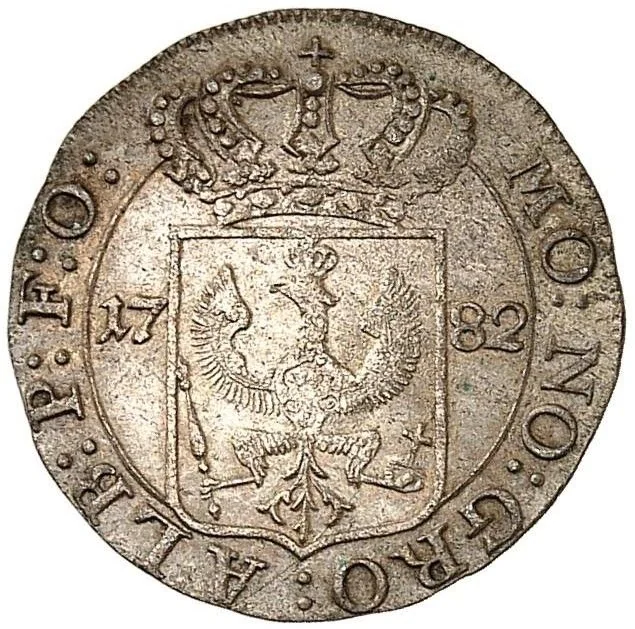
Crowned arms flank date within inner circle.
Inscription:
MO NO GRO ALB P F O
1782
1782
Script: Latin
Reverse
Edge
Mints
| Name | Mark |
|---|---|
| Berlin | — |
Mintings
| Year | Mint Mark | Mintage | Quality | Collection |
|---|---|---|---|---|
| 1781 | — | 54,000 | ||
| 1782 | — | — |
Historical background
In 1781, East Frisia existed in a complex and fragmented monetary landscape, a direct consequence of its political status. The region was not an independent sovereign state but a Prussian province, having been annexed by the Kingdom of Prussia in 1744. Despite this political integration, East Frisia retained significant local administrative peculiarities, and its currency system reflected a transitional period where old regional traditions coexisted with the imposing framework of the Prussian state.
The official currency was the Prussian Thaler, divided into 24 Groschen, each of 12 Pfennige. However, in daily commerce, older and more familiar local units like the Emder Gulden and Emder Thaler remained in widespread parallel circulation, their values fixed against the Prussian standard at official exchange rates. Furthermore, due to East Frisia's historic trade links across the North Sea and with neighboring German territories, a multitude of foreign coins—particularly Dutch Ducats and Guilders, but also coins from Hamburg and other Hanseatic cities—were commonly used, especially for larger mercantile transactions.
This multiplicity of coins created practical challenges. Merchants and citizens had to constantly be aware of fluctuating exchange values and the varying silver content of coins, leading to confusion and potential for fraud. While Prussian authorities sought to standardize the monetary system, the process was gradual. Thus, in 1781, an East Frisian merchant or farmer would have handled a jumble of coins, navigating a semi-integrated currency zone that was slowly being absorbed into the Prussian economic sphere but remained distinctly local in its everyday financial practices.
The official currency was the Prussian Thaler, divided into 24 Groschen, each of 12 Pfennige. However, in daily commerce, older and more familiar local units like the Emder Gulden and Emder Thaler remained in widespread parallel circulation, their values fixed against the Prussian standard at official exchange rates. Furthermore, due to East Frisia's historic trade links across the North Sea and with neighboring German territories, a multitude of foreign coins—particularly Dutch Ducats and Guilders, but also coins from Hamburg and other Hanseatic cities—were commonly used, especially for larger mercantile transactions.
This multiplicity of coins created practical challenges. Merchants and citizens had to constantly be aware of fluctuating exchange values and the varying silver content of coins, leading to confusion and potential for fraud. While Prussian authorities sought to standardize the monetary system, the process was gradual. Thus, in 1781, an East Frisian merchant or farmer would have handled a jumble of coins, navigating a semi-integrated currency zone that was slowly being absorbed into the Prussian economic sphere but remained distinctly local in its everyday financial practices.
✨ Legendary