

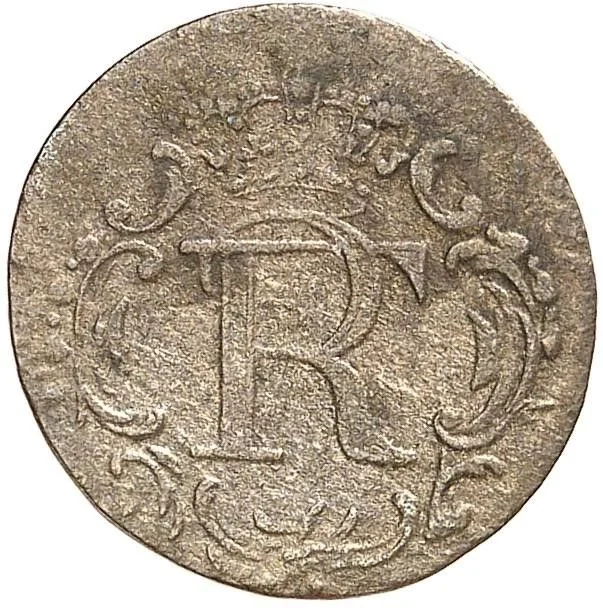
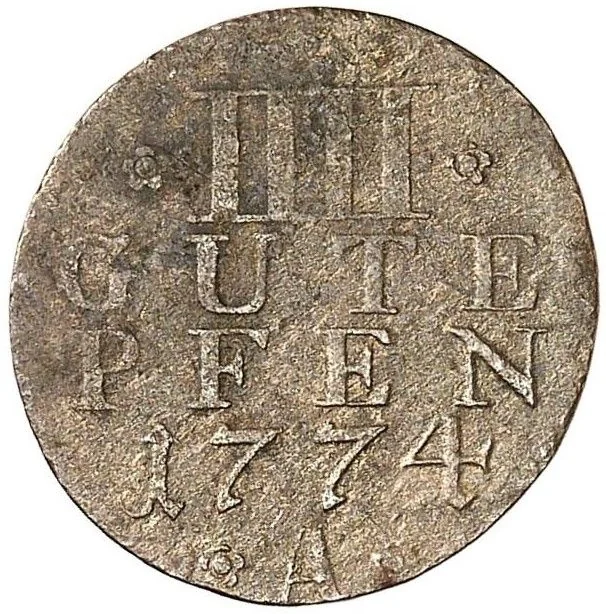
4 pfennigs – East Frisia
Add to wishlist
Germany
Context
Material
References
KM: #
Numista: #315428
Obverse
Reverse
Edge
Mints
| Name | Mark |
|---|---|
| Berlin | A |
Mintings
| Year | Mint Mark | Mintage | Quality | Collection |
|---|---|---|---|---|
| 1774 | A | — |
Historical background
In 1774, the currency situation in East Frisia was complex and fragmented, a direct legacy of its political history. The region was not a unified monetary zone but a patchwork of different circulating coins and units of account. While nominally under Prussian rule since 1744, East Frisia retained many of its old monetary systems. The most important local unit was the East Frisian Reichstaler, divided into 36 Grote, each of which was further divided into 5 Schwaren. However, this was primarily a money of account used for bookkeeping and contracts, not a single, universally minted coin.
In daily transactions, a bewildering variety of physical coins circulated. These included Dutch daalders and ducats, various German Reichstalers and Gulden from neighbouring states like Hanover and Münster, and smaller regional coins. The value of these coins relative to the East Frisian Reichstaler was set by official Kurantzettel (exchange rate bulletins), which were frequently updated. This created a constant need for money changers (Wechsler) and made commerce cumbersome, as merchants and farmers had to navigate fluctuating values between the coin in their hand and the unit in which prices were set.
This monetary fragmentation was a significant hindrance to trade and economic development. Prussian authorities recognized the problem and desired greater standardization to integrate East Frisia into the broader Prussian economic sphere. However, in 1774, comprehensive reform was still in the future. The situation thus remained one of managed confusion, where official rates tried to bring order to a marketplace saturated with diverse foreign and legacy coins, reflecting East Frisia’s position as a historical crossroads now under a new central authority.
In daily transactions, a bewildering variety of physical coins circulated. These included Dutch daalders and ducats, various German Reichstalers and Gulden from neighbouring states like Hanover and Münster, and smaller regional coins. The value of these coins relative to the East Frisian Reichstaler was set by official Kurantzettel (exchange rate bulletins), which were frequently updated. This created a constant need for money changers (Wechsler) and made commerce cumbersome, as merchants and farmers had to navigate fluctuating values between the coin in their hand and the unit in which prices were set.
This monetary fragmentation was a significant hindrance to trade and economic development. Prussian authorities recognized the problem and desired greater standardization to integrate East Frisia into the broader Prussian economic sphere. However, in 1774, comprehensive reform was still in the future. The situation thus remained one of managed confusion, where official rates tried to bring order to a marketplace saturated with diverse foreign and legacy coins, reflecting East Frisia’s position as a historical crossroads now under a new central authority.
✨ Legendary