

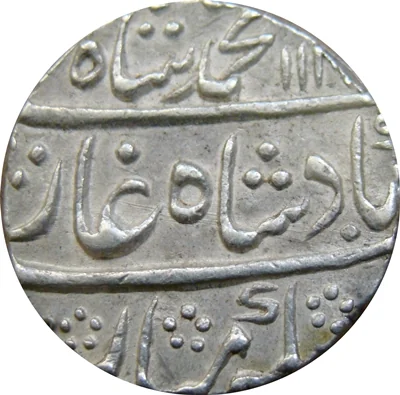
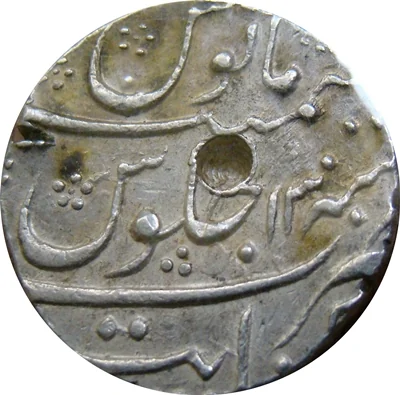
1 Rupee – Mughal Empire
India
Context
Years: 1131–1748
Country: India 
Issuer: Mughal Empire
Ruler: Muhammad Shah
Currency:
(1540—1842)
Demonetized: Yes
Material
Diameter: 24.04 mm
Weight: 11.55 g
Silver weight: 11.55 g
Shape: Irregular round
Composition: Silver
Magnetic: No
Technique: Hammered
References
KM: #Click to copy to clipboard436.34
Numista: #72917
Value
Bullion value: $32.83
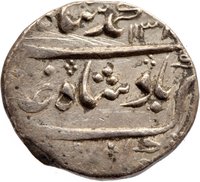
Obverse
Description:
KM# 436.34 Rupee. Mubarak Badshah Ghazi.
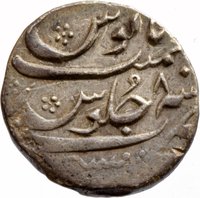
Reverse
Description:
Sana julus zerb
Edge
Mintings
| Year | Mint Mark | Mintage | Quality | Collection |
|---|---|---|---|---|
| — | — | — | ||
| 1719 | — | — | ||
| 1720 | — | — | ||
| 1721 | — | — | ||
| 1723 | — | — | ||
| 1725 | — | — | ||
| 1726 | — | — | ||
| 1731 | — | — | ||
| 1732 | — | — | ||
| 1733 | — | — | ||
| 1742 | — | — | ||
| 1746 | — | — | ||
| 1748 | — | — |
Historical background
The year 1131 AH (1718-1719 CE) in the Mughal Empire was a period of severe monetary instability and fiscal crisis, set against the backdrop of rapid political disintegration. Following the death of the last powerful emperor, Aurangzeb, in 1707, the central treasury had been drained by relentless wars of succession, rebellions (notably the Sikhs, Jats, and Marathas), and the crippling expenses of maintaining a vast, stagnant army. By 1719, the empire had witnessed the installation and deposition of multiple puppet emperors—Farrukhsiyar was overthrown and brutally murdered in 1719, and Rafi ud-Darajat and Rafi ud-Daulah reigned for mere months—leaving the state's finances under the control of competing noble factions, primarily the Sayyid brothers.
The currency system, once the robust and standardized foundation of the Mughal economy, was in severe decline. The primary silver coin, the rupee, saw widespread debasement. Regional governors and minting authorities, taking advantage of the weak centre, often issued coins with reduced silver content to fund their own armies and administrations. This led to a loss of public confidence in the currency, causing hoarding of older, purer coins (Gresham's Law in effect) and disrupting trade. Furthermore, the influx of New World silver into India via European trading companies, which had previously sustained the Mughal coinage, was now often diverted or captured by emerging regional powers like the Marathas, further straining the imperial mint's ability to produce high-quality currency.
Consequently, the monetary situation reflected the empire's political fragmentation. While the official rupee still circulated, its value and purity were inconsistent. In practice, regional currencies and even older coins from previous reigns became preferred in trade, creating a complex and inefficient monetary landscape. This fiscal anarchy severely hampered the central authority's ability to pay salaries, leading to further alienation of the nobility and military, and accelerating the empire's collapse into a collection of independent successor states, each of which would soon establish its own distinct currency system.
The currency system, once the robust and standardized foundation of the Mughal economy, was in severe decline. The primary silver coin, the rupee, saw widespread debasement. Regional governors and minting authorities, taking advantage of the weak centre, often issued coins with reduced silver content to fund their own armies and administrations. This led to a loss of public confidence in the currency, causing hoarding of older, purer coins (Gresham's Law in effect) and disrupting trade. Furthermore, the influx of New World silver into India via European trading companies, which had previously sustained the Mughal coinage, was now often diverted or captured by emerging regional powers like the Marathas, further straining the imperial mint's ability to produce high-quality currency.
Consequently, the monetary situation reflected the empire's political fragmentation. While the official rupee still circulated, its value and purity were inconsistent. In practice, regional currencies and even older coins from previous reigns became preferred in trade, creating a complex and inefficient monetary landscape. This fiscal anarchy severely hampered the central authority's ability to pay salaries, leading to further alienation of the nobility and military, and accelerating the empire's collapse into a collection of independent successor states, each of which would soon establish its own distinct currency system.
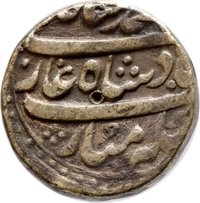
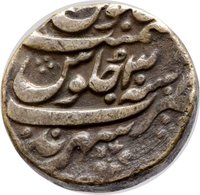
💎 Extremely Rare