

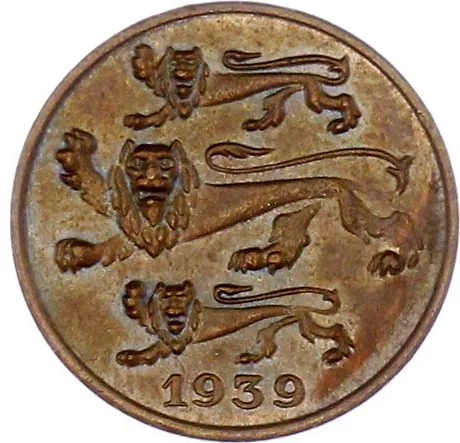
Obverse
Description:
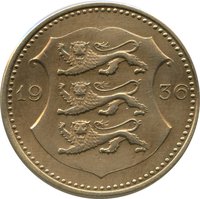
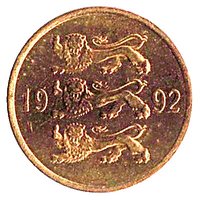
Three lions left, date below.
Inscription:
1939
Script: Latin
Engraver: Günther Reindorff
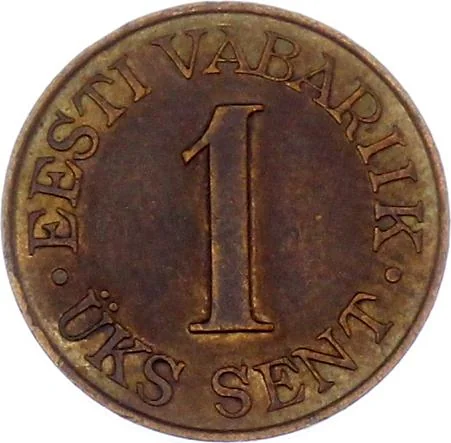
Reverse
Description:
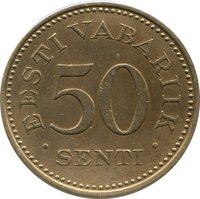
Denomination
Inscription:
EESTI VABARIIK
1
·ÜKS SENT·
1
·ÜKS SENT·
Translation:
REPUBLIC OF ESTONIA
1
·ONE SENT·
1
·ONE SENT·
Script: Latin
Language: Estonian
Engraver: Georg Vestenberg
Edge
Plain
Mintings
| Year | Mint Mark | Mintage | Quality | Collection |
|---|---|---|---|---|
| 1939 | — | 4,299,000 |
Historical background
In 1939, Estonia's currency, the kroon (EKR), was in a period of precarious stability, underpinned by the nation's hard-won economic independence. Introduced in 1928 to replace the mark, the kroon was established on the gold standard and pegged to the Swedish krona, a system managed by the conservative Bank of Estonia. This discipline had fostered trust, controlled inflation, and facilitated international trade, making the kroon a symbol of the young republic's sovereignty and prudent governance during the interwar period.
However, this stability existed under the growing shadow of geopolitical threat. The secret protocols of the Molotov-Ribbentrop Pact in August 1939 placed Estonia within the Soviet sphere of influence, immediately destabilizing the economic environment. While the kroon's formal peg and value nominally held, capital flight accelerated and economic uncertainty soared as the threat of Soviet annexation became palpable. The state attempted to maintain normalcy, but commerce and banking were severely disrupted by the looming political crisis.
The currency's fate was sealed with the Soviet ultimatum and subsequent military occupation in June 1940. The Soviet regime quickly moved to integrate Estonia's economy, initially allowing the kroon to circulate alongside the Soviet ruble at a forced, unfavorable exchange rate. By the end of the year, the kroon was formally demonetized and replaced entirely by the ruble, completing the monetary annexation. Thus, the Estonian kroon, a pillar of national independence, was abolished not by economic failure but by overwhelming external force, marking the end of an era.
However, this stability existed under the growing shadow of geopolitical threat. The secret protocols of the Molotov-Ribbentrop Pact in August 1939 placed Estonia within the Soviet sphere of influence, immediately destabilizing the economic environment. While the kroon's formal peg and value nominally held, capital flight accelerated and economic uncertainty soared as the threat of Soviet annexation became palpable. The state attempted to maintain normalcy, but commerce and banking were severely disrupted by the looming political crisis.
The currency's fate was sealed with the Soviet ultimatum and subsequent military occupation in June 1940. The Soviet regime quickly moved to integrate Estonia's economy, initially allowing the kroon to circulate alongside the Soviet ruble at a forced, unfavorable exchange rate. By the end of the year, the kroon was formally demonetized and replaced entirely by the ruble, completing the monetary annexation. Thus, the Estonian kroon, a pillar of national independence, was abolished not by economic failure but by overwhelming external force, marking the end of an era.
🌟 Uncommon