

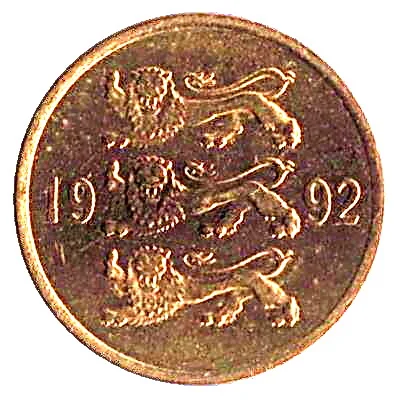
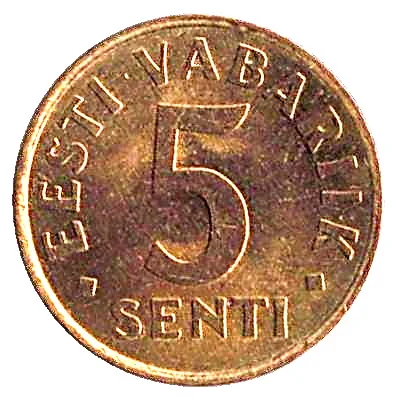
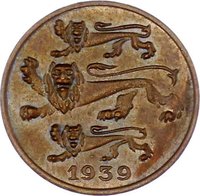
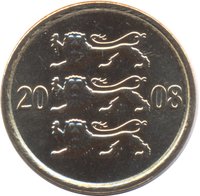
Obverse
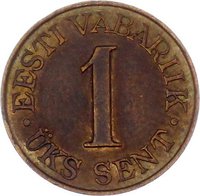
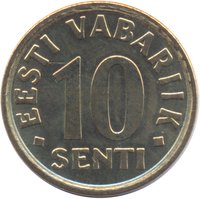
Reverse
Edge
Plain
Mints
| Name | Mark |
|---|---|
| RE Juveel / OÜ Juveliir / Riigiettevõte Juveel | — |
Mintings
| Year | Mint Mark | Mintage | Quality | Collection |
|---|---|---|---|---|
| 1991 | — | 38,790,000 | ||
| 1992 | — | — | ||
| 1995 | — | 5,000,000 |
Historical background
Following the dissolution of the Soviet Union in 1991, newly independent Estonia faced an immediate and severe monetary crisis. The country was still operating within the collapsing Soviet rouble zone, which was plagued by hyperinflation and chronic shortages, leading to a rapid erosion of savings and economic instability. Estonia's first crucial step was to establish its own monetary authority, the Bank of Estonia, in December 1991, tasked with the urgent mission of creating a stable and independent currency system to replace the Soviet rouble.
The government, led by Prime Minister Mart Laar and advised by young reformers, decisively rejected joining the Russian-led rouble zone and instead pursued a radical path toward a hard currency peg. Inspired by the ideas of economist Milton Friedman, the cornerstone of Estonia's strategy was the introduction of a new national currency, the kroon, which was to be introduced in mid-1992. Critically, it was designed to operate under a currency board arrangement, a strict system that mandated full foreign exchange backing and a fixed exchange rate pegged to the German Deutsche Mark.
This disciplined framework was revolutionary. It meant that every kroon in circulation would be backed by gold and foreign reserves, legally prohibiting the central bank from printing money to finance government deficits. The move was a powerful signal of commitment to financial stability and Western integration, effectively importing the credibility of the Bundesbank. The successful introduction of the kroon in June 1992 swiftly halted hyperinflation, restored confidence, and laid the foundational pillar for Estonia's subsequent "economic miracle" and rapid transition to a market economy.
The government, led by Prime Minister Mart Laar and advised by young reformers, decisively rejected joining the Russian-led rouble zone and instead pursued a radical path toward a hard currency peg. Inspired by the ideas of economist Milton Friedman, the cornerstone of Estonia's strategy was the introduction of a new national currency, the kroon, which was to be introduced in mid-1992. Critically, it was designed to operate under a currency board arrangement, a strict system that mandated full foreign exchange backing and a fixed exchange rate pegged to the German Deutsche Mark.
This disciplined framework was revolutionary. It meant that every kroon in circulation would be backed by gold and foreign reserves, legally prohibiting the central bank from printing money to finance government deficits. The move was a powerful signal of commitment to financial stability and Western integration, effectively importing the credibility of the Bundesbank. The successful introduction of the kroon in June 1992 swiftly halted hyperinflation, restored confidence, and laid the foundational pillar for Estonia's subsequent "economic miracle" and rapid transition to a market economy.
🌱 Very Common