

Obverse
Description:
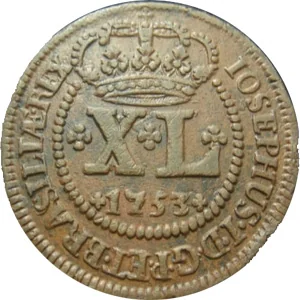
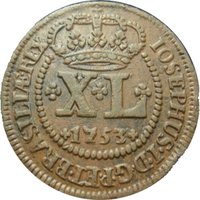
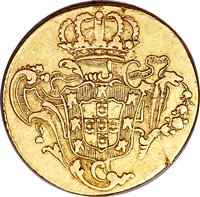
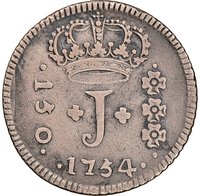
Pearl-circled crown over XL, flowers, and date.
Inscription:
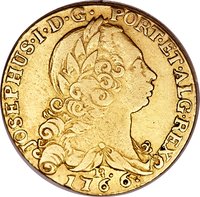
IOSEPHUS·I·D·G·P·ET·BRASILÆ·REX
*X*L*
·1753·
*X*L*
·1753·
Script: Latin
Reverse
Edge
Plain
Mints
| Name | Mark |
|---|---|
| Imprensa Nacional - Casa da Moeda | — |
Mintings
| Year | Mint Mark | Mintage | Quality | Collection |
|---|---|---|---|---|
| 1753 | — | 121,360 | ||
| 1760 | — | 216,129 | ||
| 1774 | — | 231,336 |
Historical background
In 1753, Brazil was a colony of Portugal, and its currency situation was complex and problematic, reflecting its extractive economic role within the Portuguese Empire. The primary currency in official use was the Portuguese real (plural: réis), but the colony suffered from a severe and chronic shortage of minted coinage. This scarcity was a deliberate policy of the Portuguese Crown, which sought to keep precious metals, especially gold from the Minas Gerais region, flowing to the metropolis in Lisbon. Much of the gold was minted into coin in Portugal and often circulated elsewhere in the empire, leaving Brazil with insufficient means for its internal daily commerce.
To facilitate local trade, a variety of substitute currencies and commodity monies circulated widely alongside the scarce official coins. These included gold dust, measured by weight, and even sugar, tobacco, and cacao, which served as barter-based mediums of exchange in different regions. Furthermore, due to the influx of foreign traders (often illicitly), Spanish American coins, particularly silver pesos or "patacas," were commonly used, especially in the southern regions. This created a messy and inefficient monetary environment where values were unstable and transactions were cumbersome.
The Portuguese administration, under the Marquis of Pombal, was aware of these issues and was in the early stages of implementing reforms. In 1753, the Crown had recently established the Intendência do Ouro in 1751 to better control and tax gold production. While the direct solution—the founding of the first official mint in Brazil, the Casa da Moeda do Rio de Janeiro—would not occur until 1694 (and was later relocated and re-established), the mid-1750s was a period of tightening colonial control over fiscal matters. The monetary chaos of 1753 thus encapsulates the tension between a colony rich in resources and a metropole determined to monopolize those riches, forcing the local economy to rely on an irregular and improvised monetary system.
To facilitate local trade, a variety of substitute currencies and commodity monies circulated widely alongside the scarce official coins. These included gold dust, measured by weight, and even sugar, tobacco, and cacao, which served as barter-based mediums of exchange in different regions. Furthermore, due to the influx of foreign traders (often illicitly), Spanish American coins, particularly silver pesos or "patacas," were commonly used, especially in the southern regions. This created a messy and inefficient monetary environment where values were unstable and transactions were cumbersome.
The Portuguese administration, under the Marquis of Pombal, was aware of these issues and was in the early stages of implementing reforms. In 1753, the Crown had recently established the Intendência do Ouro in 1751 to better control and tax gold production. While the direct solution—the founding of the first official mint in Brazil, the Casa da Moeda do Rio de Janeiro—would not occur until 1694 (and was later relocated and re-established), the mid-1750s was a period of tightening colonial control over fiscal matters. The monetary chaos of 1753 thus encapsulates the tension between a colony rich in resources and a metropole determined to monopolize those riches, forcing the local economy to rely on an irregular and improvised monetary system.
⭐ Rare