

4 skilling – Denmark
Add to wishlist
Denmark
Context
Material
References
KM: #
Numista: #71072
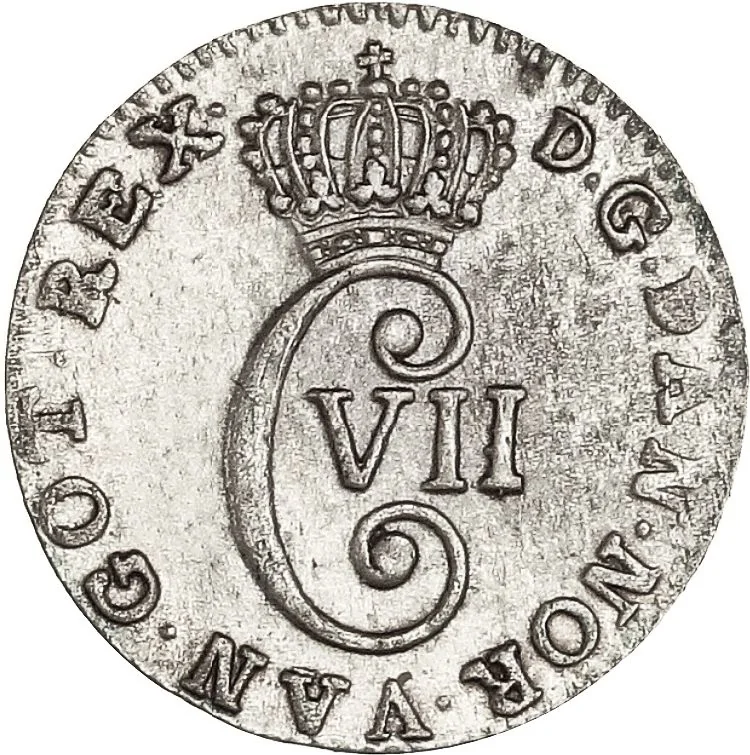
Obverse
Description:
Crowned royal monogram. Rim inscription.
Inscription:
C VII
D • G • DAN • NOR • VAN • GOT • REX •
D • G • DAN • NOR • VAN • GOT • REX •
Script: Latin
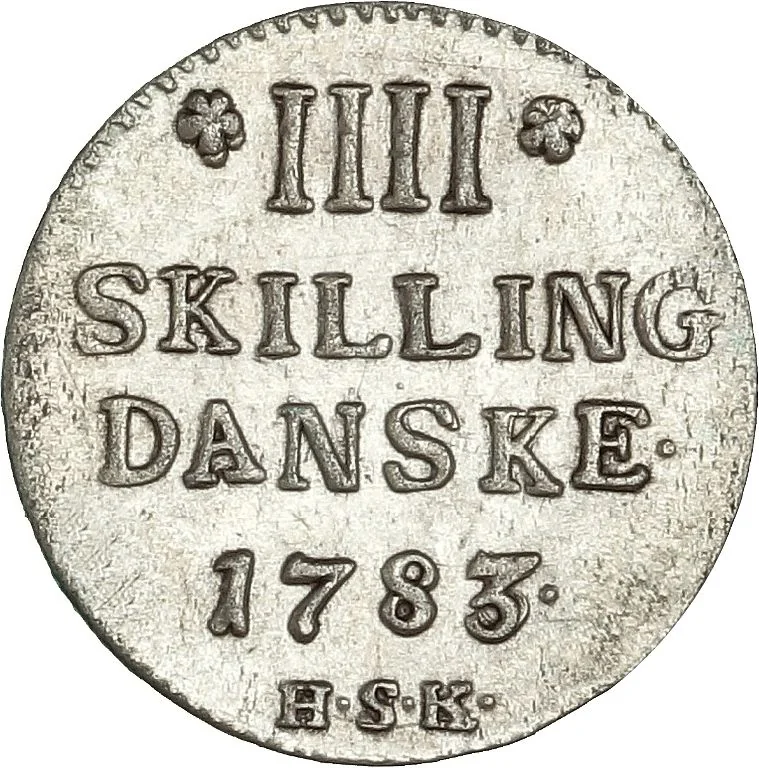
Reverse
Description:
Value and date stacked,
mintmark below.
mintmark below.
Inscription:
* IIII *
SKILLING
DANSKE
1783
H • S • K
SKILLING
DANSKE
1783
H • S • K
Script: Latin
Edge
Mints
| Name | Mark |
|---|---|
| Royal Danish Mint | — |
Mintings
| Year | Mint Mark | Mintage | Quality | Collection |
|---|---|---|---|---|
| 1783 | — | — |
Historical background
In 1783, Denmark operated under a silver standard, with the rigsdaler specie as the primary currency unit. However, the monetary system was complex and strained. The state treasury, heavily indebted from decades of war and ambitious public projects, struggled with liquidity. Furthermore, the circulation was a confusing mix of full-value silver coins, older debased coins, and a growing volume of paper money issued by the state-run Kurantbanken since 1737. This paper currency, the kurantdaler, was not directly convertible to silver on demand, leading to it trading at a fluctuating discount against the silver rigsdaler.
The year itself was a point of significant economic pressure, falling within the wider "Agricultural Depression" that followed the boom years of the Napoleonic Wars. While Denmark-Norway had prospered from neutral trade during the American Revolutionary War, the post-1783 peace brought a sharp contraction. Falling grain prices and reduced trade revenues squeezed state finances further. This exacerbated the underlying weakness of the paper currency, as public confidence in the Kurantbanken's notes wavered due to the state's habit of financing deficits by simply printing more money.
Consequently, Denmark faced a classic currency crisis of the era: a growing divergence between the nominal value of paper money and its real value in silver, a burdensome national debt, and a fragile economy. The situation would continue to deteriorate, leading to the state bankruptcy of 1813 and a full currency reform. Thus, the currency situation in 1783 was one of underlying instability, where the structural flaws of the monetary system were being acutely stressed by a worsening post-war economic climate.
The year itself was a point of significant economic pressure, falling within the wider "Agricultural Depression" that followed the boom years of the Napoleonic Wars. While Denmark-Norway had prospered from neutral trade during the American Revolutionary War, the post-1783 peace brought a sharp contraction. Falling grain prices and reduced trade revenues squeezed state finances further. This exacerbated the underlying weakness of the paper currency, as public confidence in the Kurantbanken's notes wavered due to the state's habit of financing deficits by simply printing more money.
Consequently, Denmark faced a classic currency crisis of the era: a growing divergence between the nominal value of paper money and its real value in silver, a burdensome national debt, and a fragile economy. The situation would continue to deteriorate, leading to the state bankruptcy of 1813 and a full currency reform. Thus, the currency situation in 1783 was one of underlying instability, where the structural flaws of the monetary system were being acutely stressed by a worsening post-war economic climate.

💎 Very Rare