

8 skilling – Denmark
Add to wishlist
Denmark
Context
Material
Diameter: 22.78 mm
Weight: 3.06 g
Silver Weight:: 1.72 g
Shape: Round
Composition: 56.25% Silver
Standard: Gold tenth ounce
Magnetic: No
References
KM: #
Numista: #318050
Value
Bullion value: $4.36
Obverse
Description:
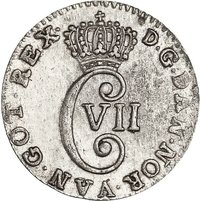
Crowned royal monogram. Rim inscription.
Inscription:
C7
D·G·DAN·NOR·VAN·GOT·REX·
D·G·DAN·NOR·VAN·GOT·REX·
Reverse
Description:
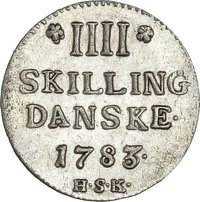
Oval crowned shield with Danish, Norwegian, and Swedish arms. Value encircles rim; date below, split by mintmaster initials.
Inscription:
8 · SKILLING | DANSKE ·
17 H·S·K· 82
17 H·S·K· 82
Edge
Mints
| Name | Mark |
|---|---|
| Royal Danish Mint | HSK |
Mintings
| Year | Mint Mark | Mintage | Quality | Collection |
|---|---|---|---|---|
| 1782 | HSK | — |
Historical background
In 1782, Denmark operated under a fixed silver standard, with the rigsdaler specie as the primary unit of account. However, the monetary reality was complex and strained. The state had issued substantial amounts of paper money, the so-called kurant rigsdaler, which circulated alongside a variety of older physical coins, including both full-value silver species and debased coins. The critical problem was that the paper kurant money was not fully convertible to silver and traded at a significant and fluctuating discount against the rigsdaler specie, creating a de facto dual-currency system that hampered trade and state finances.
This instability was a direct legacy of costly wars and economic policies in the preceding decades, particularly under King Christian VII. To finance conflicts like the Great Northern War and the state’s involvement in broad mercantilist projects, the government had increasingly relied on borrowing and the issuance of inconvertible paper notes. By 1782, the public debt was enormous, and confidence in the paper currency was low. The discount between the silver-based and paper-based rigsdaler created uncertainty for merchants, complicated tax collection, and reflected a deeper crisis of sovereign credit.
The situation demanded reform, and it was under the guidance of Chief Minister Count Andreas Peter Bernstorff and the influential financial expert Count Ernst Schimmelmann that steps were being taken. The period around 1782 was one of cautious stabilization within the broader "Regeneration Period," focusing on budgetary restraint and gradual debt reduction to restore confidence. The ultimate goal, which would be realized later with the 1788 establishment of the Rigsbank, was to unify the currency, restore convertibility, and place state finances on a more solid metallic foundation, thereby supporting Denmark's neutral trade ambitions during the European wars.
This instability was a direct legacy of costly wars and economic policies in the preceding decades, particularly under King Christian VII. To finance conflicts like the Great Northern War and the state’s involvement in broad mercantilist projects, the government had increasingly relied on borrowing and the issuance of inconvertible paper notes. By 1782, the public debt was enormous, and confidence in the paper currency was low. The discount between the silver-based and paper-based rigsdaler created uncertainty for merchants, complicated tax collection, and reflected a deeper crisis of sovereign credit.
The situation demanded reform, and it was under the guidance of Chief Minister Count Andreas Peter Bernstorff and the influential financial expert Count Ernst Schimmelmann that steps were being taken. The period around 1782 was one of cautious stabilization within the broader "Regeneration Period," focusing on budgetary restraint and gradual debt reduction to restore confidence. The ultimate goal, which would be realized later with the 1788 establishment of the Rigsbank, was to unify the currency, restore convertibility, and place state finances on a more solid metallic foundation, thereby supporting Denmark's neutral trade ambitions during the European wars.
✨ Legendary