

1 Rupee – Mughal Empire
India
Context
Years: 1734–1749
Country: India 
Issuer: Mughal Empire
Ruler: Muhammad Shah
Currency:
(1540—1842)
Demonetized: Yes
Material
References
KM: #Click to copy to clipboard436.15
Numista: #54629
Value
Bullion value: $32.12
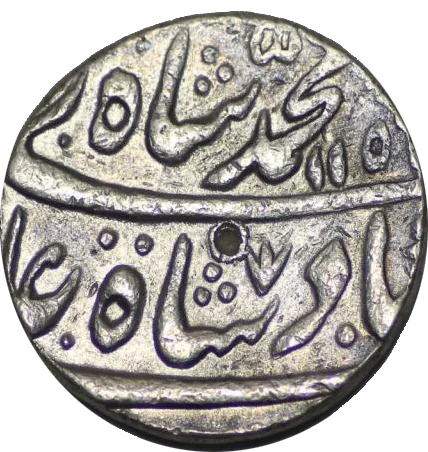
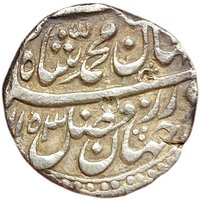
Obverse
Description:
AH: Emperor's Reign Year
Inscription:
Muhammad Shah Badshah Gazi Sikka Mubarak
۱۱٥
۱۱٥
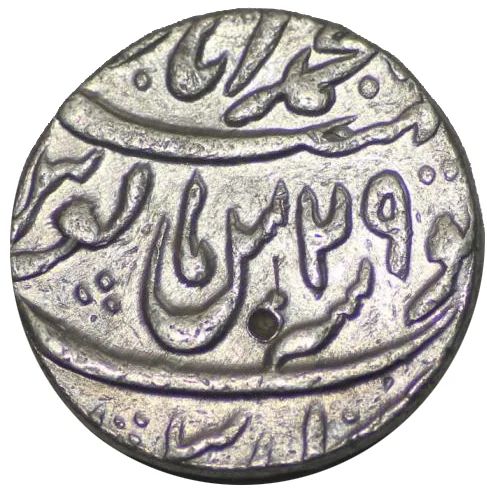
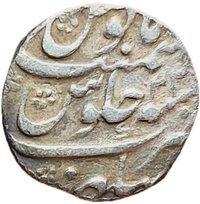
Reverse
Description:
RY Date & Mint
Inscription:
Memanat sanat manus julus zarb Muhammadabad Banaras ٢٩
۲۹
۲۹
Edge
Plain
Mints
| Name | Mark |
|---|---|
| Varanasi | — |
Mintings
| Year | Mint Mark | Mintage | Quality | Collection |
|---|---|---|---|---|
| 1734 | — | — | ||
| — | — | — | ||
| 1735 | — | — | ||
| 1736 | — | — | ||
| 1737 | — | — | ||
| 1738 | — | — | ||
| 1739 | — | — | ||
| 1740 | — | — | ||
| 1741 | — | — | ||
| 1741 | — | — | ||
| 1742 | — | — | ||
| 1743 | — | — | ||
| 1744 | — | — | ||
| 1745 | — | — | ||
| 1746 | — | — | ||
| 1747 | — | — | ||
| 1748 | — | — | ||
| 1749 | — | — |
Historical background
In 1734, the Mughal Empire's currency system was in a state of operational tension, caught between the enduring prestige of its established standards and the mounting pressures of imperial decline. The silver rupee, most commonly the high-purity Sikka rupee struck in the emperor's name, remained the principal currency for large-scale trade and state revenue. It coexisted with the gold mohur (worth approximately 14-16 rupees) and a plethora of copper dams for petty local transactions. The system was theoretically centralized, with imperial mints (Taksals) in major cities like Delhi, Lahore, and Ahmedabad, but in practice, regional powers were increasingly asserting their monetary autonomy.
The primary challenge was not a collapse of the currency itself but a creeping fragmentation and debasement driven by political weakness. Emperor Muhammad Shah (r. 1719-1748) held the throne in Delhi, but his authority was severely eroded. Powerful regional governors and emerging entities like the Marathas, the Nawabs of Bengal, and the Awadh began striking their own coins, often still bearing the emperor's name as a formality but effectively controlling mint output and seigniorage. Furthermore, to finance continuous warfare and court extravagance, the central treasury occasionally resorted to reducing the weight or purity of coins, leading to inflation and a loss of public confidence in some issues.
This period also saw intense monetary competition from foreign coins. The silver Riyal of Spain and the New World (the famous "Piece of Eight") flooded Indian markets through European trade, particularly with the British East India Company in Bengal. Valued for their consistent silver content, these foreign coins circulated widely, often preferred over suspect local issues. Thus, in 1734, the Mughal monetary landscape was a complex mosaic of imperial coins, nascent regional currencies, and foreign silver, reflecting the broader transition of political and economic power from a centralized empire to competing successor states and European trading interests.
The primary challenge was not a collapse of the currency itself but a creeping fragmentation and debasement driven by political weakness. Emperor Muhammad Shah (r. 1719-1748) held the throne in Delhi, but his authority was severely eroded. Powerful regional governors and emerging entities like the Marathas, the Nawabs of Bengal, and the Awadh began striking their own coins, often still bearing the emperor's name as a formality but effectively controlling mint output and seigniorage. Furthermore, to finance continuous warfare and court extravagance, the central treasury occasionally resorted to reducing the weight or purity of coins, leading to inflation and a loss of public confidence in some issues.
This period also saw intense monetary competition from foreign coins. The silver Riyal of Spain and the New World (the famous "Piece of Eight") flooded Indian markets through European trade, particularly with the British East India Company in Bengal. Valued for their consistent silver content, these foreign coins circulated widely, often preferred over suspect local issues. Thus, in 1734, the Mughal monetary landscape was a complex mosaic of imperial coins, nascent regional currencies, and foreign silver, reflecting the broader transition of political and economic power from a centralized empire to competing successor states and European trading interests.
💎 Extremely Rare