

10 Kreuzers – Kingdom of Bohemia
Context
Years: 1758–1768
Country: Bohemia
Issuer: Kingdom of Bohemia
Ruler: Maria Theresa
Currency:
(1754—1857)
Demonetized: Yes
Material
References
KM: #Click to copy to clipboard784
Numista: #69116
Value
Bullion value: $10.59
Obverse
Description:
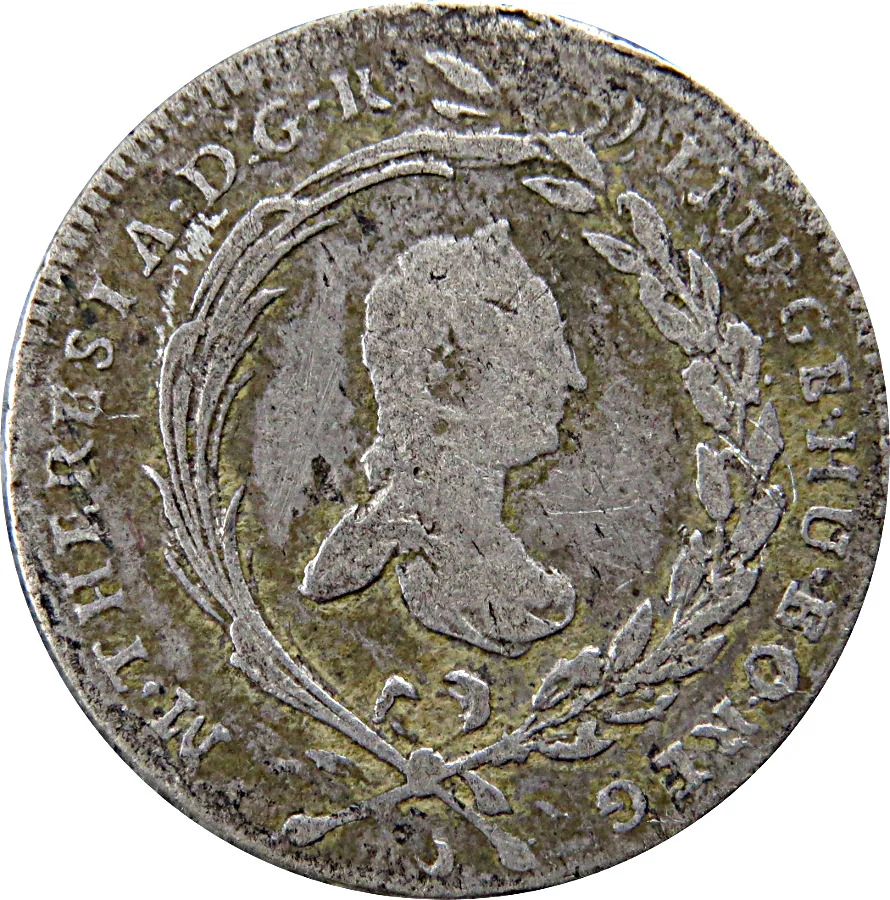
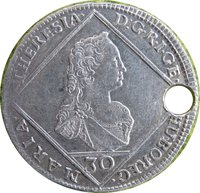
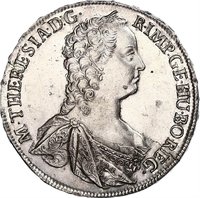
Portrait of Maria Theresia facing right within a wreath, encircled by the legend: "M.T. Dei Gratia Imperatrix Romanorum Germaniae Hungariae Bohemiae Regina."
Inscription:
M.THERESIA.D:G.R / IMP.GE.HU.BO.REG
Script: Latin
Reverse
Description:
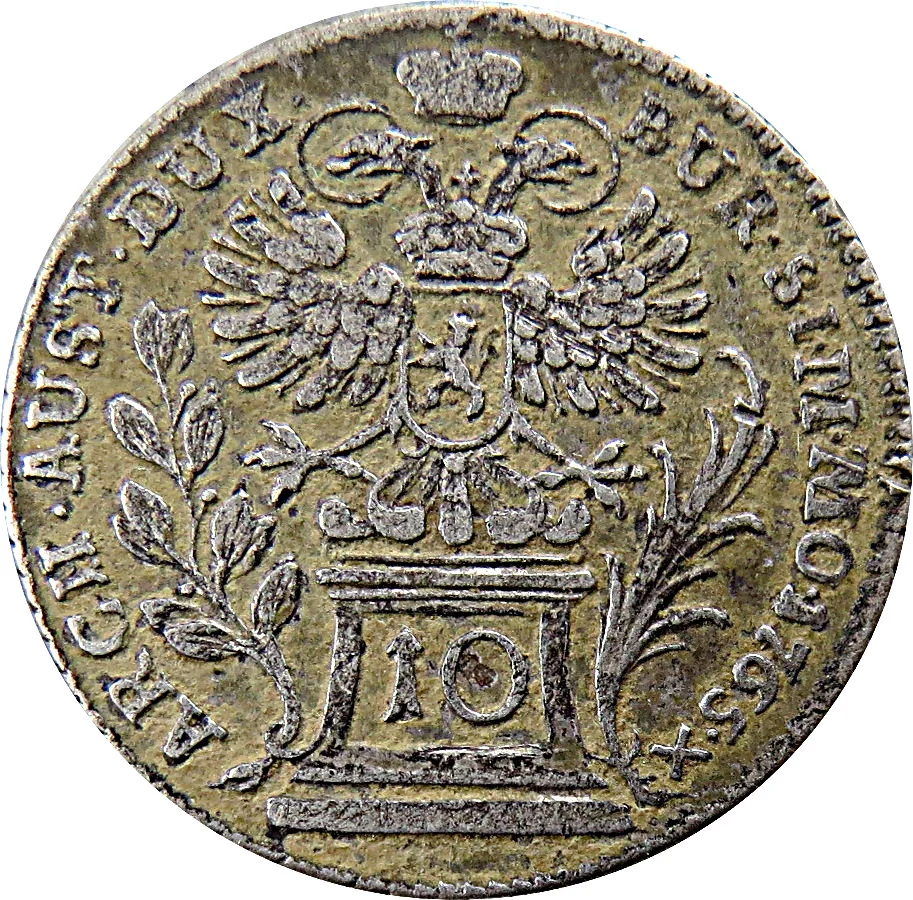
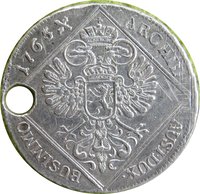
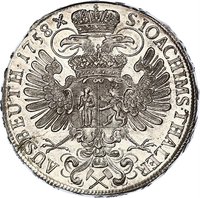
Imperial double-headed eagle with Bohemian shield, on a pedestal flanked by twigs. Legend: "Archidux Austriae Dux Burgundiae Silesiae Marchio Moraviae".
Inscription:
ARCH.AUST.DUX.
BUR.SI.M.MO.1765.X
BUR.SI.M.MO.1765.X
Script: Latin
Edge
Mints
| Name | Mark |
|---|---|
| Prague | — |
Mintings
| Year | Mint Mark | Mintage | Quality | Collection |
|---|---|---|---|---|
| 1758 | — | — | ||
| 1759 | — | — | ||
| 1760 | — | — | ||
| 1763 | — | — | ||
| 1764 | — | — | ||
| 1765 | — | — | ||
| 1766 | — | — | ||
| 1767 | — | — | BU | |
| 1768 | — | — |
Historical background
In 1758, the Kingdom of Bohemia, a core province of the Habsburg Monarchy, was in the midst of the Seven Years' War (1756-1763). The financial demands of the conflict placed immense strain on the state's monetary system. To fund the war against Prussia, which had invaded and occupied parts of Bohemia (including Prague in 1757), the Habsburg government in Vienna resorted to heavy debasement of the coinage. This involved significantly reducing the silver content in coins, particularly the standard Conventionsthaler and its fractional kreuzer denominations, to create more money from the same amount of precious metal.
This policy led to a classic and severe financial crisis. The newly minted, inferior coins flooded the market, causing rapid inflation and a loss of public confidence. Older, full-weight coins were hoarded or melted down for their intrinsic silver value (Gresham's Law in action), disappearing from circulation. This created a chaotic dual system where prices in debased currency skyrocketed, while transactions in reliable specie became difficult. The situation was exacerbated by the direct costs of warfare—requisitions, destruction, and the need to pay and supply large armies—further draining the local economy.
Consequently, the monetary landscape in Bohemia in 1758 was one of instability and hardship. The Habsburg state's short-term fiscal strategy undermined the very foundation of economic life. While aimed at preserving the military effort, the currency debasement inflicted widespread suffering on the Bohemian population, eroding savings, disrupting trade, and contributing to the general devastation of the war years. The situation would only begin to stabilize after the war's conclusion, with Maria Theresa's major currency reform of 1762 that introduced a new, stable standard.
This policy led to a classic and severe financial crisis. The newly minted, inferior coins flooded the market, causing rapid inflation and a loss of public confidence. Older, full-weight coins were hoarded or melted down for their intrinsic silver value (Gresham's Law in action), disappearing from circulation. This created a chaotic dual system where prices in debased currency skyrocketed, while transactions in reliable specie became difficult. The situation was exacerbated by the direct costs of warfare—requisitions, destruction, and the need to pay and supply large armies—further draining the local economy.
Consequently, the monetary landscape in Bohemia in 1758 was one of instability and hardship. The Habsburg state's short-term fiscal strategy undermined the very foundation of economic life. While aimed at preserving the military effort, the currency debasement inflicted widespread suffering on the Bohemian population, eroding savings, disrupting trade, and contributing to the general devastation of the war years. The situation would only begin to stabilize after the war's conclusion, with Maria Theresa's major currency reform of 1762 that introduced a new, stable standard.
⭐ Rare