

1 Schilling – Spanish Netherlands
Netherlands
Context
Years: 1698–1700
Country: Netherlands 
Issuer: Spanish Netherlands
Ruler: Charles II
Currency:
(1506—1713)
Demonetized: Yes
Material
References
KM: #Click to copy to clipboard119
Numista: #66947
Value
Bullion value: $8.47
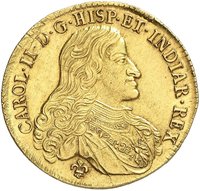
Obverse
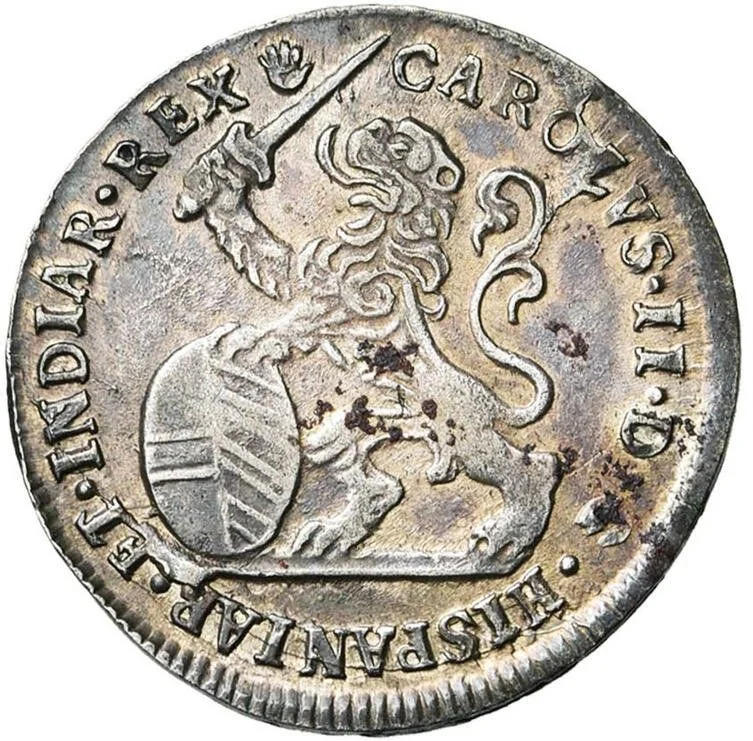
Description:
Lion rampant with sword and shield.
Inscription:
CAROLUS II D G HISPANIAR ET INDIAR REX
Script: Latin
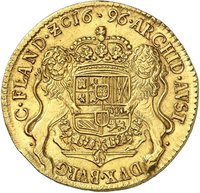
Reverse
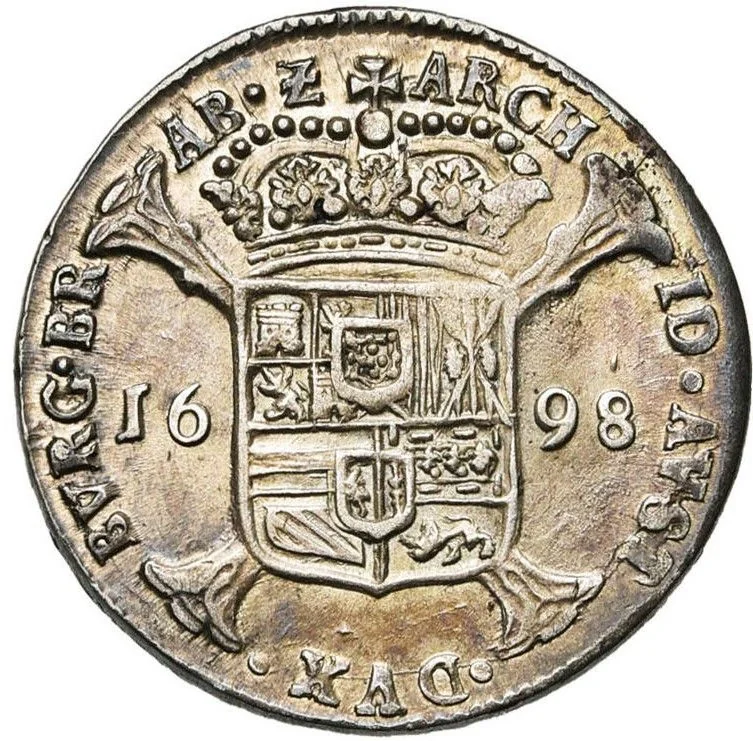
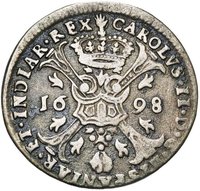
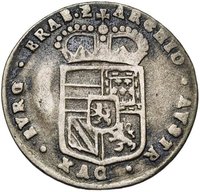
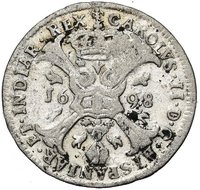
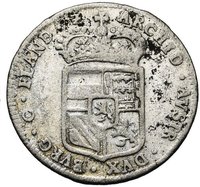
Description:
Crowned shield splits date over St. Andrew's cross.
Inscription:
ARCHID AVST DVX BVRG BRAB Z
Script: Latin
Edge
Plain
Mints
| Name | Mark |
|---|---|
| Antwerp | Hand |
Mintings
| Year | Mint Mark | Mintage | Quality | Collection |
|---|---|---|---|---|
| 1698 | — | — | ||
| 1699 | — | — | ||
| 1700 | — | — |
Historical background
In 1698, the Spanish Netherlands was grappling with a severe and protracted monetary crisis, a direct legacy of the ongoing Nine Years' War (1688-1697). The region, a battleground for European powers, suffered from the immense costs of warfare, which were financed largely through the debasement of coinage. Authorities, both local and the cash-strapped government in Madrid, repeatedly reduced the silver content in coins to fund military operations, leading to a flood of low-value, unstable currency. This practice drove older, full-weight coins out of circulation (Gresham's Law) and caused rampant inflation, crippling daily commerce and creating widespread economic uncertainty even as the war officially concluded.
The situation was further complicated by the circulation of a bewildering variety of coins. Alongside the debased domestic issues, there were older Spanish reales, Dutch guilders, French écus, and German thalers, all trading at fluctuating and disputed values. This monetary chaos stifled trade, as merchants could not trust the value of payments, and it eroded public confidence in the entire financial system. The lack of a uniform, trusted currency hampered economic recovery in the war-ravaged provinces, making it difficult to pay soldiers, settle debts, or fund reconstruction.
Recognizing the crisis, the Habsburg government and local authorities initiated urgent reforms. The year 1698 saw concerted efforts to standardize and stabilize the currency. Plans were set to recall the debased coinage and mint new, full-value pieces according to stricter standards, particularly aiming to align the Brabant guilder with the reliable Dutch guilder. While these measures were a necessary step toward recovery, their implementation was slow and faced significant challenges, including scarce bullion and ongoing political tensions. Thus, in 1698, the currency situation remained one of fragile transition from wartime chaos toward a hoped-for, but not yet achieved, stability.
The situation was further complicated by the circulation of a bewildering variety of coins. Alongside the debased domestic issues, there were older Spanish reales, Dutch guilders, French écus, and German thalers, all trading at fluctuating and disputed values. This monetary chaos stifled trade, as merchants could not trust the value of payments, and it eroded public confidence in the entire financial system. The lack of a uniform, trusted currency hampered economic recovery in the war-ravaged provinces, making it difficult to pay soldiers, settle debts, or fund reconstruction.
Recognizing the crisis, the Habsburg government and local authorities initiated urgent reforms. The year 1698 saw concerted efforts to standardize and stabilize the currency. Plans were set to recall the debased coinage and mint new, full-value pieces according to stricter standards, particularly aiming to align the Brabant guilder with the reliable Dutch guilder. While these measures were a necessary step toward recovery, their implementation was slow and faced significant challenges, including scarce bullion and ongoing political tensions. Thus, in 1698, the currency situation remained one of fragile transition from wartime chaos toward a hoped-for, but not yet achieved, stability.
💎 Extremely Rare