

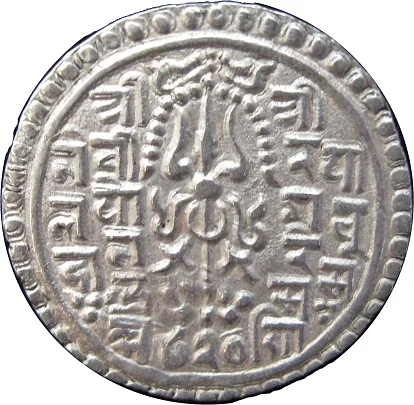
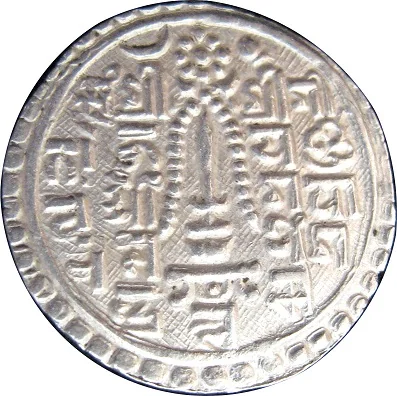
1 Mohar – Patan Kingdom
Nepal
Context
Year: 1700
Nepal Sambat Year: 820
Country: Nepal 
Issuer: Patan Kingdom
Ruler: Yoga Narendra Malla
Currency:
(1546—1932)
Demonetized: Yes
Material
References
KM: #Click to copy to clipboard320
Numista: #66322
Value
Bullion value: $15.39
Obverse
Reverse
Edge
Plain
Mintings
| Year | Mint Mark | Mintage | Quality | Collection |
|---|---|---|---|---|
| 1700 | — | — |
Historical background
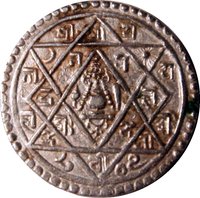
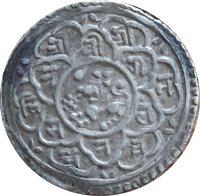
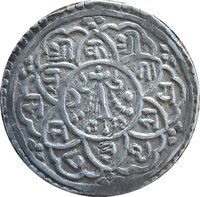
By 1700, the currency situation in the Patan Kingdom (one of the three sovereign city-states in the Kathmandu Valley, now part of Nepal) was complex and indicative of both its economic vitality and its political subordination. The kingdom minted its own distinctive silver coinage, the most common being the Mohar and its fractional denominations. These coins bore the dynastic symbols of the Malla kings, such as the goddess Kali, the king's name in Devanagari script, and often a crescent moon, asserting Patan's independent identity and facilitating a thriving trans-Himalayan trade with Tibet and India.
However, this monetary autonomy was increasingly constrained by the political and economic realities of the time. The three rival Malla kingdoms—Kathmandu, Patan, and Bhaktapur—all issued their own coinage, which circulated concurrently and often at fluctuating exchange rates, creating a cumbersome environment for merchants. More significantly, the powerful Gorkha Kingdom to the west, under Prithvi Narayan Shah, had begun a blockade and military campaign against the valley states. This stranglehold disrupted trade routes and likely affected the supply of silver, the key raw material for Patan's currency, placing severe strain on its economy.
Thus, the currency of Patan in 1700 existed in a state of precarious transition. While the physically minted coins themselves remained a testament to the kingdom's sophisticated craftsmanship and last era of Malla cultural flourish, the system they operated within was under severe duress. The coins symbolized a fading sovereignty, as the gathering threat from Gorkha foreshadowed the end of Patan's independent monetary policy, which would culminate just over a half-century later with the valley's conquest and the imposition of a unified Nepalese currency under the Shah dynasty.
However, this monetary autonomy was increasingly constrained by the political and economic realities of the time. The three rival Malla kingdoms—Kathmandu, Patan, and Bhaktapur—all issued their own coinage, which circulated concurrently and often at fluctuating exchange rates, creating a cumbersome environment for merchants. More significantly, the powerful Gorkha Kingdom to the west, under Prithvi Narayan Shah, had begun a blockade and military campaign against the valley states. This stranglehold disrupted trade routes and likely affected the supply of silver, the key raw material for Patan's currency, placing severe strain on its economy.
Thus, the currency of Patan in 1700 existed in a state of precarious transition. While the physically minted coins themselves remained a testament to the kingdom's sophisticated craftsmanship and last era of Malla cultural flourish, the system they operated within was under severe duress. The coins symbolized a fading sovereignty, as the gathering threat from Gorkha foreshadowed the end of Patan's independent monetary policy, which would culminate just over a half-century later with the valley's conquest and the imposition of a unified Nepalese currency under the Shah dynasty.
✨ Legendary