

1 Mohar – Patan Kingdom
Nepal
Context
Year: 1685
Vikram Samvat Year: 805
Country: Nepal 
Issuer: Patan Kingdom
Ruler: Yoga Narendra Malla
Currency:
(1546—1932)
Demonetized: Yes
Material
References
KM: #Click to copy to clipboard337
Numista: #59114
Value
Bullion value: $15.56
Obverse
Description:
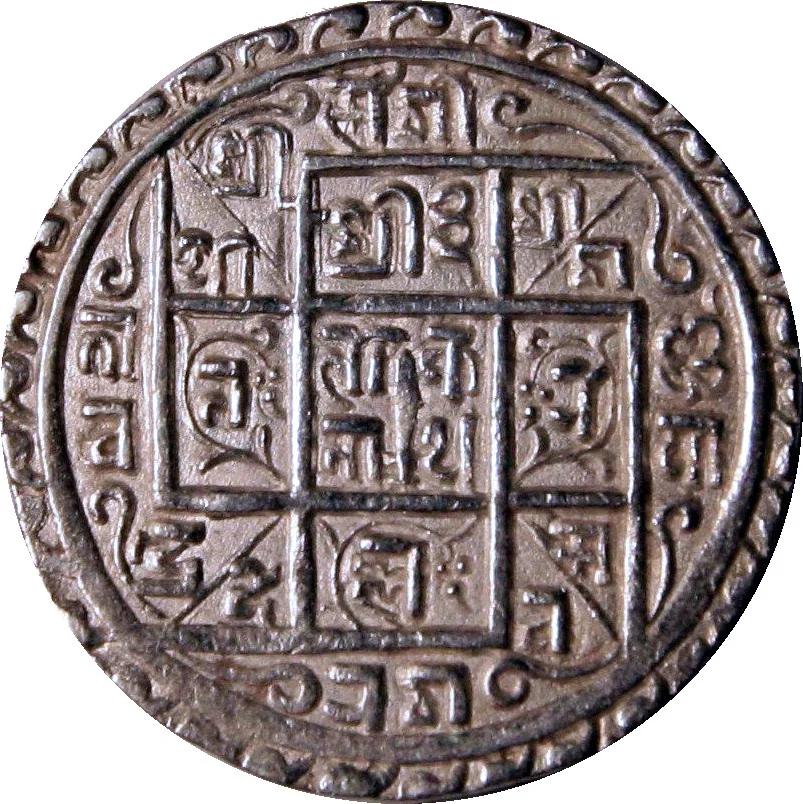
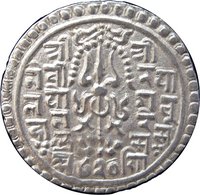
A silver mohar of Yoga ruler Narendra Malla, King of Patan (r. 1685–1705 AD). One of two mohars issued in the names of queens Narendra Lakshmi Devi and Pratapa Lakshmi Devi (KM#337). Dated NS 805 (1685 AD). The obverse features a square-swastika design interwoven with the legend "Sri 3 Lokanath, Sri Sri Yoga Narendra Malla Deva, Samgitarnnava paraga".
Reverse
Description:
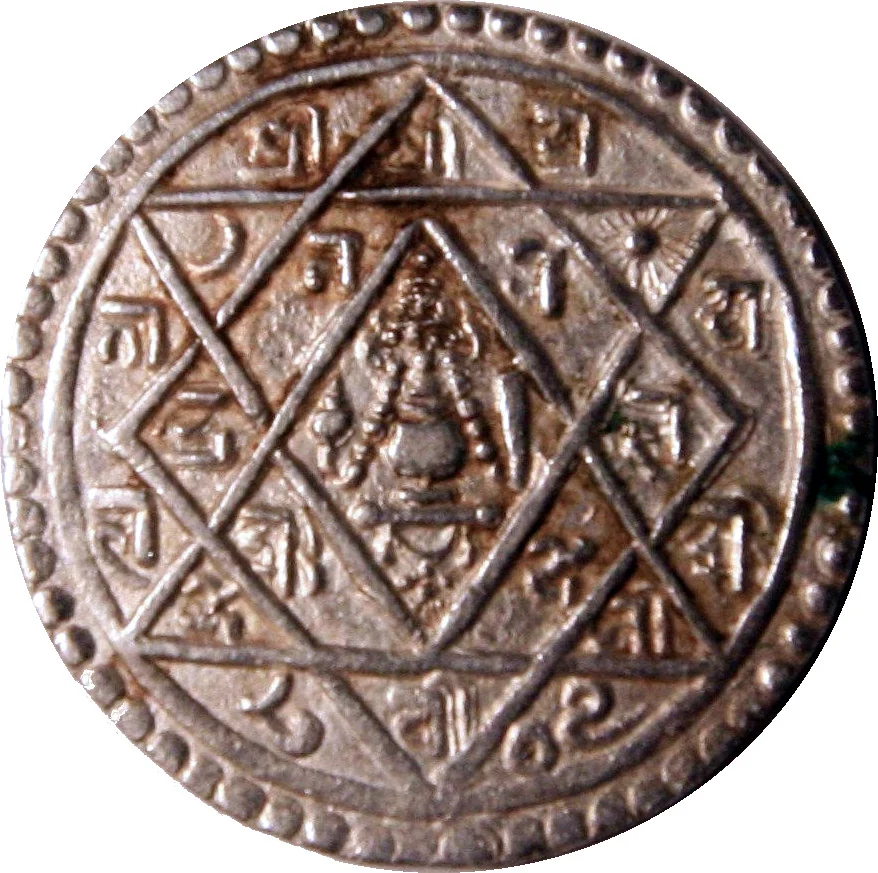
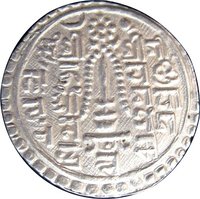
Two intersecting triangles form a rhombus on the reverse. At its center, a vermilion box holds a conch and mace bucket, encircled by the legend: "Sri Narendra Lakshmi Devi, Sri Pratapa Lakshmi Devi, 805".
Edge
Mintings
| Year | Mint Mark | Mintage | Quality | Collection |
|---|---|---|---|---|
| 1685 | — | — |
Historical background
In 1685, the Patan Kingdom (one of the three medieval Malla kingdoms in the Kathmandu Valley, now part of modern Lalitpur, Nepal) operated within a complex and sophisticated monetary system. The kingdom's economy was primarily driven by agriculture, trade, and skilled craftsmanship, particularly in metalwork and religious art. As a vital hub on the trans-Himalayan trade route between Tibet and India, Patan saw a constant flow of goods and currencies, creating a multi-currency environment. The official coinage was the silver mohar, struck under the authority of King Srinivasa Malla (ruled 1661–1685), who had died earlier that very year, leaving his son Yog Narendra Malla to ascend the throne. This political transition likely introduced some uncertainty into the monetary sphere, as the continuity of coinage standards and royal authority were being re-established.
The currency situation was characterized by the concurrent circulation of both indigenous and foreign coins. Alongside the locally minted mohars, which often featured intricate designs of deities and symbols like the lotus and conch shell, traders commonly used Tibetan tangkas (silver coins) and Mughal Indian rupees. The value and acceptance of these coins were based on their intrinsic silver content and weight, requiring merchants and money-changers (sarrafs) to be adept at assaying and exchanging. Furthermore, smaller transactions were facilitated by cowrie shells and by cutting silver coins into fractional pieces, as smaller denomination coinage was limited.
This system, while functional, faced underlying pressures. The kingdom's limited silver mines meant it relied heavily on imported bullion, making its money supply vulnerable to trade fluctuations. Additionally, the constant influx of foreign currencies and the practice of clipping or debasing coins posed challenges to maintaining a stable standard. Thus, in 1685, Patan's currency was a reflection of its prosperous but interdependent position—a locally sovereign system deeply embedded in and sensitive to the broader economic currents of South Asia.
The currency situation was characterized by the concurrent circulation of both indigenous and foreign coins. Alongside the locally minted mohars, which often featured intricate designs of deities and symbols like the lotus and conch shell, traders commonly used Tibetan tangkas (silver coins) and Mughal Indian rupees. The value and acceptance of these coins were based on their intrinsic silver content and weight, requiring merchants and money-changers (sarrafs) to be adept at assaying and exchanging. Furthermore, smaller transactions were facilitated by cowrie shells and by cutting silver coins into fractional pieces, as smaller denomination coinage was limited.
This system, while functional, faced underlying pressures. The kingdom's limited silver mines meant it relied heavily on imported bullion, making its money supply vulnerable to trade fluctuations. Additionally, the constant influx of foreign currencies and the practice of clipping or debasing coins posed challenges to maintaining a stable standard. Thus, in 1685, Patan's currency was a reflection of its prosperous but interdependent position—a locally sovereign system deeply embedded in and sensitive to the broader economic currents of South Asia.
💎 Extremely Rare