

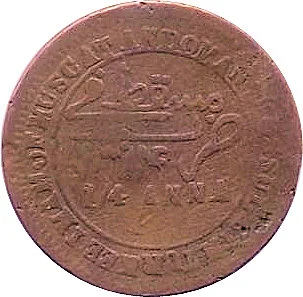
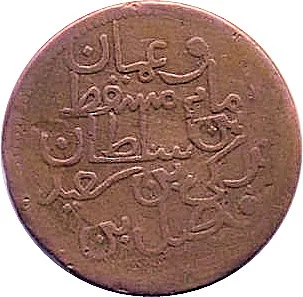
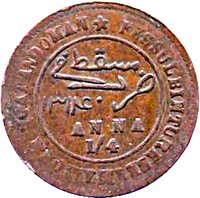
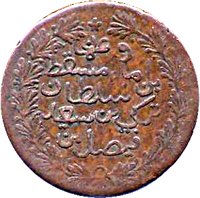
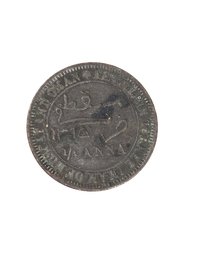
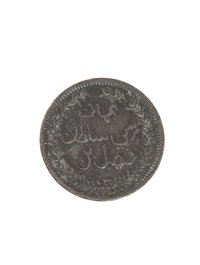
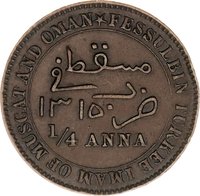
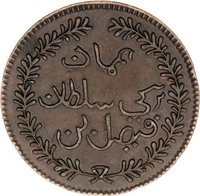
¼ anna – Muscat and Oman
Add to wishlist
Oman
Context
Year: 1897
Islamic (Hijri) Year:: 1314
Country: Oman
Issuer: Muscat and Oman
Ruler: Faisal bin Turki
Currency:
(1891—1959)
Demonetized: Yes
Material
References
KM: #
Numista: #104112
Mintings
| Year | Mint Mark | Mintage | Quality | Collection |
|---|---|---|---|---|
| 1897 | — | — |
Historical background
In 1897, the currency situation in Muscat and Oman was a complex tapestry of foreign and indigenous coins, reflecting the Sultanate's pivotal role in Indian Ocean trade and its lack of a formal, unified monetary system. The primary currency in circulation was the Indian Rupee, particularly the British Indian silver rupee and its fractional denominations (annas and pice). This dominance was a direct result of Muscat's deep historical and commercial ties with British India, with the rupee serving as the de facto standard for government accounts and larger transactions, especially in the coastal capital of Muscat.
Alongside the rupee, a multitude of other coins circulated freely, creating a merchant's bazaar of exchange. The most important of these was the Maria Theresa Thaler (MT$). This large silver Austrian coin was the preferred currency for the interior's caravan trade and in parts of the Omani hinterland, valued for its consistent silver content and wide acceptance across Arabia and East Africa. Additionally, older Ottoman and Persian coins, Spanish dollars, and even coins from neighbouring Trucial States were accepted, with their value determined by weight and fineness of silver rather than face value.
This monetary heterogeneity presented significant challenges. Exchange rates between rupees, thalers, and other coins fluctuated, complicating trade and taxation. The Sultanate's own coinage was limited; it struck small, low-denomination copper baizas (the only locally minted coin of the era) and some silver sadiyya rupees for local use, but these were insufficient to unify the system. Consequently, the economy operated on a cumbersome system of manual assay and negotiation, reliant on money-changers (sarrafs) and the inherent value of silver bullion, leaving Muscat and Oman without a sovereign currency as the 20th century approached.
Alongside the rupee, a multitude of other coins circulated freely, creating a merchant's bazaar of exchange. The most important of these was the Maria Theresa Thaler (MT$). This large silver Austrian coin was the preferred currency for the interior's caravan trade and in parts of the Omani hinterland, valued for its consistent silver content and wide acceptance across Arabia and East Africa. Additionally, older Ottoman and Persian coins, Spanish dollars, and even coins from neighbouring Trucial States were accepted, with their value determined by weight and fineness of silver rather than face value.
This monetary heterogeneity presented significant challenges. Exchange rates between rupees, thalers, and other coins fluctuated, complicating trade and taxation. The Sultanate's own coinage was limited; it struck small, low-denomination copper baizas (the only locally minted coin of the era) and some silver sadiyya rupees for local use, but these were insufficient to unify the system. Consequently, the economy operated on a cumbersome system of manual assay and negotiation, reliant on money-changers (sarrafs) and the inherent value of silver bullion, leaving Muscat and Oman without a sovereign currency as the 20th century approached.
💎 Extremely Rare