

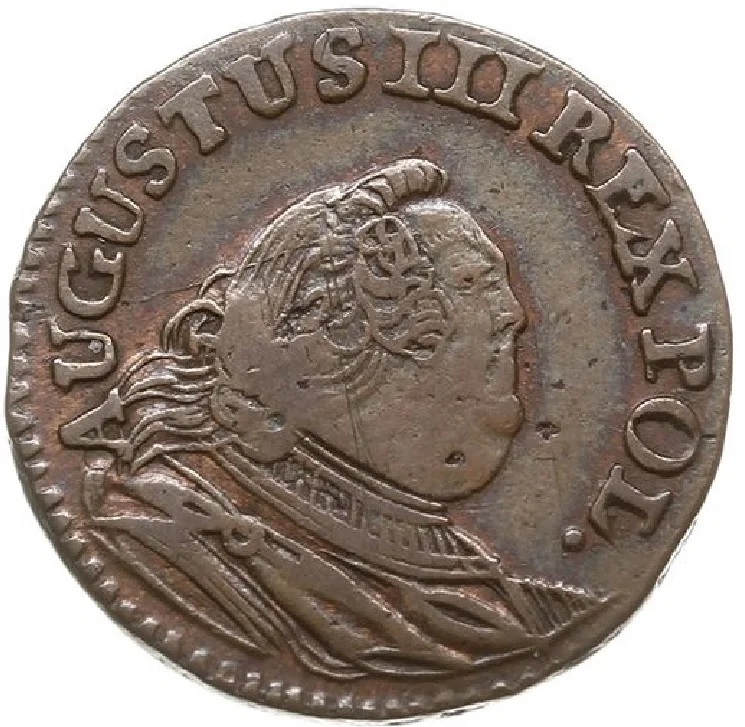
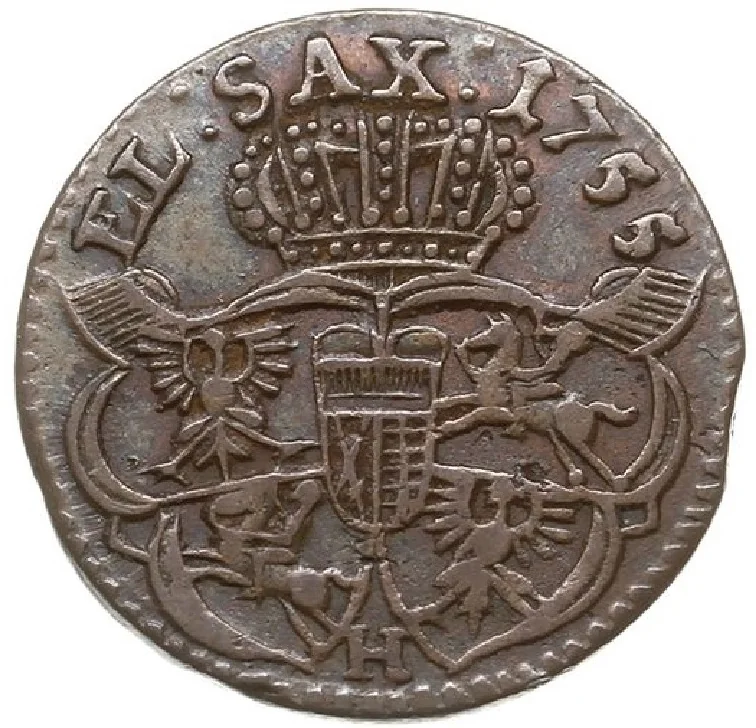
1 schilling – Polish–Lithuanian Commonwealth
Add to wishlist
Poland
Context
Years: 1750–1755
Country: Poland
Issuer: Polish–Lithuanian Commonwealth
Ruler: Augustus III
Currency:
(1573—1795)
Demonetized: Yes
Material
References
KM: #
Numista: #118084
Mints
| Name | Mark |
|---|---|
| Guben | — |
Mintings
| Year | Mint Mark | Mintage | Quality | Collection |
|---|---|---|---|---|
| 1750 | B | — | ||
| 1750 | H | — | ||
| 1751 | B | — | ||
| 1751 | D | — | ||
| 1751 | S | — | ||
| 1751 | V | — | ||
| 1752 | G | — | ||
| 1752 | H | — | ||
| 1752 | I | — | ||
| 1752 | L | — | ||
| 1752 | N | — | ||
| 1752 | O | — | ||
| 1752 | R | — | ||
| 1752 | V | — | ||
| 1752 | A | — | ||
| 1752 | B | — | ||
| 1752 | C | — | ||
| 1752 | D | — | ||
| 1752 | E | — | ||
| 1752 | F | — | ||
| 1752 | S | — | ||
| 1752 | T | — | ||
| 1752 | U | — | ||
| 1753 | A | — | ||
| 1753 | D | — | ||
| 1753 | B | — | ||
| 1753 | C | — | ||
| 1753 | F | — | ||
| 1753 | G | — | ||
| 1753 | H | — | ||
| 1753 | I | — | ||
| 1753 | L | — | ||
| 1753 | N | — | ||
| 1753 | O | — | ||
| 1753 | P | — | ||
| 1753 | R | — | ||
| 1753 | S | — | ||
| 1753 | T | — | ||
| 1753 | V | — | ||
| 1754 | H | — | ||
| 1754 | F | — | ||
| 1755 | H | — |
Historical background
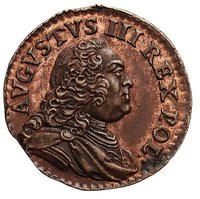
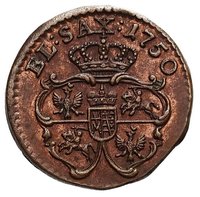
By 1750, the currency system of the Polish–Lithuanian Commonwealth was in a state of profound dysfunction, a direct reflection of the political paralysis of the state itself. The primary unit was the złoty polski (Polish złoty), but it existed only as a money of account, with no actual coins minted to its standard. Instead, a chaotic mix of domestic and foreign specie circulated. The most important physical coins were German- and Prussian-minted thalers (known as talary) and Polish złotys (złotówki), which were actually subsidiary silver coins worth about a quarter of the accounting złoty. The system was further complicated by a vast influx of debased copper shillings (szelągi) minted en masse by the Commonwealth's own mints, often leased to private individuals by corrupt magnates.
This monetary chaos stemmed from the "liberum veto" and the dominance of the nobility (szlachta), who resisted all central fiscal reforms. The central treasury was perpetually empty, and the state had effectively abdicated its monetary sovereignty. To raise funds, the Crown leased minting rights to private individuals, most notoriously to the Saxon Count Heinrich von Brühl, who flooded the country with low-quality copper coinage. This practice, known as bilon (token coinage), generated short-term profit for the lessee and the treasury but caused severe inflation and a loss of public trust in the currency, as the intrinsic metal value of coins fell far below their face value.
The consequences were severe for the economy. The dual system of accounting versus physical money, combined with the flood of debased coinage, created confusion, hampered trade, and led to Gresham's Law in action: good silver thalers were hoarded or exported, while bad copper money drove out better coinage from circulation. This monetary instability weakened an already decentralised state, crippling its ability to fund a modern army or bureaucracy. Thus, in 1750, the Commonwealth's currency was not merely an economic problem but a glaring symptom of a political system in terminal decline, unable to assert the most basic sovereign function of controlling its own money.
This monetary chaos stemmed from the "liberum veto" and the dominance of the nobility (szlachta), who resisted all central fiscal reforms. The central treasury was perpetually empty, and the state had effectively abdicated its monetary sovereignty. To raise funds, the Crown leased minting rights to private individuals, most notoriously to the Saxon Count Heinrich von Brühl, who flooded the country with low-quality copper coinage. This practice, known as bilon (token coinage), generated short-term profit for the lessee and the treasury but caused severe inflation and a loss of public trust in the currency, as the intrinsic metal value of coins fell far below their face value.
The consequences were severe for the economy. The dual system of accounting versus physical money, combined with the flood of debased coinage, created confusion, hampered trade, and led to Gresham's Law in action: good silver thalers were hoarded or exported, while bad copper money drove out better coinage from circulation. This monetary instability weakened an already decentralised state, crippling its ability to fund a modern army or bureaucracy. Thus, in 1750, the Commonwealth's currency was not merely an economic problem but a glaring symptom of a political system in terminal decline, unable to assert the most basic sovereign function of controlling its own money.
🌟 Limited