

¼ Mohar – Nepal
Nepal
Context
Material
References
KM: #Click to copy to clipboard496
Numista: #372654
Value
Bullion value: $3.92
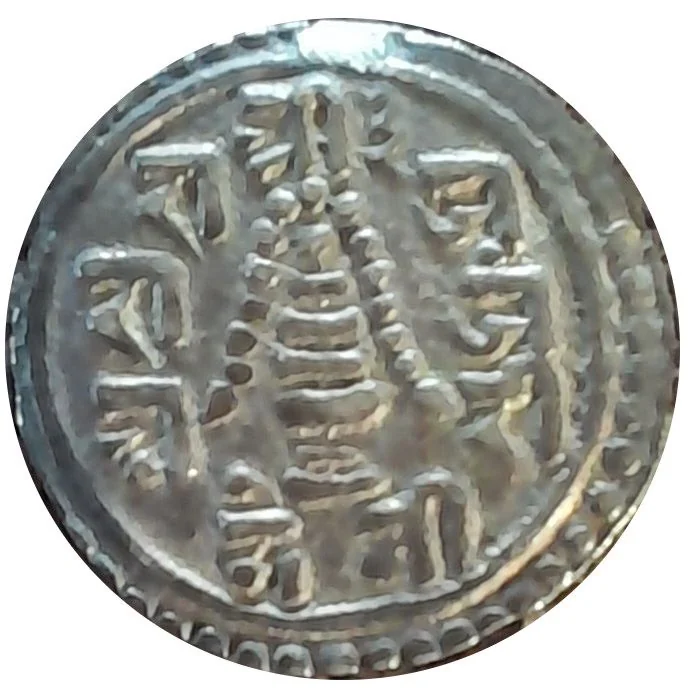
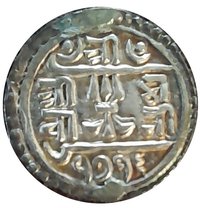
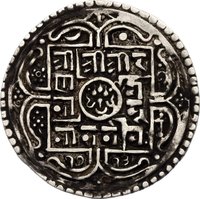
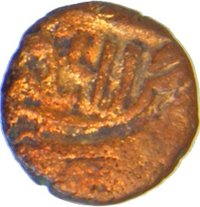
Obverse
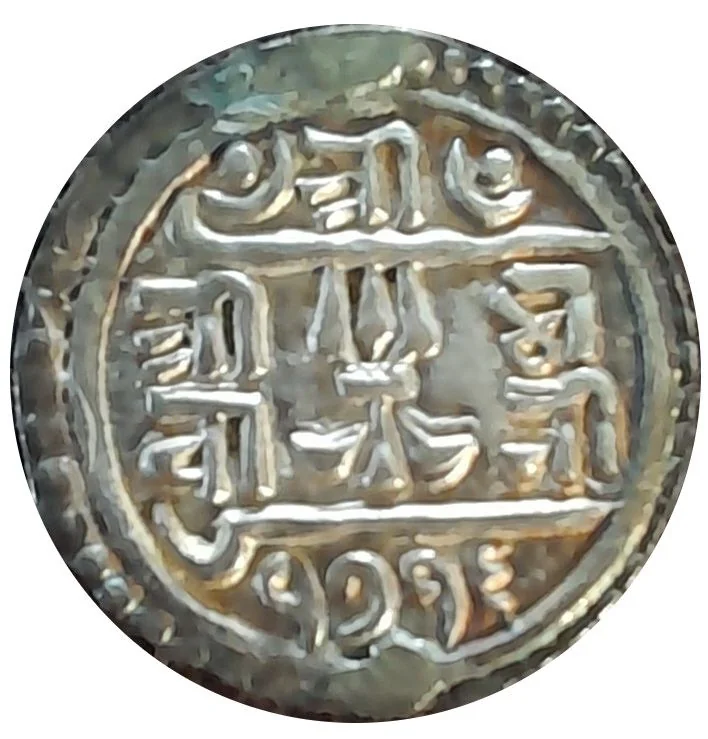
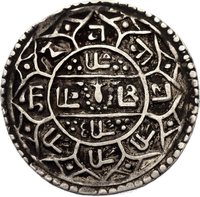
Reverse
Edge
Mintings
| Year | Mint Mark | Mintage | Quality | Collection |
|---|---|---|---|---|
| 1790 | — | — | ||
| 1794 | — | — | ||
| 1801 | — | — |
Historical background
In 1790, Nepal was a collection of small, competing kingdoms, primarily the Gorkha, Kathmandu, Patan, and Bhaktapur, each with its own autonomous economic system. There was no unified national currency. The most prominent medium of exchange in the Kathmandu Valley was the Malla coinage, silver Mohars issued by the three Malla kings of Kathmandu, Patan, and Bhaktapur. These coins were often crude, hammer-struck pieces bearing symbols of deities like the lotus or the swastika, and their weight and purity could vary between kingdoms, complicating trade.
Meanwhile, the rising Gorkha Kingdom under Prithvi Narayan Shah, who had begun his unification campaign in the 1740s, was issuing its own distinct silver Mohars. By 1790, Shah had successfully conquered the Kathmandu Valley (1768-69), but the process of fully integrating the monetary systems was still ongoing. His Gorkhali coins, minted in the name of the goddess Kali, were beginning to circulate alongside the older Malla issues, creating a period of monetary duality.
The broader economic landscape was one of transition and multiplicity. Alongside these local silver coins, barter remained widespread, especially in rural areas and for everyday transactions. Furthermore, significant trade with Tibet (using silver Tam or Srang coins) and India (where Mughal and emerging Company rupees circulated) meant that foreign currencies were also in common use, particularly for larger commerce. Thus, the currency situation in 1790 was fragmented, reflecting the political upheaval of the era, as the old Malla systems coexisted and were gradually being supplanted by the new Gorkhali coinage that would become the foundation of a unified Nepalese currency.
Meanwhile, the rising Gorkha Kingdom under Prithvi Narayan Shah, who had begun his unification campaign in the 1740s, was issuing its own distinct silver Mohars. By 1790, Shah had successfully conquered the Kathmandu Valley (1768-69), but the process of fully integrating the monetary systems was still ongoing. His Gorkhali coins, minted in the name of the goddess Kali, were beginning to circulate alongside the older Malla issues, creating a period of monetary duality.
The broader economic landscape was one of transition and multiplicity. Alongside these local silver coins, barter remained widespread, especially in rural areas and for everyday transactions. Furthermore, significant trade with Tibet (using silver Tam or Srang coins) and India (where Mughal and emerging Company rupees circulated) meant that foreign currencies were also in common use, particularly for larger commerce. Thus, the currency situation in 1790 was fragmented, reflecting the political upheaval of the era, as the old Malla systems coexisted and were gradually being supplanted by the new Gorkhali coinage that would become the foundation of a unified Nepalese currency.
✨ Legendary