

½ stuiver – Netherlands East Indies
Add to wishlist
Indonesia
Context
Year: 1644
Country: Indonesia
Issuer: Netherlands East Indies
Period:
(1602—1800)
Currency:
(1601—1694)
Demonetized: Yes
Material
References
KM: #
Numista: #57175
Obverse
Description:
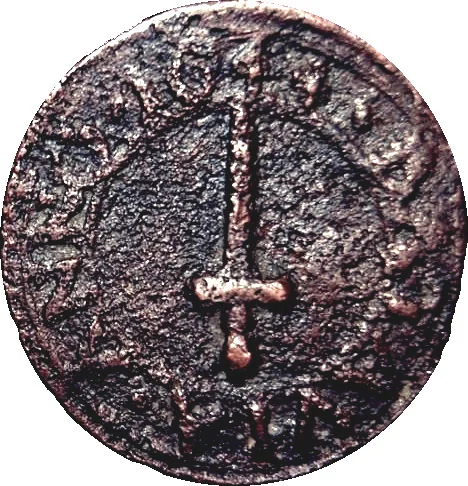
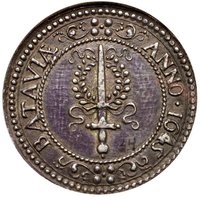
Batavia arms (vertical sword) in inner circle, date above within outer circle.
Inscription:
· BATAVIA · ANNO · 1644 ·
Reverse
Description:
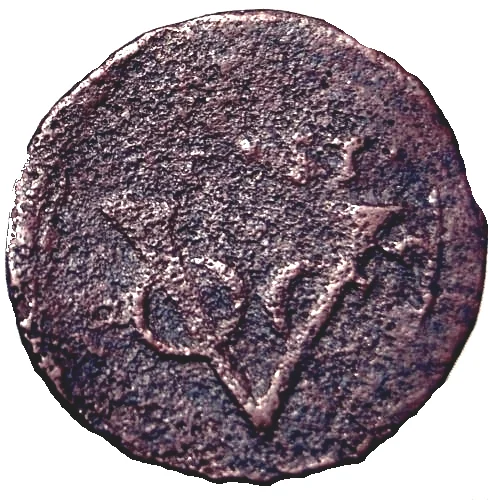
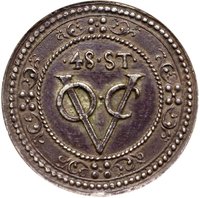
VOC monogram below value, encircled.
Inscription:
· ½ · ST ·
VOC
VOC
Edge
Mintings
| Year | Mint Mark | Mintage | Quality | Collection |
|---|---|---|---|---|
| 1644 | — | — |
Historical background
In 1644, the currency situation in the Netherlands East Indies (NEI) was characterized by a complex and often chaotic multiplicity of coins, driven by the voracious needs of the Dutch East India Company (VOC). The VOC’s primary objective was to extract profit through trade, and a reliable medium of exchange was essential. However, the Company did not initially succeed in imposing a single, unified currency. Instead, the monetary landscape was a patchwork of Spanish silver reales (known as "pieces of eight"), Japanese gold koban, various Indian and Persian coins, and local tin doits and copper picis. This diversity reflected the VOC's position at the hub of intra-Asian trade, where any silver or gold coin of recognized weight and purity could circulate.
The VOC actively sought to control and profit from this system by establishing mints, most notably in Batavia. Here, imported Spanish reals and other foreign coins were often counterstamped with the VOC monogram to verify their value for local use. More significantly, the Company produced its own low-value copper and tin coins, like the doit, for everyday transactions among the local population and for paying small-scale expenses. This created a two-tiered system: high-value silver and gold for regional trade and Company finance, and low-value base metal coins for the local bazaar economy. The scarcity of precious metals in Europe often led to a drain of silver from the Indies to pay for spices and other goods, further complicating liquidity.
This monetary plurality created significant challenges, including widespread counterfeiting, constant fluctuations in exchange rates between different coin types, and complex accounting. The VOC frequently issued ordinances to fix exchange rates and outlaw certain coins, but with limited success across the vast archipelago. Thus, in 1644, the currency system was fundamentally unstable—a pragmatic but messy solution to the problem of financing a commercial empire, where the Company’s bookkeeping in guilders and stuivers often bore little relation to the physical jumble of coins actually changing hands in its ports and warehouses.
The VOC actively sought to control and profit from this system by establishing mints, most notably in Batavia. Here, imported Spanish reals and other foreign coins were often counterstamped with the VOC monogram to verify their value for local use. More significantly, the Company produced its own low-value copper and tin coins, like the doit, for everyday transactions among the local population and for paying small-scale expenses. This created a two-tiered system: high-value silver and gold for regional trade and Company finance, and low-value base metal coins for the local bazaar economy. The scarcity of precious metals in Europe often led to a drain of silver from the Indies to pay for spices and other goods, further complicating liquidity.
This monetary plurality created significant challenges, including widespread counterfeiting, constant fluctuations in exchange rates between different coin types, and complex accounting. The VOC frequently issued ordinances to fix exchange rates and outlaw certain coins, but with limited success across the vast archipelago. Thus, in 1644, the currency system was fundamentally unstable—a pragmatic but messy solution to the problem of financing a commercial empire, where the Company’s bookkeeping in guilders and stuivers often bore little relation to the physical jumble of coins actually changing hands in its ports and warehouses.

💎 Extremely Rare