

24 Skilling – Norway
Norway
Context
Years: 1772–1788
Issuer: Norway 
Ruler: Christian VII
Currency:
(1746—1814)
Demonetized: Yes
Total mintage: 1,700,900
Material
References
KM: #Click to copy to clipboard250
Numista: #55898
Value
Bullion value: $14.65
Obverse
Description:
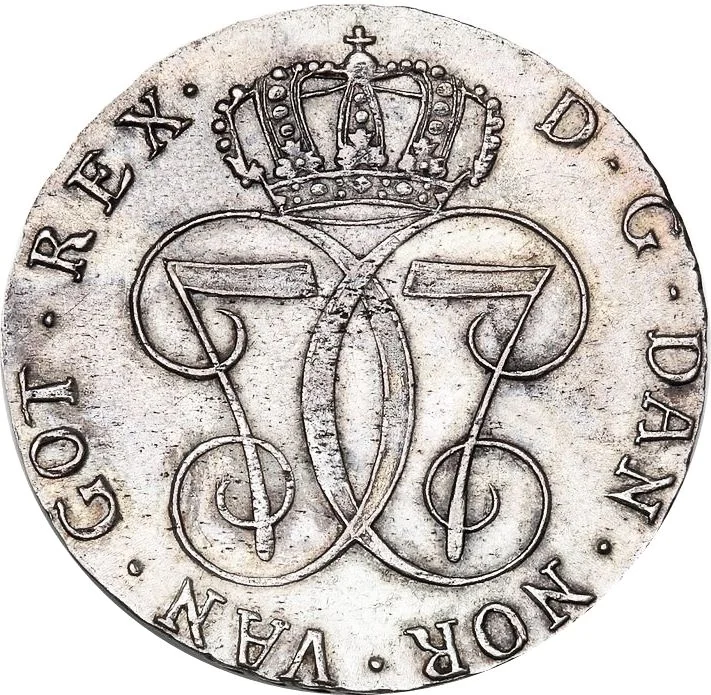
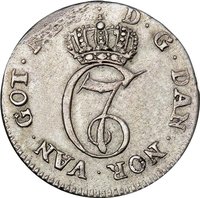
Crowned mirrored monogram of Christian VII within an inscription.
Inscription:
D · G · DAN · NOR · VAN · GOT · REX ·
Script: Latin
Reverse
Description:
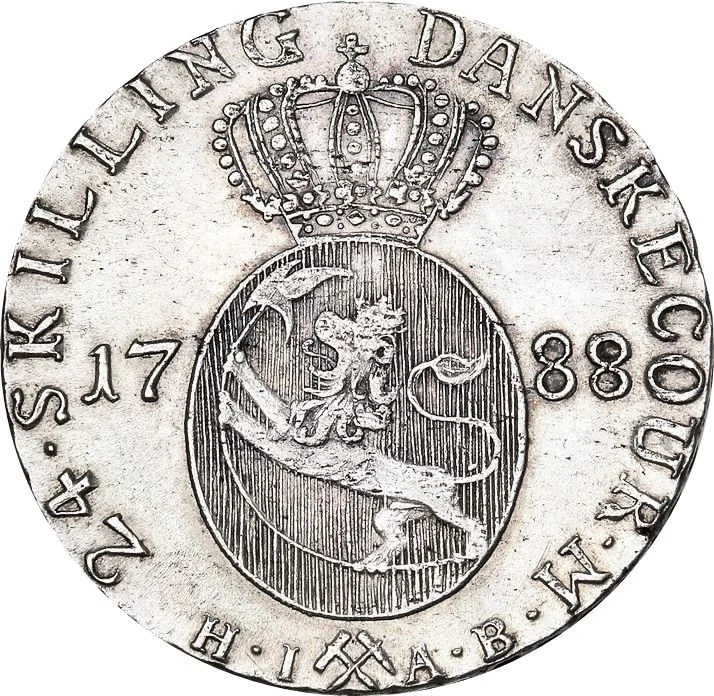
Shield on a cross, featuring a crowned Norwegian lion with a halberd against a lined background. Inscription surrounds the design. Date is split by the shield; mintmark and mintmaster's initials are below.
Inscription:
24·SKILLING DANSKE COUR·M
17 | 88
H·I ⚒ A·B·
17 | 88
H·I ⚒ A·B·
Script: Latin
Edge
Mints
| Name | Mark |
|---|---|
| Norwegian Mint | — |
Mintings
| Year | Mint Mark | Mintage | Quality | Collection |
|---|---|---|---|---|
| 1772 | — | 299,000 | ||
| 1773 | — | 1,035,200 | ||
| 1774 | — | 282,700 | ||
| 1775 | — | 4,000 | ||
| 1783 | — | 16,000 | ||
| 1788 | — | 64,000 |
Historical background
In 1772, Norway found itself in a complex monetary situation as an integral part of the Danish-Norwegian dual monarchy. The kingdom operated on a silver standard, with the primary unit being the riksdaler specie, but the reality was a chaotic circulation of multiple coin types. Alongside domestic coins, a vast array of foreign currencies—most notably Dutch ducats and German thalers—circulated freely due to extensive international trade. This created constant difficulties in exchange and valuation, as the intrinsic silver content of each coin type determined its actual worth in daily transactions.
The system was further strained by a chronic shortage of small change, which crippled local markets and everyday commerce. To address this, the state had authorized the use of kreditivsedler (credit notes) issued by the Kurantbanken in Copenhagen since 1737. However, these were not true banknotes but rather interest-bearing deposit certificates, primarily used by merchants and for larger transactions. For the general populace, the lack of standardized, low-denomination coins led to the use of makeshift solutions like fragmented coins or private tokens, fostering uncertainty and inefficiency.
This period preceded significant monetary reforms. The underlying pressure for a more unified and manageable system would lead, within a few years, to the establishment of the Danish-Norwegian Speciesbank in 1773 and the issuance of the first proper banknotes intended for broader circulation. Therefore, 1772 represents a late stage of an increasingly untenable pre-modern currency system, marked by metallic confusion and a growing recognition of the need for centralized paper money to facilitate economic growth in Norway.
The system was further strained by a chronic shortage of small change, which crippled local markets and everyday commerce. To address this, the state had authorized the use of kreditivsedler (credit notes) issued by the Kurantbanken in Copenhagen since 1737. However, these were not true banknotes but rather interest-bearing deposit certificates, primarily used by merchants and for larger transactions. For the general populace, the lack of standardized, low-denomination coins led to the use of makeshift solutions like fragmented coins or private tokens, fostering uncertainty and inefficiency.
This period preceded significant monetary reforms. The underlying pressure for a more unified and manageable system would lead, within a few years, to the establishment of the Danish-Norwegian Speciesbank in 1773 and the issuance of the first proper banknotes intended for broader circulation. Therefore, 1772 represents a late stage of an increasingly untenable pre-modern currency system, marked by metallic confusion and a growing recognition of the need for centralized paper money to facilitate economic growth in Norway.
💎 Extremely Rare