

8 skilling – Norway
Add to wishlist
Norway
Context
Years: 1773–1775
Issuer: Norway
Ruler: Christian VII
Currency:
(1746—1814)
Demonetized: Yes
Total mintage: 1,106,400
Material
Diameter: 21.9 mm
Weight: 3.06 g
Silver Weight:: 1.72 g
Thickness: 0.95 mm
Shape: Round
Composition: 56.2% Silver
Standard: Gold tenth ounce
Magnetic: No
Alignment: Medal alignment
flip
References
KM: #
Numista: #46039
Value
Bullion value: $4.36
Obverse
Description:
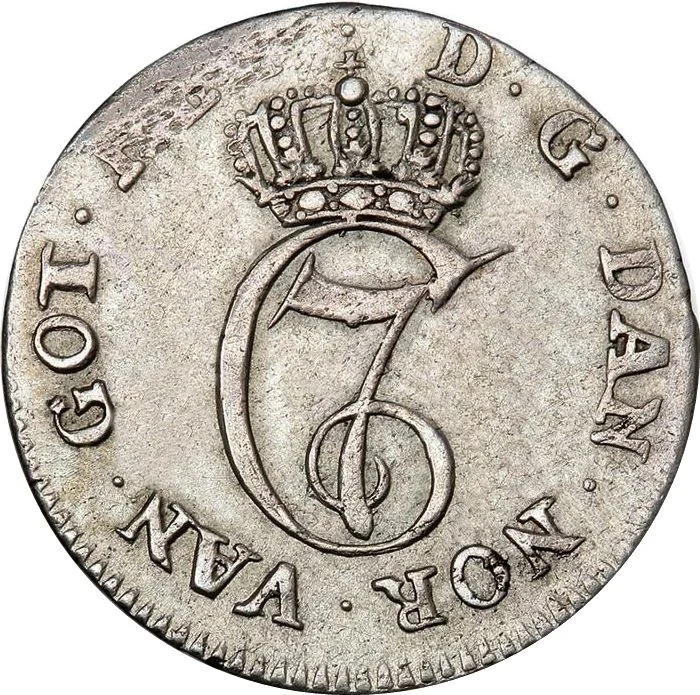
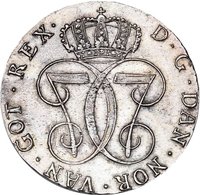
Christian VII crowned monogram. Inscribed. Toothed edge.
Inscription:
D · G · DAN · NOR · VAN · GOT · REX ·
Script: Latin
Reverse
Description:
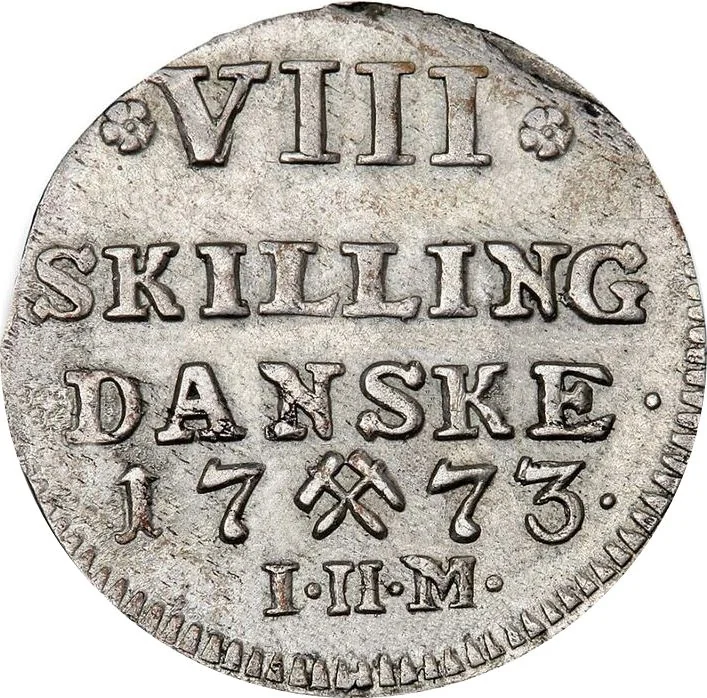
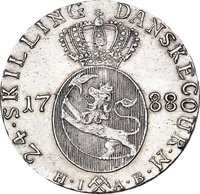
Value and date on four lines.
Date divided by mintmark.
Mintmaster's initials below.
Toothed ring edge.
Date divided by mintmark.
Mintmaster's initials below.
Toothed ring edge.
Inscription:
❀ VIII ❀
SKILLING
DANSKE·
17 ⚒ 73·
I·H·M·
SKILLING
DANSKE·
17 ⚒ 73·
I·H·M·
Script: Latin
Edge
Mints
| Name | Mark |
|---|---|
| Norwegian Mint | — |
Mintings
| Year | Mint Mark | Mintage | Quality | Collection |
|---|---|---|---|---|
| 1773 | — | 548,800 | ||
| 1774 | — | 413,600 | ||
| 1775 | — | 144,000 |
Historical background
In 1773, Norway was part of the Dano-Norwegian dual monarchy, and its currency situation was complex and challenging. The primary circulating coin was the riksdaler, subdivided into marks and skilling, but the system was plagued by a severe shortage of small change. This scarcity crippled everyday market transactions for common people, leading to widespread use of makeshift solutions. Merchants issued private token coins (billettmynter), and in remote areas, barter remained common, while the government struggled to maintain an adequate supply of official coinage.
The root of the problem lay in the state's fiscal policy. To finance involvement in European wars, the government had repeatedly debased the coinage, reducing its silver content. This led to Gresham's Law in action: "bad money drives out good." Older, full-value silver coins were hoarded or exported, leaving the inferior, newer coins in circulation. Furthermore, Denmark-Norway was on a silver standard, but international trade imbalances often drained silver bullion out of the kingdom, exacerbating the mint's inability to produce sufficient sound currency.
Consequently, the year 1773 fell within a period of monetary instability that hindered economic growth and caused public frustration. The situation underscored the central government's difficulty in managing a unified currency for the twin kingdoms, especially for Norway's more decentralized and rural economy. This persistent crisis would eventually contribute to the push for monetary reform, culminating in the establishment of the Norges Bank (the Bank of Norway) in 1816, after the dissolution of the union with Denmark.
The root of the problem lay in the state's fiscal policy. To finance involvement in European wars, the government had repeatedly debased the coinage, reducing its silver content. This led to Gresham's Law in action: "bad money drives out good." Older, full-value silver coins were hoarded or exported, leaving the inferior, newer coins in circulation. Furthermore, Denmark-Norway was on a silver standard, but international trade imbalances often drained silver bullion out of the kingdom, exacerbating the mint's inability to produce sufficient sound currency.
Consequently, the year 1773 fell within a period of monetary instability that hindered economic growth and caused public frustration. The situation underscored the central government's difficulty in managing a unified currency for the twin kingdoms, especially for Norway's more decentralized and rural economy. This persistent crisis would eventually contribute to the push for monetary reform, culminating in the establishment of the Norges Bank (the Bank of Norway) in 1816, after the dissolution of the union with Denmark.
💎 Extremely Rare