

1 Mohar – Nepal
Nepal
Context
Material
References
KM: #Click to copy to clipboard454.2
Numista: #55677
Value
Bullion value: $15.69
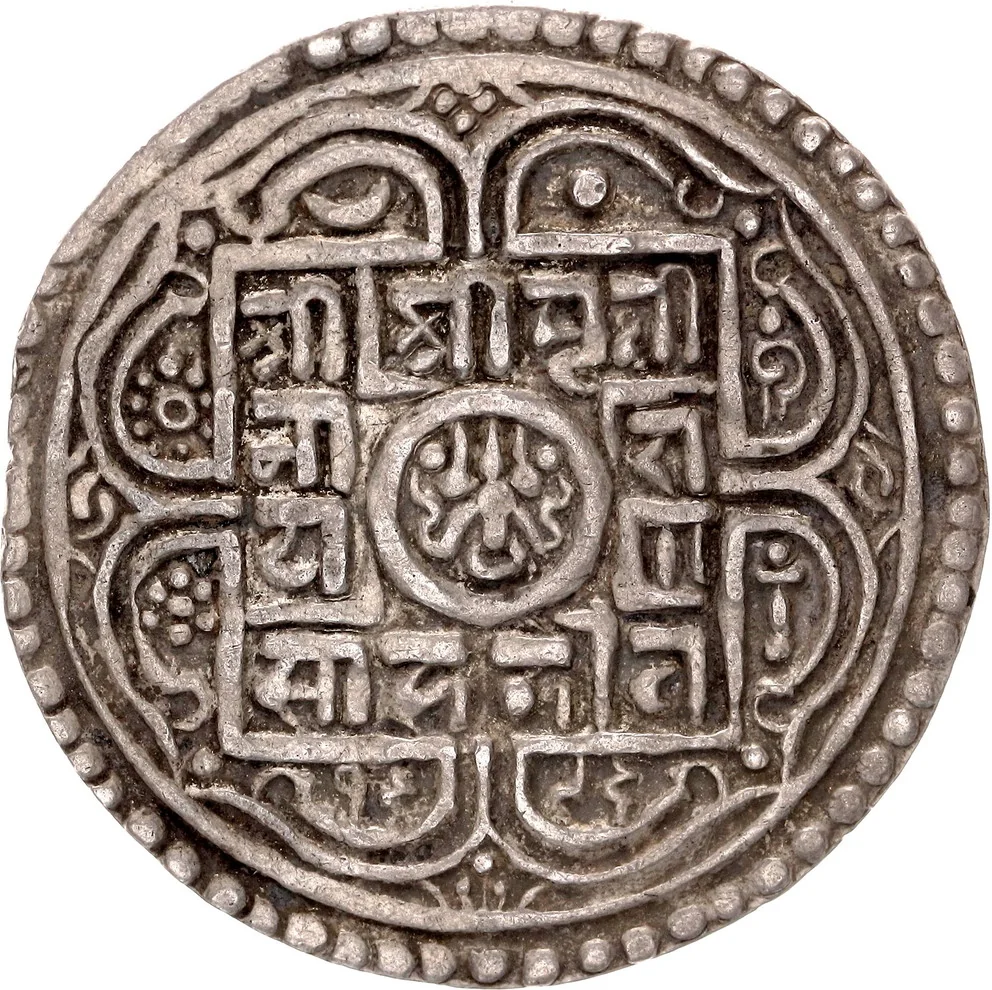
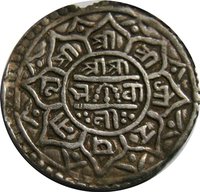
Obverse
Description:
King's Name,
Saka Date Below
Saka Date Below
Inscription:
Sri Sri Prithvi Narayan Shah Deva
SE 1692
SE 1692
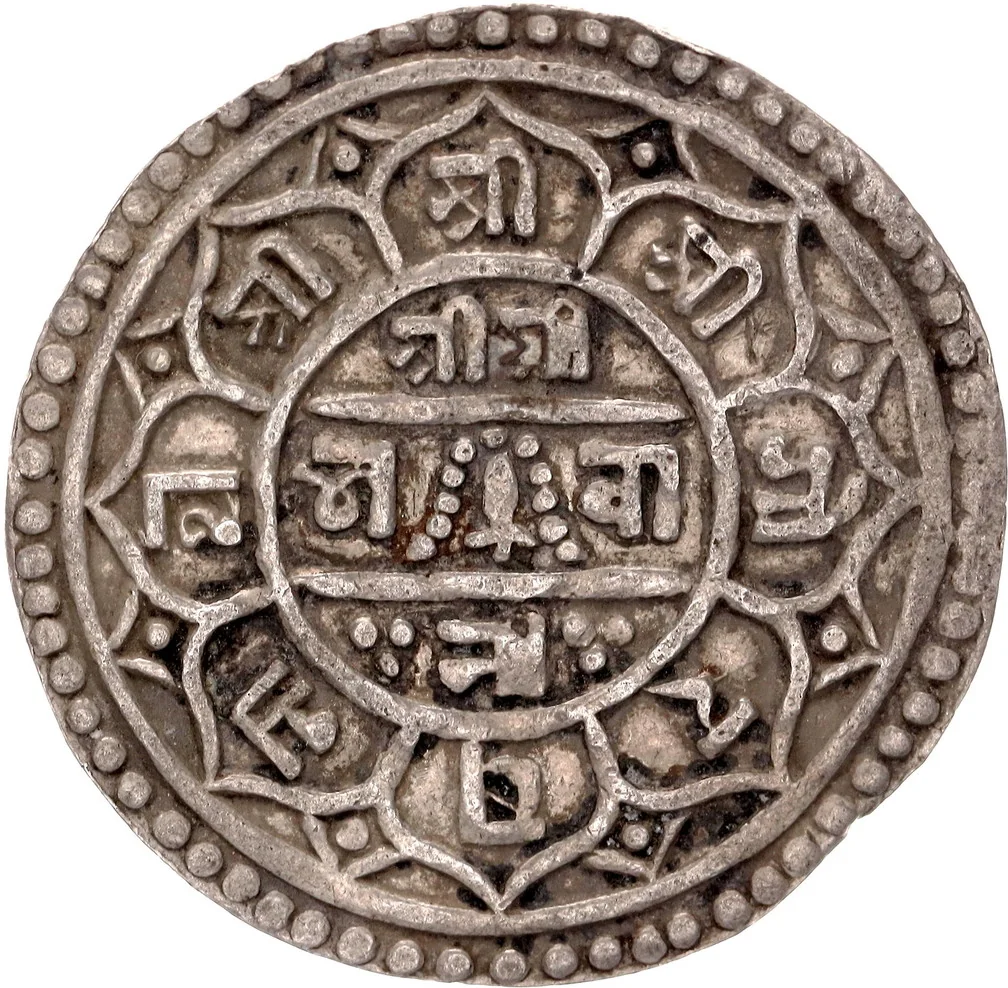
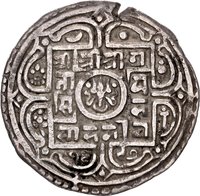
Reverse
Inscription:
Sri Sri Bhabani
Sri Sri Sri Gorakhanath
Sri Sri Sri Gorakhanath
Edge
Mintings
| Year | Mint Mark | Mintage | Quality | Collection |
|---|---|---|---|---|
| 1768 | — | — | ||
| 1769 | — | — | ||
| 1770 | — | — | ||
| 1771 | — | — | ||
| 1772 | — | — | ||
| 1773 | — | — | ||
| 1774 | — | — |
Historical background
In 1768, the currency situation in the Kingdom of Nepal was in a state of profound transition, directly mirroring the political unification achieved by Prithvi Narayan Shah of Gorkha. Prior to his conquest of the Kathmandu Valley that year, the region was a patchwork of small, independent states and the three Malla kingdoms of Kathmandu, Patan, and Bhaktapur. Each of these entities, particularly the wealthy Malla courts, minted their own distinct silver and copper coins, leading to a complex and fragmented monetary system with varying weights, purities, and designs.
The immediate aftermath of the Gorkhali conquest saw the continuation of these local currencies for practical purposes, but with a decisive shift in authority. Prithvi Narayan Shah strategically allowed the existing Malla coinage to remain in circulation to ensure economic stability and avoid disrupting trade. However, he swiftly overstruck many captured coins with his own insignia—the sword and crescent symbol of the Shah dynasty—and the name of the conquered city (e.g., "Sri Bhaktapur"). This act was less an economic reform and more a powerful political statement, physically imprinting the new sovereign's authority onto the very medium of exchange.
Thus, the currency landscape in 1768 was one of coexistence and superimposition. Older Malla issues, new Gorkhali overstrikes, and coins from neighboring regions and Tibet all circulated simultaneously. The foundational work for a unified national currency had begun with the establishment of the first central mint at Thankot, but the systematic creation of a single, standardized Nepalese rupee would be a task for the subsequent decades, finalized under the reign of his successors. The year 1768, therefore, stands as the pivotal moment when Nepal’s monetary history was forcibly, yet incompletely, consolidated under a single crown.
The immediate aftermath of the Gorkhali conquest saw the continuation of these local currencies for practical purposes, but with a decisive shift in authority. Prithvi Narayan Shah strategically allowed the existing Malla coinage to remain in circulation to ensure economic stability and avoid disrupting trade. However, he swiftly overstruck many captured coins with his own insignia—the sword and crescent symbol of the Shah dynasty—and the name of the conquered city (e.g., "Sri Bhaktapur"). This act was less an economic reform and more a powerful political statement, physically imprinting the new sovereign's authority onto the very medium of exchange.
Thus, the currency landscape in 1768 was one of coexistence and superimposition. Older Malla issues, new Gorkhali overstrikes, and coins from neighboring regions and Tibet all circulated simultaneously. The foundational work for a unified national currency had begun with the establishment of the first central mint at Thankot, but the systematic creation of a single, standardized Nepalese rupee would be a task for the subsequent decades, finalized under the reign of his successors. The year 1768, therefore, stands as the pivotal moment when Nepal’s monetary history was forcibly, yet incompletely, consolidated under a single crown.
💎 Very Rare