


½ Penny – Ireland
Ireland
Context
Material
References
KM: #Click to copy to clipboard140
Numista: #5528
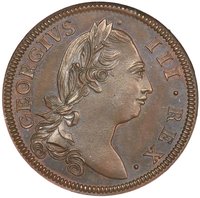
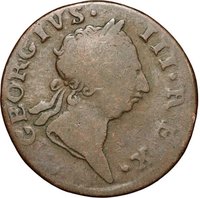
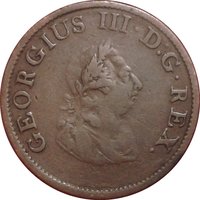
Obverse
Description:
Long-haired Type 3 bust, facing right.
Inscription:
GEORGIVS · III · REX ·
Script: Latin
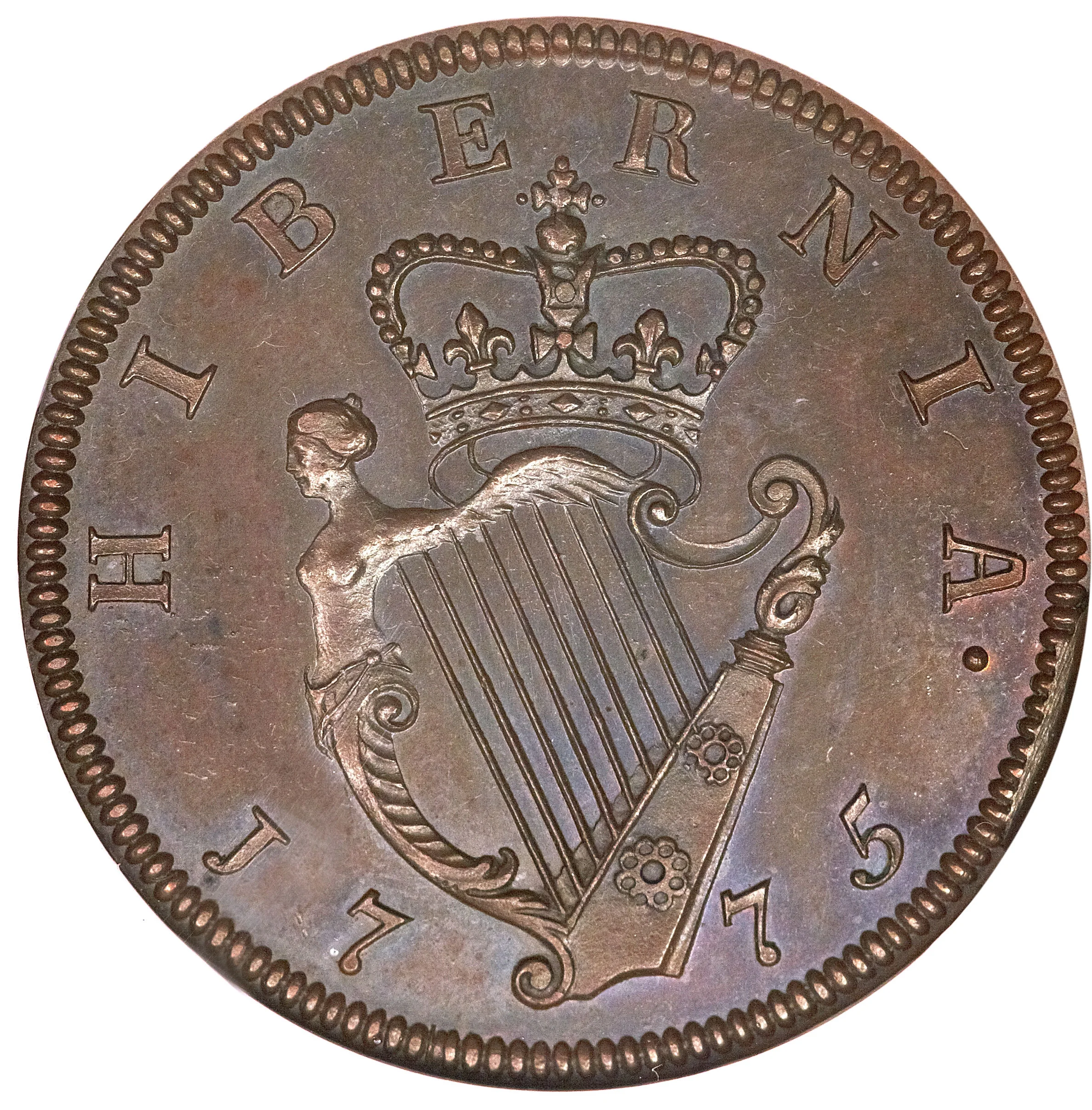
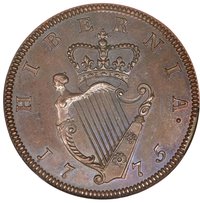
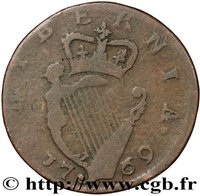
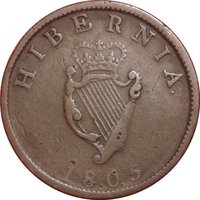
Reverse
Edge
Plain
Mints
| Name | Mark |
|---|---|
| Royal Mint (Tower of London) | — |
Mintings
| Year | Mint Mark | Mintage | Quality | Collection |
|---|---|---|---|---|
| 1774 | — | — | ||
| 1774 | — | — | Proof | |
| 1775 | — | — | ||
| 1775 | — | — | Proof | |
| 1776 | — | — | ||
| 1781 | — | — | ||
| 1781 | — | — | Proof | |
| 1782 | — | — | ||
| 1782 | — | — | Proof |
Historical background
In 1774, Ireland operated under a complex and restrictive monetary system largely dictated by its political and economic subordination to Great Britain. The official currency was sterling, but the scarcity of gold and silver coinage was a chronic problem, hindering everyday trade and economic growth. This shortage was exacerbated by the fact that Ireland, as a net importer from Britain, saw much of its specie (hard coin) flow eastward across the Irish Sea to settle trade imbalances, leaving the domestic economy perpetually starved of legal tender.
To fill this vacuum, a proliferation of informal and often unreliable currencies circulated. These included privately minted tokens issued by merchants and landowners, as well as a vast amount of paper promissory notes from provincial banks. Furthermore, a wide array of foreign coins—particularly Spanish dollars and Portuguese moidores—were in common use, their value subject to local agreement and fluctuation. This created a chaotic and inefficient marketplace where the value and authenticity of money were constant concerns for both businesses and the public.
This unsatisfactory currency situation was a symptom of broader grievances under the mercantilist constraints of the 18th-century British Empire. Irish economic autonomy was severely limited by Westminster, which prohibited the minting of a distinct Irish coinage. The currency scarcity stifled enterprise and fueled resentment among the growing Protestant professional and merchant classes, contributing to the simmering discontent that would soon find political expression in the movement for legislative independence, achieved just five years later with the repeal of the Declaratory Act and the passing of the Constitution of 1782.
To fill this vacuum, a proliferation of informal and often unreliable currencies circulated. These included privately minted tokens issued by merchants and landowners, as well as a vast amount of paper promissory notes from provincial banks. Furthermore, a wide array of foreign coins—particularly Spanish dollars and Portuguese moidores—were in common use, their value subject to local agreement and fluctuation. This created a chaotic and inefficient marketplace where the value and authenticity of money were constant concerns for both businesses and the public.
This unsatisfactory currency situation was a symptom of broader grievances under the mercantilist constraints of the 18th-century British Empire. Irish economic autonomy was severely limited by Westminster, which prohibited the minting of a distinct Irish coinage. The currency scarcity stifled enterprise and fueled resentment among the growing Protestant professional and merchant classes, contributing to the simmering discontent that would soon find political expression in the movement for legislative independence, achieved just five years later with the repeal of the Declaratory Act and the passing of the Constitution of 1782.
🌱 Fairly Common