

1 Dam – Mughal Empire
India
Context
Years: 1590–1603
Country: India 
Issuer: Mughal Empire
Ruler: Akbar
Currency:
(1540—1842)
Demonetized: Yes
Material
References
KM: #Click to copy to clipboard32.9
Numista: #55068
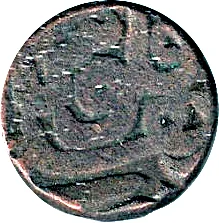
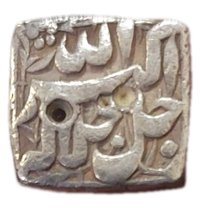
Obverse
Inscription:
Falus Zarb Dehli
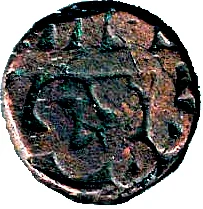
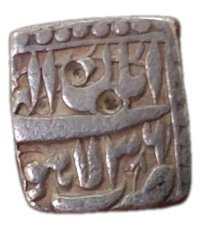
Reverse
Description:
Illahi Date & Month
Inscription:
(4?)9 Farwardin
Edge
Plain
Mintings
| Year | Mint Mark | Mintage | Quality | Collection |
|---|---|---|---|---|
| — | 35 | — | ||
| — | — | — | ||
| — | 37 | — | ||
| — | 38 | — | ||
| — | 39 | — | ||
| — | 40 | — | ||
| — | 41 | — | ||
| — | 42 | — | ||
| — | 43 | — | ||
| — | 44 | — | ||
| — | 45 | — | ||
| — | 46 | — | ||
| — | 47 | — |
Historical background
In 1590, the Mughal Empire's currency system was robust and highly standardized, reflecting the administrative efficiency and economic expansion of Emperor Akbar's reign. The foundation was the silver rupee (or rupya), a coin of remarkable purity and consistency that served as the primary unit of account and medium for large transactions. It was complemented by a tri-metallic system: the gold mohur (primarily for hoarding, high-value trade, and gifts), the copper dam (the essential coin for daily subsistence and local markets), and smaller fractional coins. This structure, centrally controlled from the imperial mints (dar al-zarb), facilitated both long-distance commerce and the intricate machinery of the mansabdari system, where salaries and revenues were calculated in rupees but often disbursed in assignments of land revenue (jagirs).
The stability of the currency was a direct result of Akbar's centralizing reforms. He had established strict imperial control over mints, standardizing weights, designs, and metallic content across the empire. The famous Ilahi calendar year, inscribed on coins, allowed for precise dating and accountability. Furthermore, Akbar had successfully demonetized the debased coins of previous regional sultanates, replacing them with uniform Mughal issues. This reliability made the Mughal rupee, particularly from the capital mint at Agra, a trusted currency not only within the empire but also in international trade across the Indian Ocean, competing with the Spanish silver dollar.
However, this system in 1590 existed on the cusp of a significant transformation. The empire's vast silver stocks, which backed the rupee, were largely dependent on overland trade and limited domestic mining. Within the next few decades, the massive influx of New World silver—primarily from Spanish America via European traders—would begin flooding the Mughal economy through ports like Surat. This influx would provide the metallic base for further monetization and commercial growth but would also, over the long term, contribute to inflationary pressures and subtly shift economic power toward coastal regions, setting the stage for the 17th century's "great silver inflation."
The stability of the currency was a direct result of Akbar's centralizing reforms. He had established strict imperial control over mints, standardizing weights, designs, and metallic content across the empire. The famous Ilahi calendar year, inscribed on coins, allowed for precise dating and accountability. Furthermore, Akbar had successfully demonetized the debased coins of previous regional sultanates, replacing them with uniform Mughal issues. This reliability made the Mughal rupee, particularly from the capital mint at Agra, a trusted currency not only within the empire but also in international trade across the Indian Ocean, competing with the Spanish silver dollar.
However, this system in 1590 existed on the cusp of a significant transformation. The empire's vast silver stocks, which backed the rupee, were largely dependent on overland trade and limited domestic mining. Within the next few decades, the massive influx of New World silver—primarily from Spanish America via European traders—would begin flooding the Mughal economy through ports like Surat. This influx would provide the metallic base for further monetization and commercial growth but would also, over the long term, contribute to inflationary pressures and subtly shift economic power toward coastal regions, setting the stage for the 17th century's "great silver inflation."
💎 Extremely Rare