

1 duit – Netherlands East Indies
Add to wishlist
Indonesia
Context
Year: 1756
Country: Indonesia
Issuer: Netherlands East Indies
Period:
(1602—1800)
Currency:
(1726—1854)
Demonetized: Yes
Material
Weight: 3.09 g
Shape: Round
Composition: Copper
Standard: Gold tenth ounce
Magnetic: No
Alignment: Medal alignment
flip
References
KM: #
Numista: #53937
Obverse
Description:
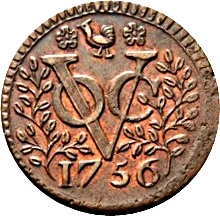
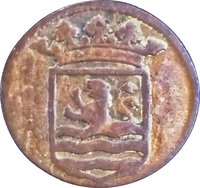
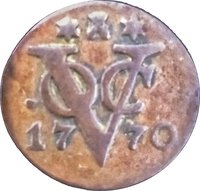
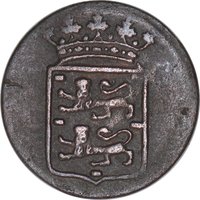
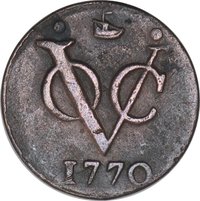
VOC monogram flanked by branches, privy mark above, date below.
Inscription:
VOC
1756
1756
Script: Latin
Reverse
Description:
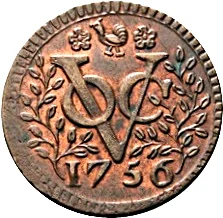
VOC monogram flanked by branches, privy mark above, date below.
Inscription:
VOC
1756
1756
Script: Latin
Edge
Mints
| Name | Mark |
|---|---|
| Hoorn | — |
Mintings
| Year | Mint Mark | Mintage | Quality | Collection |
|---|---|---|---|---|
| 1756 | — | — |
Historical background
In 1756, the currency system of the Netherlands East Indies (NEI) was a complex and often chaotic amalgamation of official and unofficial monies, reflecting its role as the hub of the Dutch East India Company (VOC) trading empire. The official unit of account was the Netherlands Indies guilder, but the physical currency in circulation was overwhelmingly silver coins from across the globe. The most important of these was the Spanish American silver dollar or "real of eight," known locally as the rijksdaalder, which served as the de facto standard for large transactions. Alongside these flowed a torrent of other coins: Japanese koban, Mexican and Peruvian pesos, Dutch ducatons, and a variety of Indian and Arabian silver rupees, all valued by weight and fineness rather than face value.
This monetary jungle was a direct result of the VOC's chronic shortage of specie. The Company's operations were a continuous drain of silver to pay for spices, textiles, and later coffee and tea from Asia, and it could never mint enough coinage itself to meet demand. Consequently, the economy relied on attracting foreign coins through trade. To bring order, the Batavia government periodically issued official plakkaten (decrees) setting valuation rates for dozens of different coin types. However, these rates often failed to match market values, leading to Gresham's Law in action: undervalued "good" coins were hoarded or exported, while overvalued "bad" coins flooded into circulation, frustrating both merchants and colonial officials.
The situation was further complicated by the widespread use of credit instruments and the existence of a dual economy. Within the VOC's fortified ports like Batavia, company bookkeeping and promissory notes facilitated large-scale commerce. Beyond these walls, in the binnenlanden (hinterlands), barter and local commodity monies—such as cowrie shells in some regions—remained prevalent for everyday transactions. Thus, in 1756, the NEI's currency system was less a unified system and more a fragile, negotiated equilibrium between the VOC's administrative decrees, the relentless flow of global silver, and the practical realities of local Asian markets, all of which strained the Company's weakening financial control.
This monetary jungle was a direct result of the VOC's chronic shortage of specie. The Company's operations were a continuous drain of silver to pay for spices, textiles, and later coffee and tea from Asia, and it could never mint enough coinage itself to meet demand. Consequently, the economy relied on attracting foreign coins through trade. To bring order, the Batavia government periodically issued official plakkaten (decrees) setting valuation rates for dozens of different coin types. However, these rates often failed to match market values, leading to Gresham's Law in action: undervalued "good" coins were hoarded or exported, while overvalued "bad" coins flooded into circulation, frustrating both merchants and colonial officials.
The situation was further complicated by the widespread use of credit instruments and the existence of a dual economy. Within the VOC's fortified ports like Batavia, company bookkeeping and promissory notes facilitated large-scale commerce. Beyond these walls, in the binnenlanden (hinterlands), barter and local commodity monies—such as cowrie shells in some regions—remained prevalent for everyday transactions. Thus, in 1756, the NEI's currency system was less a unified system and more a fragile, negotiated equilibrium between the VOC's administrative decrees, the relentless flow of global silver, and the practical realities of local Asian markets, all of which strained the Company's weakening financial control.
✨ Legendary