

1 mariengroschen – East Frisia
Add to wishlist
Germany
Context
Material
References
KM: #
Numista: #53806
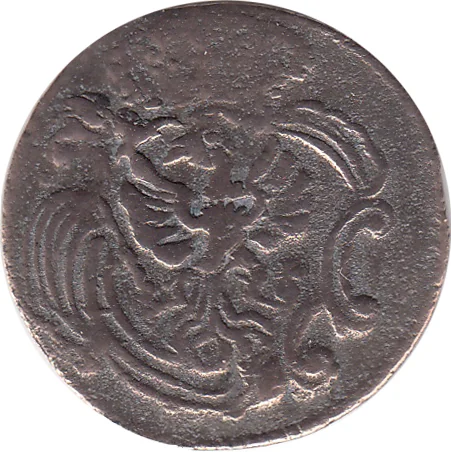
Obverse
Description:
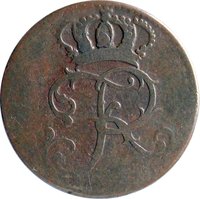
Crowned arms in an ornate shield.
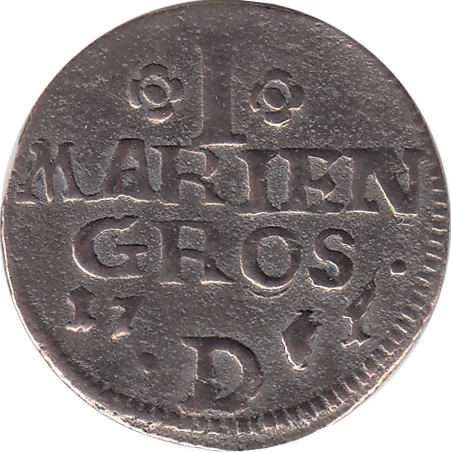
Reverse
Edge
Plain
Mintings
| Year | Mint Mark | Mintage | Quality | Collection |
|---|---|---|---|---|
| 1761 | D | — |
Historical background
In 1761, East Frisia was a small, strategically located territory in a state of profound monetary confusion. The region was not an independent state but a principality under Prussian administration, having been annexed by Frederick the Great in 1744. This political subjugation was directly reflected in its currency situation, which was characterized by the simultaneous circulation of multiple coinage systems. Prussian Reichsthalers and Groschen circulated alongside older, and often debased, coins from the prior Austrian period and the Dutch Republic, whose currency heavily influenced trade across the nearby border.
The core of the problem lay in the lack of a unified, authoritative currency. Different coins had varying intrinsic silver content and exchange rates, which were often set by local decree rather than market value. This created a fertile ground for arbitrage and fraud, as bad money (debased coin) tended to drive out the good (full-weight Prussian coin), which was often hoarded or melted down. For merchants and the populace, this meant everyday transactions were fraught with complexity and uncertainty, hindering commerce and creating widespread economic frustration.
The Prussian administration, focused on the larger war effort of the Seven Years' War (1756-1763), had limited capacity to impose immediate monetary reform in East Frisia. While they attempted to enforce the use of Prussian currency for official payments and taxes, the practical reality on the ground was a disordered mosaic of old and new money. Thus, in 1761, East Frisia’s currency was less a coherent system and more a lingering symptom of its recent political transition, awaiting a more stable postwar period for genuine standardization under Prussian rule.
The core of the problem lay in the lack of a unified, authoritative currency. Different coins had varying intrinsic silver content and exchange rates, which were often set by local decree rather than market value. This created a fertile ground for arbitrage and fraud, as bad money (debased coin) tended to drive out the good (full-weight Prussian coin), which was often hoarded or melted down. For merchants and the populace, this meant everyday transactions were fraught with complexity and uncertainty, hindering commerce and creating widespread economic frustration.
The Prussian administration, focused on the larger war effort of the Seven Years' War (1756-1763), had limited capacity to impose immediate monetary reform in East Frisia. While they attempted to enforce the use of Prussian currency for official payments and taxes, the practical reality on the ground was a disordered mosaic of old and new money. Thus, in 1761, East Frisia’s currency was less a coherent system and more a lingering symptom of its recent political transition, awaiting a more stable postwar period for genuine standardization under Prussian rule.
✨ Legendary