

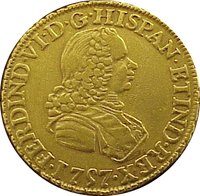
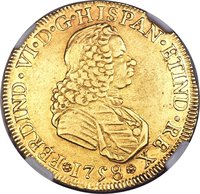
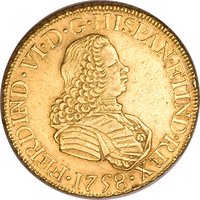
Obverse
Description:
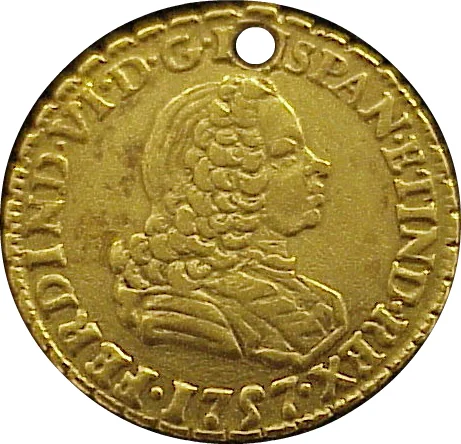
Fernando VI armored bust facing right, encircled by legend with date below.
Inscription:
HISPAN * ET IND* REX
FERDIND * VI * D * G
FERDIND * VI * D * G
Script: Latin
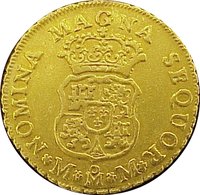
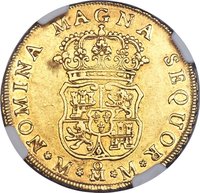
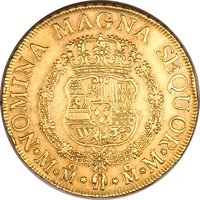
Reverse
Description:
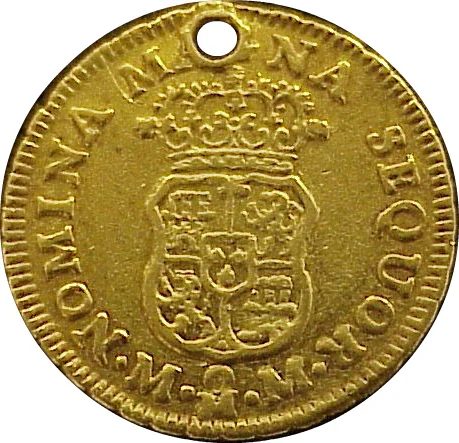
Shield with crown, encircled by legend, mint mark flanked by assayer's initials.
Inscription:
NOMINA MAGNA SEQUOR
M * Mo * M
M * Mo * M
Script: Latin
Edge
Mintings
| Year | Mint Mark | Mintage | Quality | Collection |
|---|---|---|---|---|
| 1757 | MM | — | ||
| 1759 | MM | — |
Historical background
In 1757, the currency situation in New Spain was characterized by a chronic and worsening shortage of circulating specie, particularly low-denomination coins for daily transactions. The colony's economy, one of the wealthiest in the world due to its prolific silver mines, paradoxically suffered because the vast majority of newly minted pesos fuertes (pieces of eight) were immediately exported. These silver coins were needed to pay for imported goods from Europe and Asia, to satisfy royal taxes, and to fund Spain's military engagements in Europe, draining the local money supply. This scarcity crippled local commerce, forcing many provinces to resort to barter or the use of informal tokens, such as tlacos (lead or copper tokens issued by shops) and pilones (credit notes), creating a chaotic and unreliable system of exchange.
The royal response to this crisis was the establishment of the Casa de Moneda de México branch in Guatemala in 1733, and more directly, the authorization in 1755 for provincial mints in Durango and Guadalupe (Zacatecas) to strike copper coins. By 1757, these new macuquinas (crudely struck coins) of 1, 2, 4, and 8 maravedíes in copper were entering circulation. However, this solution was deeply unpopular. The public, accustomed to silver, distrusted the fiduciary copper currency, fearing devaluation and forced acceptance. Furthermore, the coins were easily counterfeited, and their introduction did not solve the underlying structural drain of silver, instead adding a layer of inflationary pressure and public resentment.
Therefore, the monetary landscape of 1757 was one of transition and tension. While the royal government attempted to alleviate the small-change crisis through a new copper coinage, the populace and local merchants remained skeptical. The economy operated on a dual track: a strained official system of silver for large-scale and international trade, and an inefficient patchwork of low-value copper and private tokens for the everyday economy. This unstable foundation highlighted the contradictions of colonial policy, where New Spain's immense mineral wealth failed to translate into a stable and sufficient currency for its own internal market.
The royal response to this crisis was the establishment of the Casa de Moneda de México branch in Guatemala in 1733, and more directly, the authorization in 1755 for provincial mints in Durango and Guadalupe (Zacatecas) to strike copper coins. By 1757, these new macuquinas (crudely struck coins) of 1, 2, 4, and 8 maravedíes in copper were entering circulation. However, this solution was deeply unpopular. The public, accustomed to silver, distrusted the fiduciary copper currency, fearing devaluation and forced acceptance. Furthermore, the coins were easily counterfeited, and their introduction did not solve the underlying structural drain of silver, instead adding a layer of inflationary pressure and public resentment.
Therefore, the monetary landscape of 1757 was one of transition and tension. While the royal government attempted to alleviate the small-change crisis through a new copper coinage, the populace and local merchants remained skeptical. The economy operated on a dual track: a strained official system of silver for large-scale and international trade, and an inefficient patchwork of low-value copper and private tokens for the everyday economy. This unstable foundation highlighted the contradictions of colonial policy, where New Spain's immense mineral wealth failed to translate into a stable and sufficient currency for its own internal market.
Series: 1757 New Spain circulation coins
✨ Legendary