

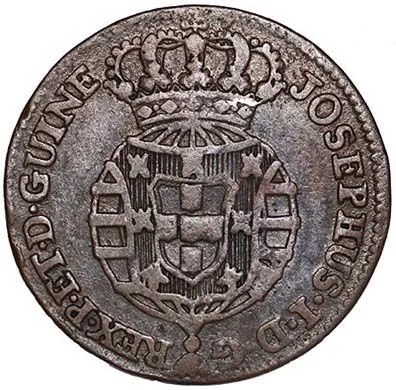
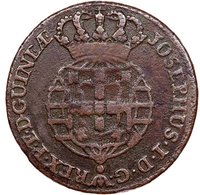
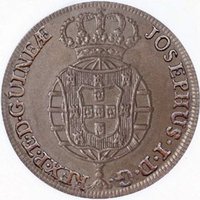
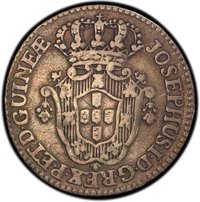
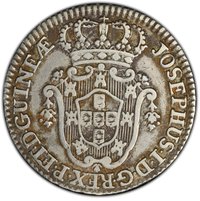
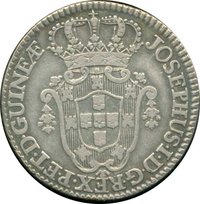
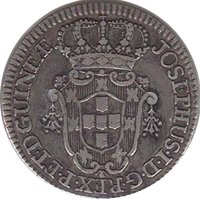
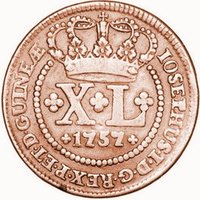
Obverse
Inscription:
JOSEPHUS·I·D·G·REX·P·ET·D·GUINEÆ·
Script: Latin
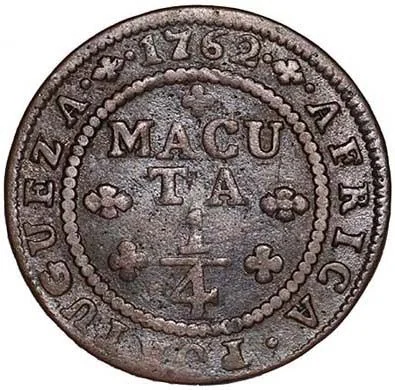
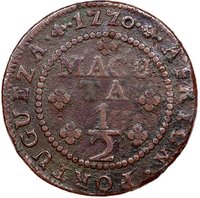
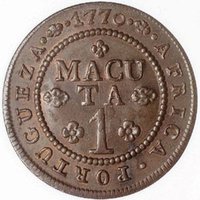
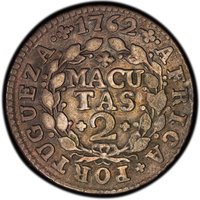
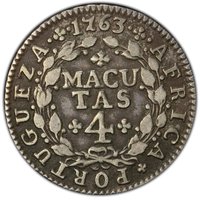
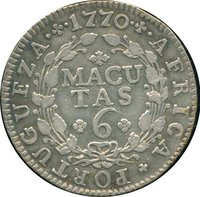
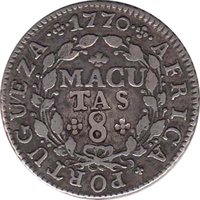
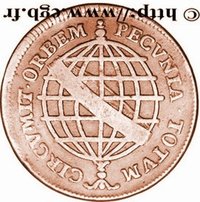
Reverse
Inscription:
·AFRICA·PORTUGUEZA·1770·
MACUTA
1/4
MACUTA
1/4
Script: Latin
Edge
Plain
Mintings
| Year | Mint Mark | Mintage | Quality | Collection |
|---|---|---|---|---|
| 1762 | — | — | ||
| 1763 | — | — | ||
| 1770 | — | 268,000 | ||
| 1771 | — | 280,000 |
Historical background
In 1762, Angola was a Portuguese colony whose economic life was fundamentally structured by the transatlantic slave trade. The primary "currency" was not minted coins or official paper money, but rather people. Enslaved Africans were the central unit of account, store of value, and medium of exchange for major transactions between Portuguese traders, colonial authorities, and African intermediaries. A complex system of trade goods, such as textiles, alcohol, firearms, and shells (particularly nzimbu shells from Luanda Island), served as smaller-denomination currency for local markets and to purchase provisions for the enslaved captives during their horrific Middle Passage.
The Portuguese crown attempted to impose a formal monetary system, but it was chronically unstable and limited in circulation. Coins, like the real and macuta (a copper coin worth 50 réis), were minted but were scarce and often debased. Their use was largely confined to the coastal settlements of Luanda and Benguela, where they facilitated government salaries, tax payments, and trade within the Portuguese community. The vast interior economy operated on the older, established systems of commodity money and the trade in human beings, which the colonial administration itself relied upon for its revenue.
Therefore, the currency situation was one of stark duality: a fragile and inadequate official coinage circulating in the colonial enclaves, overshadowed by a brutal and dominant human currency that fueled the entire colony's existence. This system created immense wealth for slave traders and the Portuguese crown while devastating Angolan societies, a reality that defined the economic landscape far more than any minted coin could in 1762.
The Portuguese crown attempted to impose a formal monetary system, but it was chronically unstable and limited in circulation. Coins, like the real and macuta (a copper coin worth 50 réis), were minted but were scarce and often debased. Their use was largely confined to the coastal settlements of Luanda and Benguela, where they facilitated government salaries, tax payments, and trade within the Portuguese community. The vast interior economy operated on the older, established systems of commodity money and the trade in human beings, which the colonial administration itself relied upon for its revenue.
Therefore, the currency situation was one of stark duality: a fragile and inadequate official coinage circulating in the colonial enclaves, overshadowed by a brutal and dominant human currency that fueled the entire colony's existence. This system created immense wealth for slave traders and the Portuguese crown while devastating Angolan societies, a reality that defined the economic landscape far more than any minted coin could in 1762.
Series: 1762 Angola circulation coins
⭐ Rare