

40 réis – Angola
Add to wishlist
Angola
Obverse
Description:
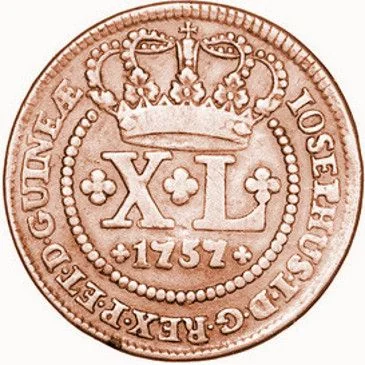
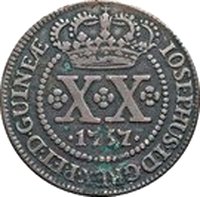
Pearl-circled crown over XL, flowers, and date.
Inscription:
IOSEPHUS·I·D·G·REX·P·ET·D·GUINEAE·
XL
· 1757 ·
XL
· 1757 ·
Script: Latin
Reverse
Edge
Plain
Mints
| Name | Mark |
|---|---|
| Imprensa Nacional - Casa da Moeda | — |
Mintings
| Year | Mint Mark | Mintage | Quality | Collection |
|---|---|---|---|---|
| 1753 | — | 22,015 | ||
| 1757 | — | — |
Historical background
In 1753, Angola was not a sovereign nation but a Portuguese colony, primarily serving as a source of enslaved people for the plantations of Brazil. The currency situation was therefore primitive and fragmented, reflecting its role in the transatlantic slave trade. The primary "currency" was, in fact, trade goods. Enslaved Africans were purchased from local rulers using commodities like textiles (especially Asian and European cloth), firearms, gunpowder, alcohol (Brazilian cachaça and Portuguese wine), and shells—particularly nzimbu shells from the island of Luanda, which held traditional value. Portuguese colonial authorities attempted to impose their own coinage, but these coins were scarce and often used for official taxes and larger mercantile transactions within the coastal settlements rather than for daily internal trade.
The Portuguese crown had introduced coinage for Angola, such as silver patacas and copper réis, but their circulation was extremely limited to Luanda and a few fortified settlements (presídios). The colonial economy was chronically short of specie (minted money), as any significant inflow of coin was quickly exported to pay for trade goods from Europe or was siphoned off to Brazil. Consequently, a complex system of barter and commodity money prevailed. Even taxes owed to the colonial government, like the musungo tax on slave traders, could be paid in specified goods like cloth or beads, underscoring the lack of a unified monetary standard.
This system created a dual economy: a coastal mercantile sphere influenced by Portuguese currency and credit, and a vast interior economy operating on traditional and imported commodity monies. The entire financial structure was subservient to the slave trade, with credit advanced from Brazilian and Portuguese merchants in the form of goods, which were then used inland to procure captives. Therefore, the "currency situation" in 1753 Angola was less about national finance and more about the logistical tools of human trafficking, characterized by a severe shortage of coin and a reliance on commodities that served as both trade goods and a medium of exchange.
The Portuguese crown had introduced coinage for Angola, such as silver patacas and copper réis, but their circulation was extremely limited to Luanda and a few fortified settlements (presídios). The colonial economy was chronically short of specie (minted money), as any significant inflow of coin was quickly exported to pay for trade goods from Europe or was siphoned off to Brazil. Consequently, a complex system of barter and commodity money prevailed. Even taxes owed to the colonial government, like the musungo tax on slave traders, could be paid in specified goods like cloth or beads, underscoring the lack of a unified monetary standard.
This system created a dual economy: a coastal mercantile sphere influenced by Portuguese currency and credit, and a vast interior economy operating on traditional and imported commodity monies. The entire financial structure was subservient to the slave trade, with credit advanced from Brazilian and Portuguese merchants in the form of goods, which were then used inland to procure captives. Therefore, the "currency situation" in 1753 Angola was less about national finance and more about the logistical tools of human trafficking, characterized by a severe shortage of coin and a reliance on commodities that served as both trade goods and a medium of exchange.
💎 Very Rare