

5 réis – Angola
Add to wishlist
Angola
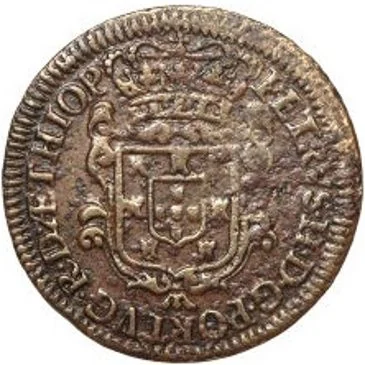
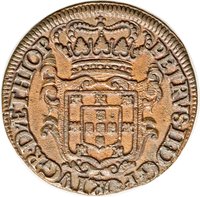
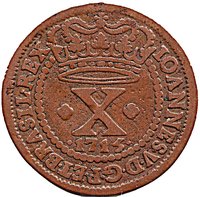
Obverse
Description:
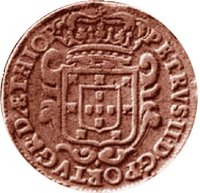
Crowned Portuguese coat of arms.
Inscription:
PETRVS·II·D·G·PORTVG·R·D·ÆTHIOP
Script: Latin
Engraver: Roque Francisco
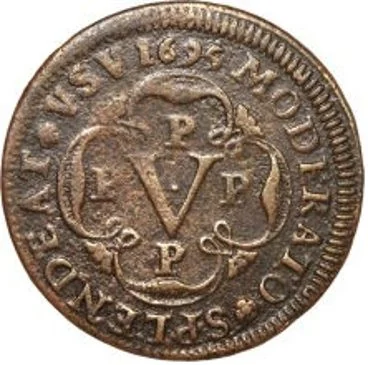
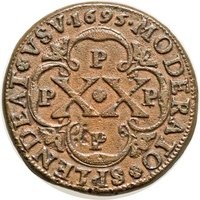
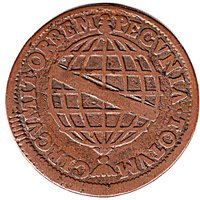
Reverse
Description:
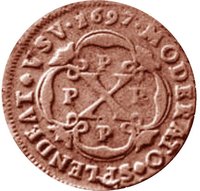
Value V between PPPP and ornaments.
Inscription:
MODERATO SPLENDEAT VSV·1695 (6)·
P
P V P
P
P
P V P
P
Script: Latin
Engraver: Roque Francisco
Edge
Plain
Categories
| Symbols> Coat of Arms |
| Symbol> Crown |
Mints
| Name | Mark |
|---|---|
| Porto | PPPP |
Historical background
In 1695, the currency situation in the Kingdom of Ndongo and Matamba (a region of modern-day Angola) was defined by a complex interplay of local, regional, and global systems, with the transatlantic slave trade acting as the dominant economic engine. Internally, small-scale trade utilized traditional currencies such as nzimbu shells (imbued shells from Luanda Island), salt, cloth, and copper bracelets called libongos. However, the Portuguese colonial presence, centered in the fortress settlement of Luanda, was aggressively imposing a mercantilist framework. The primary "currency" for international exchange was not coin or shell, but human beings. Enslaved Africans were the central commodity, with their value measured against a variety of imported goods.
Portuguese traders operated on a credit system, advancing European merchandise—most notably Brazilian cachaça (rum), Portuguese wine, firearms, gunpowder, and textiles—to local sobas (chiefs) and pombeiros (African and Afro-Portuguese intermediaries). These goods, valued in Portuguese réis, were then used to purchase captives, who were in turn shipped to the Americas. While Spanish pieces of eight and other coins circulated within the Portuguese merchant community, the broader economy functioned on barter and commodity money. The Portuguese crown sought to control this trade through the Alvará of 1684, which attempted to mandate the use of Portuguese currency, but in practice, the goods-for-people system remained entrenched and largely beyond bureaucratic control.
This period was one of profound monetary duality. In the hinterland, traditional African currencies facilitated local markets and social transactions. Meanwhile, on the coast and along the slave caravan routes, a brutal accounting system prevailed, where human lives were the ultimate unit of account, medium of exchange, and store of value. The year 1695 falls within a prolonged era of conflict and state formation, notably under Queen Nzinga’s former domain, where control over trade routes—and thus access to European goods—was a key objective. The currency situation, therefore, was less about a unified monetary policy and more a reflection of a violent, transitional economy being reshaped by global demand for enslaved labor.
Portuguese traders operated on a credit system, advancing European merchandise—most notably Brazilian cachaça (rum), Portuguese wine, firearms, gunpowder, and textiles—to local sobas (chiefs) and pombeiros (African and Afro-Portuguese intermediaries). These goods, valued in Portuguese réis, were then used to purchase captives, who were in turn shipped to the Americas. While Spanish pieces of eight and other coins circulated within the Portuguese merchant community, the broader economy functioned on barter and commodity money. The Portuguese crown sought to control this trade through the Alvará of 1684, which attempted to mandate the use of Portuguese currency, but in practice, the goods-for-people system remained entrenched and largely beyond bureaucratic control.
This period was one of profound monetary duality. In the hinterland, traditional African currencies facilitated local markets and social transactions. Meanwhile, on the coast and along the slave caravan routes, a brutal accounting system prevailed, where human lives were the ultimate unit of account, medium of exchange, and store of value. The year 1695 falls within a prolonged era of conflict and state formation, notably under Queen Nzinga’s former domain, where control over trade routes—and thus access to European goods—was a key objective. The currency situation, therefore, was less about a unified monetary policy and more a reflection of a violent, transitional economy being reshaped by global demand for enslaved labor.
💎 Extremely Rare