

2 deniers – France
Add to wishlist
France
Context
Material
References
KM: #
Numista: #52143
Obverse
Description:
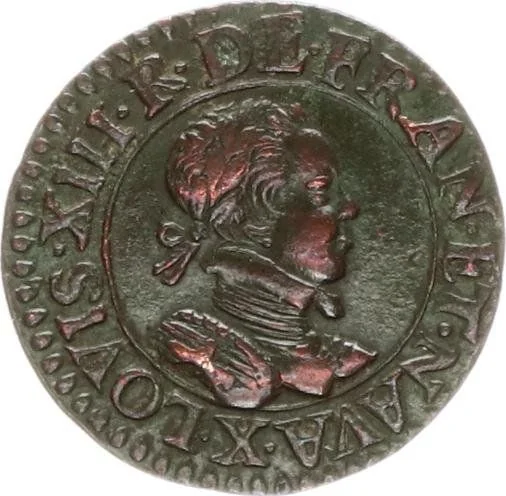
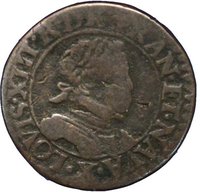
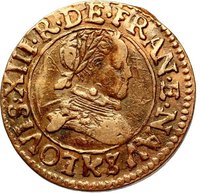
Childish bust of Louis XIII, laureate, draped, and cuirassed right, with small flat collar; mint letter below.
Inscription:
LOVIS.XIII.R.DE.FRAN.ET.NAVA.X (a)
IOVIS.XIII.R.DE.FRAN.ET.NAVA.X (b)
IOVIS.XIII.R.DE.FRAN.ET.NAVA.X (b)
Script: Latin
Reverse
Description:
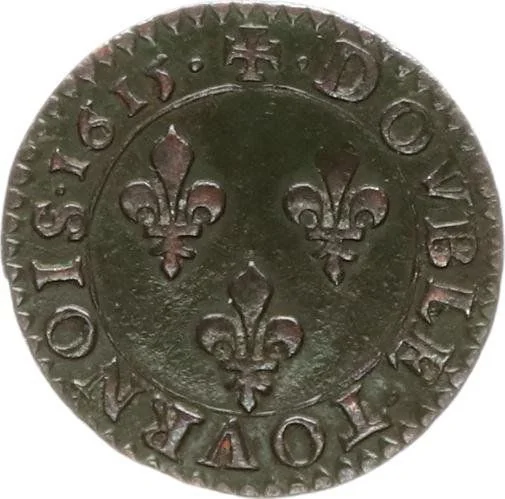
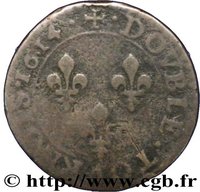
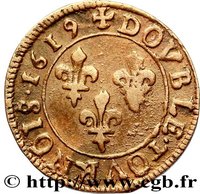
Three lilies arranged two and one.
Inscription:
+.DOVBLE.TOVRNOIS.(millésime). (1)
+ DOVBLE TOVRNOIS (millésime) (2)
+ DOVBLE TOVRNOIS (millésime) (2)
Script: Latin
Edge
Plain
Mints
| Name | Mark |
|---|---|
| Amiens | x |
Mintings
| Year | Mint Mark | Mintage | Quality | Collection |
|---|---|---|---|---|
| 1615 | X | — | ||
| 1616 | X | — |
Historical background
In 1615, France's currency situation was characterized by significant instability and manipulation under the regency of Marie de' Medici, who ruled on behalf of her young son, Louis XIII. The kingdom operated on a bimetallic system of gold écus and silver livres tournois, but the state's chronic fiscal deficits, exacerbated by the costs of recent civil wars and court extravagance, led to repeated official devaluations. The government would issue edicts altering the official exchange rate between gold and silver or decreeing that existing coins be brought in to be reminted with a lower precious metal content, a practice known as "crying up" or "crying down" the currency. This created a climate of uncertainty for both daily commerce and long-term contracts.
The primary motive for these manipulations was seigniorage—the profit the royal treasury made from controlling the mint. By frequently recalling and reissuing coins at new values, the Crown could extract immediate revenue to pay its debts and fund its operations, effectively imposing a hidden tax on the entire economy. However, this policy was economically destructive. It encouraged hoarding of older, purer coins (Gresham's Law in action), provoked widespread price inflation as merchants adjusted to the debased money, and fostered public mistrust in royal financial policy. The Cour des Monnaies, the court responsible for monetary affairs, struggled to enforce these unstable standards.
This turbulent monetary environment reflected the deeper weakness of royal financial administration before the reforms of Cardinal Richelieu and later Louis XIV. Currency manipulation was a short-term expedient that undermined economic confidence and placed a heavy burden on the peasantry and urban poor, who were most vulnerable to rising prices. The situation in 1615 thus illustrates a key challenge of the early modern French state: its inability to manage its finances through transparent taxation, forcing it to resort to measures that destabilized its own economy.
The primary motive for these manipulations was seigniorage—the profit the royal treasury made from controlling the mint. By frequently recalling and reissuing coins at new values, the Crown could extract immediate revenue to pay its debts and fund its operations, effectively imposing a hidden tax on the entire economy. However, this policy was economically destructive. It encouraged hoarding of older, purer coins (Gresham's Law in action), provoked widespread price inflation as merchants adjusted to the debased money, and fostered public mistrust in royal financial policy. The Cour des Monnaies, the court responsible for monetary affairs, struggled to enforce these unstable standards.
This turbulent monetary environment reflected the deeper weakness of royal financial administration before the reforms of Cardinal Richelieu and later Louis XIV. Currency manipulation was a short-term expedient that undermined economic confidence and placed a heavy burden on the peasantry and urban poor, who were most vulnerable to rising prices. The situation in 1615 thus illustrates a key challenge of the early modern French state: its inability to manage its finances through transparent taxation, forcing it to resort to measures that destabilized its own economy.
⭐ Rare